

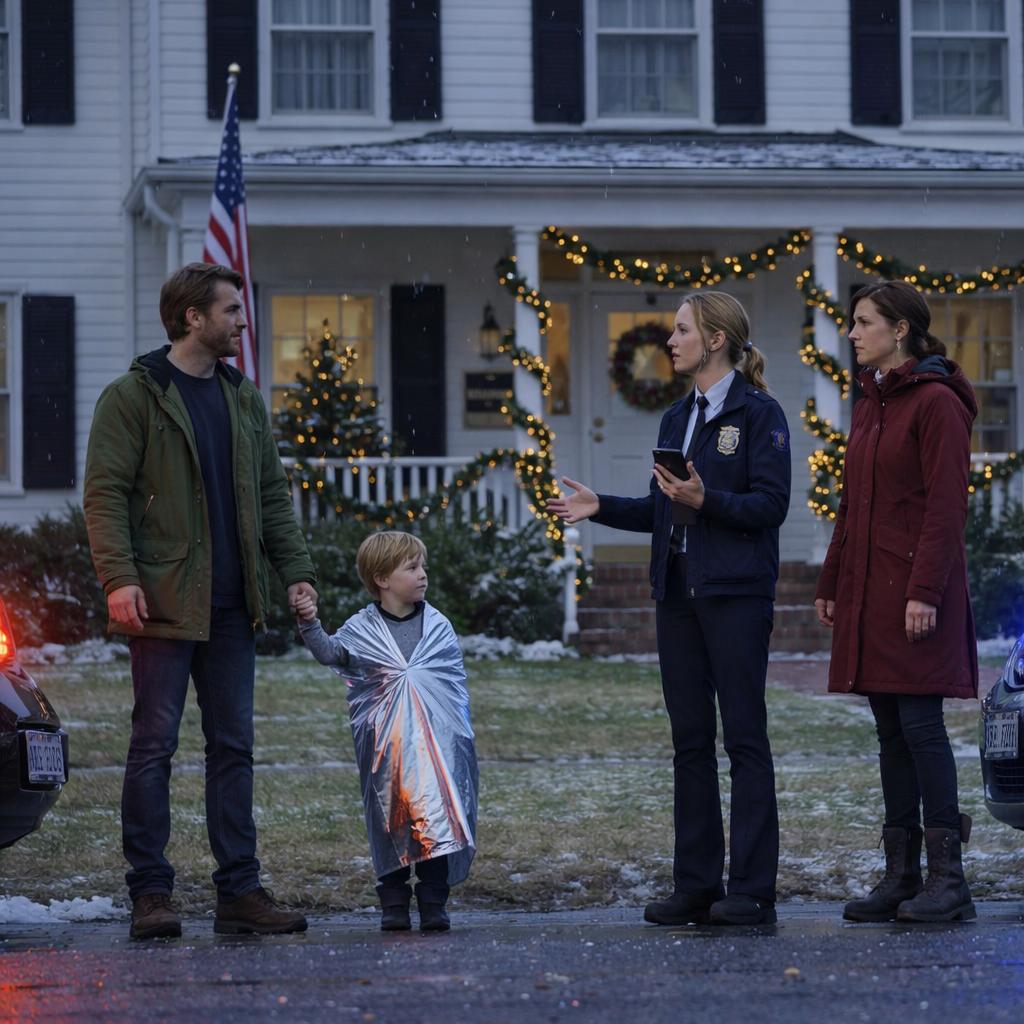
Her face was a mask that couldn’t decide what to be. Shock, anger, calculation, all flickering behind her eyes. When she saw William, she rushed forward like she was the one wounded.
“What did you do?” she screamed. Her voice rang out into the cold night air. “What did you tell him to do?”
William stared at her.
Truly stared.
Not as his wife. Not as Owen’s mother. As a person revealed by crisis.
There was no frantic concern for their son. No desperate question, Is he okay? No horror at the idea that Owen had been terrified enough to attack.
Only anger. Only accusation.
William’s voice came low and deadly calm. “What was in that shed?” he demanded.
Marsha faltered half a step. “Marsha,” she started, voice shifting, trying for confusion. “I don’t know what you…”
“What was in that shed?” Detective Stark stepped between them, her presence firm. “Mrs. Edwards, you’re going to answer questions.”
Marsha’s throat bobbed. Her gaze darted toward the house, toward the backyard, toward the shed now taped off by officers.
“I’m not going anywhere until I see my mother,” she snapped, but the words sounded rehearsed, like a line she’d practiced for attention.
“Your mother is being transported to Hartford Hospital,” Stark said evenly. “Severe facial trauma. Possible skull fracture. And you are going to answer questions about why your five-year-old son was locked in a shed.”
William watched Marsha’s face crack for the briefest second. Not sorrow. Not guilt.
Calculation.
Her eyes shifted again, like she was searching for the angle that would save her.
“I want a lawyer,” Marsha said, chin lifting.
Detective Stark nodded once, calm as stone. She signaled an officer, who guided Marsha toward a police car.
As Marsha passed William, she leaned in close, close enough that William smelled her perfume, the familiar scent suddenly nauseating.
“You’ll regret this,” she whispered. “You have no idea what you’ve done.”
William didn’t respond. He didn’t have to.
He did know.
He had seen his son’s terror validated by footage that turned his stomach inside out. He had watched a grown woman drag a five-year-old like luggage. He had watched a shed door rattle under panic.
He had watched Owen swing a spade like his life depended on it.
Back at the hospital, everything smelled like disinfectant and fluorescent light. The air had that dry chill hospitals always carried, the kind that made your skin tighten. Machines beeped in steady rhythms. Nurses moved with brisk competence, voices low.
Owen was admitted for observation.
When William finally sat beside the bed, the room felt both safe and unbearable. Owen’s small hand clutched his, fingers surprisingly strong. Even after a mild sedative to calm his panic, Owen wouldn’t let go. His eyelids fluttered, then squeezed shut again, as if sleep itself was something he didn’t trust.
William sat in the chair, spine rigid, his body running on adrenaline and dread. He watched Owen’s chest rise and fall. He watched the blanket move with each breath.
He tried not to imagine Owen locked in a shed, alone in the dark, banging until his hands hurt.
Around midnight, a child psychologist walked in.
William recognized him instantly from conferences and professional circles. Dr. Isaac Dicki had a reputation for being gentle with children and blunt with adults. He didn’t waste time. His face was grim, eyes tired.
“William,” Dr. Dicki said quietly, closing the door behind him. “I need to talk to you.”
William’s heart stuttered. “About Owen?”
Dicki nodded. “His physical exam revealed some concerning findings.”
William felt the room tilt again, that same sick lurch. “What findings?”
Dicki’s voice softened, but the words were heavy. “Old bruises,” he said. “Various stages of healing. Scarring on his back consistent with being struck with a belt or similar object. And behavioral markers that suggest prolonged psychological abuse.”
William stared at him as if the words were a cruel joke.
“Months,” Dicki added gently. “At least. Possibly longer, based on healing patterns.”
William’s vision blurred. He blinked hard, but tears slipped anyway.
Months.
His mind flashed through moments he’d dismissed. Owen flinching when Marsha raised her voice. Owen going quiet at certain questions. Owen clinging at bedtime. Owen’s sudden fear of the dark. Owen’s sudden insistence on leaving the bathroom door open.
All the times Marsha insisted on disciplining Owen privately. All the times she’d told William he didn’t understand structure. All the weekends she pushed for Sue’s house when William traveled for workshops.
William’s chest tightened until breathing hurt.
“I need to see that shed,” William said suddenly. His voice sounded strange to him, like it belonged to someone else.
Dr. Dicki frowned. “That’s a crime scene,” he said carefully. “The police won’t allow…”
“I don’t care,” William whispered. “I need to know what they did to my son.”
As if summoned by the intensity in the room, Detective Stark appeared in the doorway.
Her expression had changed from earlier. Still controlled, still professional, but there was something grim in her eyes. Like she’d opened a door she couldn’t close.
“Mr. Edwards,” she said quietly, stepping inside. “We processed the shed.”
William’s pulse hammered.
Stark hesitated, then reached into her pocket and pulled out her phone. “I think you should see this,” she said.
She handed the phone to William.
The first photo showed the shed from the outside, small and ordinary, the kind you’d store tools in. But the next photo snapped William’s breath away.
Inside, the walls had been modified. Padded. Not for comfort. For containment. The padding looked worn in spots, pressed down like someone had leaned against it repeatedly.
A metal ring had been bolted to the floor.
A chain.
A bucket in the corner.
William’s fingers tightened around the phone until his knuckles hurt.
The next photo showed the wall.
Marker scrawled in uneven lines.
Rules for bad boys.
No crying.
No talking back.
No telling Daddy.
Punishment makes you strong.
Mommy knows best.
William’s vision blurred so badly he couldn’t read at first. He wiped his eyes with the back of his hand and read it again, slower, as if reading twice might make it less real.
No telling Daddy.
His throat closed.