

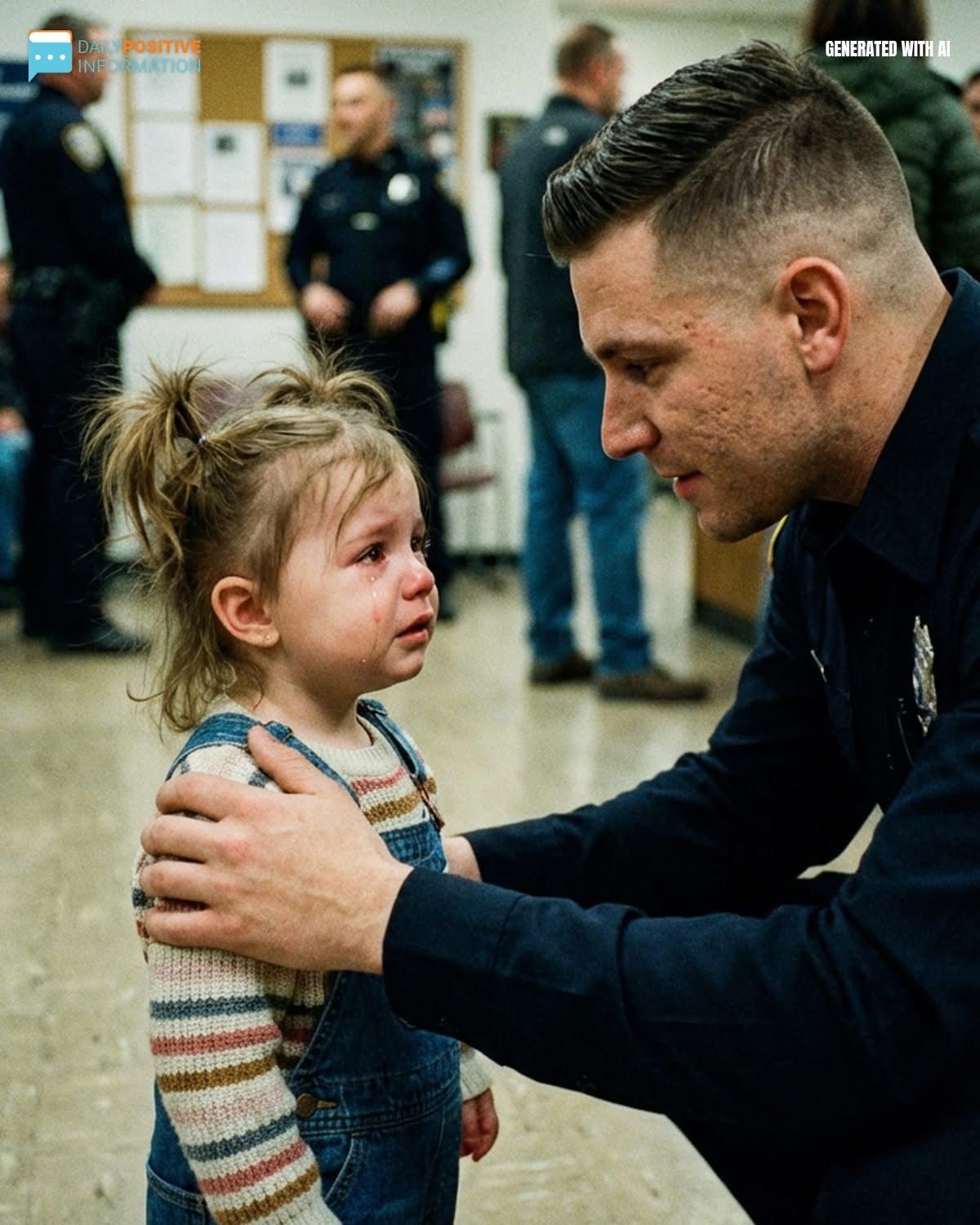
The little girl—wearing a pink dress with tiny embroidered flowers on it and small white shoes that had seen better days—studied Sergeant Rodriguez’s dark blue police uniform very closely and carefully, still sniffling and hiccupping from her prolonged crying. Her small, pudgy hand reached out tentatively to touch the shiny silver badge pinned to his chest, her fingers barely able to wrap around its edges.
“Are you really a real policeman?” she asked through her tears, her voice small and uncertain and wobbly. “Not pretend?“
“Yes, I am a real police officer,” he smiled kindly and warmly, pointing to various elements of his uniform. “See this uniform I’m wearing? And this badge right here with my number on it? And this radio on my belt? That’s how you know I’m really, truly a police officer and not just someone pretending.“
She nodded slowly and seriously, processing this important information with the kind of gravity and seriousness that only a toddler can bring to such weighty matters. She took a shaky, trembling breath—the kind children take when they’re trying very hard to be brave about something frightening—and whispered in a voice barely audible, “I… I committed a crime. A really, really bad one. Maybe the worst one ever.“
Sergeant Rodriguez maintained his calm, professional, and gentle demeanor despite the surreal absurdity of the situation unfolding before him. “Alright, sweetheart. That’s perfectly okay that you want to tell me. You’re very brave for coming here. You can tell me all about it. I’m listening very, very carefully to every word you say.“
Her little lip began to tremble dangerously, quivering in that way that signals more tears are imminent. “Will you… will you have to put me in jail? With locks on the door?” The fear in her small voice was absolutely genuine and heartbreaking in its complete sincerity.
“Well, that depends on what happened,” he said very softly and carefully, keeping his voice neutral and non-threatening and reassuring. “What exactly happened? Can you tell me the whole story from the beginning?“
The heartbreaking confession that no one was prepared for
She suddenly burst into completely fresh tears—huge ones that rolled down her round cheeks in steady streams—her words tumbling out in a desperate rush between choking, gasping sobs that made it almost difficult to understand what she was trying to say.
“I took my brother’s special toy car… the red one that Grandpa gave him for his birthday,” she cried, her small body physically shaking with the force of her sobs. “And I… I dropped it on the floor really hard. And now it’s broken into pieces. The wheels came off and everything. And it was his favorite toy in the whole world. And… and… and… now he’s so sad and he cried and cried. And it’s all my fault. I broke his most special thing. I’m such a bad person. Please, please, please don’t put me in jail forever. I promise I’ll be good forever and ever and ever.“
For one brief, suspended moment, Sergeant Rodriguez completely froze—not because he was shocked by the confession of toy destruction, which is completely normal among young children, but because the pure, raw, genuine remorse and absolute terror in this tiny child’s voice cut straight through every single professional wall and barrier he’d carefully built over twenty years of police work dealing with actual criminals.
He’d heard countless confessions in his career—from thieves who showed no remorse, from people who’d committed serious offenses and laughed about it, from repeat offenders who treated the justice system like a revolving door. But he’d never heard anyone—child or adult—express such profound guilt and fear over what was clearly an accident between siblings during normal play.
Then his expression immediately softened, his eyes getting slightly misty despite his best professional efforts to maintain composure. He gently pulled the sobbing little girl into a careful, protective embrace, letting her cry into his uniform shirt while he rubbed her back soothingly.
“Oh no, no, no, sweetheart,” he said very reassuringly, his voice warm and comforting, rubbing her back in small circles the way his own children’s teachers had done when they were upset at school. “Listen to me very, very carefully, okay? Breaking a toy by accident is not a crime. Nobody goes to jail for accidents. Your brother is going to be okay even without that toy car. He’s not hurt or in danger. Do you understand?“
She pulled back slightly from the embrace and looked up at him with those wide, wet, hopeful eyes that held so much desperate need for reassurance. “Really? I won’t go to jail for breaking his special toy?“
“Really and truly,” he nodded with absolute certainty and conviction. “I promise you. Toys can sometimes be replaced, and even if they can’t be, your brother will be okay. The most important thing is that you feel sorry and you want to make it right. That shows you have a good heart.“
“But he loved that car so much,” she whispered, tears still flowing. “Grandpa gave it to him before Grandpa went to heaven. Now it’s broken forever.“
Sergeant Rodriguez’s heart squeezed at this additional detail. The toy wasn’t just any toy—it had sentimental value, which made her guilt even more understandable.
“That makes it extra special, I understand,” he said gently. “But you know what? Your brother knows it was an accident. And accidents happen to everyone—kids and grown-ups. Have you told him you’re sorry?“
“I said sorry a hundred million times,” she said earnestly. “But sorry doesn’t fix his car.“
“No, it doesn’t fix the car,” Rodriguez agreed. “But it helps fix the hurt feelings. Did your brother forgive you?“
She nodded slowly. “He said it was okay. But he was still sad.“
“Being sad is okay,” the officer explained patiently. “It’s okay for your brother to be sad about his toy, and it’s okay for you to feel sorry. But you didn’t do anything that makes you a bad person. You made a mistake. Good people make mistakes too. The difference is that good people say sorry and try to do better next time. And that’s exactly what you did.“

The parents who finally understood what had been haunting their daughter
The mother, who’d been listening to this entire exchange with her hand over her mouth, finally spoke up, her voice thick with emotion. “We had no idea she was carrying this much guilt. The toy broke three days ago during playtime. Her brother cried for maybe ten minutes, then he was fine and went back to playing with other toys. We told her it was just an accident and not to worry. But clearly, she’s been worrying this entire time.“
The father added, “We tried gluing the car back together, but it didn’t work very well. We even offered to buy him a new one, but apparently it wouldn’t be the same because it wasn’t the one from Grandpa. We had no idea she thought this was a criminal matter.“
Sergeant Rodriguez nodded with understanding. “Children this age are just developing their sense of right and wrong. Sometimes they can’t distinguish between a small mistake and a serious wrongdoing. Everything feels very big and very important to them.“
He turned his attention back to the little girl, making sure she understood clearly. “Listen to me carefully, okay? What you did—accidentally breaking your brother’s toy—is not against the law. Police officers deal with people who do bad things on purpose, who hurt other people on purpose, who take things that don’t belong to them on purpose. You didn’t do any of those things. You were playing, and an accident happened. That’s just part of being a kid.“