

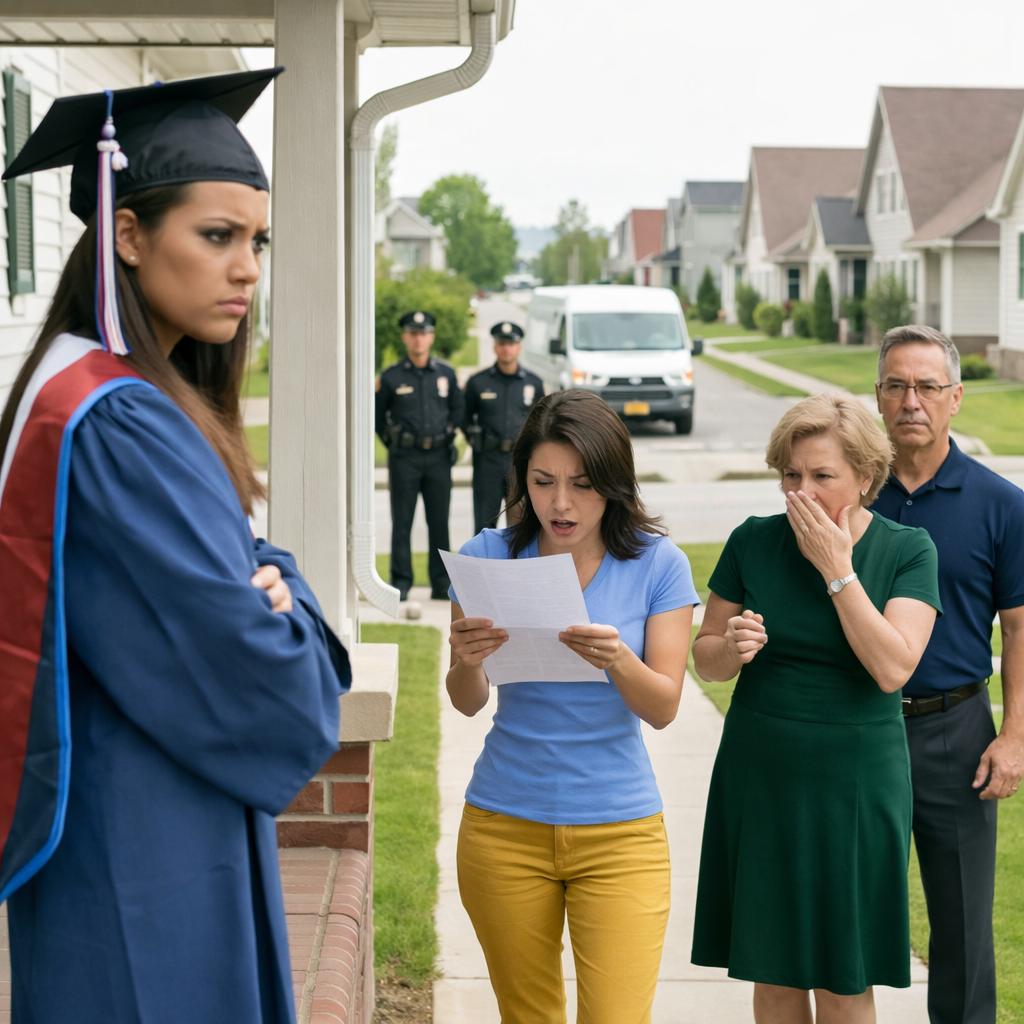
The morning my parents and sister came to evict me from my own house started like any other Tuesday, which is what made it so surreal. I was in the kitchen waiting for the kettle to shriek, watching steam curl up from the spout like a sleepy ghost, when I heard car doors slam in the driveway. Three of them. Quick succession. Heavy, purposeful, like punctuation.
I didn’t jump. I didn’t spill the coffee. I didn’t gasp the way people do in movies when danger appears at the edge of the frame.
I just stood there with my mug in my hand, feeling a calmness settle over me that wasn’t peace so much as readiness.
Because I’d known they were coming.
Two days earlier, Ashley had shown up on my porch with a folder of fake documents and the smile she used when she wanted something that wasn’t hers. She’d leaned in as if we were conspirators and said, “You have until Friday to pack your things. It’s better if you cooperate.”
Cooperate. In the house my grandparents had left me.
The house that, as far as my family believed, was finally close enough to steal.
On Tuesday morning, the kettle clicked off. The kitchen was warm, sunlight laying a soft rectangle across the hardwood floor, and for a moment the whole place looked like the life I’d been trying to build. Quiet. Stable. Mine.
Then the front doorbell rang.
Not once. Twice. Then again, impatient and sharp, as if whoever was pressing it wanted the sound to feel like a command.
I set my mug down slowly. My hands were steady. That surprised me.
My name is Emily Carter. I’m twenty-six years old, and I work as an accountant for a mid-sized firm downtown. I’m the kind of person who triple-checks numbers, who keeps an emergency fund, who reads contracts before signing them, who believes in the quiet kind of security that doesn’t show off.
I learned those habits the hard way.
In my family, there have always been two categories of people.
Ashley, and everyone else.
Ashley is my older sister by three years. She’s tall and blonde and the kind of beautiful that pulls attention like gravity. She has always known exactly how to arrange her face into whatever expression she needed. Sweet. Heartbroken. Indignant. Forgiving. Charming. She could move through a room full of strangers and leave with offers, favors, phone numbers, and sympathy she didn’t earn.
At seventeen she was homecoming queen. At eighteen she was prom queen. At nineteen she was “Most Likely to Succeed” in a graduating class that had never once seen her open a textbook without sighing dramatically.
None of it mattered.
Ashley was special. Precious. The golden child.
My parents treated her like proof they had done something right. When Ashley smiled, my mother glowed. When Ashley cried, my father rearranged his schedule. When Ashley made a mistake, it wasn’t a mistake, it was an opportunity for growth, a learning experience, a misunderstanding caused by other people.
When I made a mistake, it was character.
I learned early how the rules worked.
Ashley got a brand-new car for her sixteenth birthday. White. Shiny. Still smelled like plastic and money. She posted pictures with a bow bigger than her head. My parents stood behind her smiling like they’d won a prize.
For my sixteenth birthday, I got a used bike from a garage sale.
My mother said, “It’ll build character.”
I rode that bike through rain, through cold, through summers when the asphalt shimmered, because the bus was unreliable and asking for rides meant hearing my father sigh like I was asking him to donate a kidney.
Ashley’s college tuition was paid in full. Housing. Meal plan. Spending money. My mother bragged about it to her friends. “She deserves it,” she’d say. “She works so hard.”
I worked three jobs and took out loans.
When I asked for help buying textbooks, my father lectured me about fiscal responsibility. He said, “Nobody handed me anything,” while handing Ashley everything with both arms outstretched.
I stopped asking for things when I was fourteen.
It was easier to expect nothing than to be disappointed by their indifference. Easier to build a small, private world where I didn’t need their approval because I wasn’t going to get it anyway.
The only problem with that kind of survival is that it hardens you in quiet ways. It makes you suspicious of kindness. It makes you flinch when people offer help, because help in my family always came with strings.
Except my grandparents didn’t do strings.
Thomas and Margaret Whitfield were my mother’s parents, which meant they had watched my family dynamics with a long, pained patience. They were the kind of older couple who still held hands in the grocery store without making a show of it, who said please and thank you like it mattered, who believed that love was a verb, not a performance.
When I was a kid, their house smelled like beeswax and cinnamon and old books. Their kitchen table was always sticky with jam and conversation. They never made me feel like I was taking up space. They never sighed when I asked questions. They never compared me to Ashley as if comparison was a sport.
They saw me.
Not the quiet daughter. Not the spare. Not the one who kept her head down and tried not to be noticed.
They saw the girl who learned to be careful because carelessness cost her. The girl who stored hurt in her ribs and still showed up. The girl who tried to be good because being good felt like the only way to deserve love.
My grandfather used to look at me over his reading glasses and say, “You remind me of my mother.”
I’d roll my eyes and say, “Is that supposed to be a compliment?”
“It’s the highest compliment I can give,” he’d reply, serious. “She built a life out of nothing. She knew how to stand her ground without shouting.”
My grandmother would laugh and touch my cheek. “And you got the Whitfield eyes, too,” she’d say. “Blue like the sky right before a storm.”
The eyes skipped a generation. My mother didn’t have them. Ashley didn’t have them.
I did.