

They loved Ashley too, in their way. They bought her gifts. They hugged her at holidays. They listened to her dramatic stories and smiled politely.
But they knew her.
And they knew my parents.
And when they rewrote their will, they made a decision that would either save me or ruin me depending on whether I had the sense to protect it.
They left everything to me.
The craftsman house in Riverside, worth around eight hundred thousand dollars even before the market started doing what it did. The investment portfolio, another two hundred thousand in carefully managed stocks and bonds. Everything they’d built through decades of discipline and patience.
One hundred percent.
To Emily.
Ashley got nothing.
My parents got nothing.
Three months before my grandfather died, we sat on his back porch as the afternoon sun warmed the wood beneath our chairs. He had a blanket over his knees even though it wasn’t cold. His hands looked thinner than they used to, veins raised like river maps, but his eyes were still sharp.
“They’ve already taken enough from you,” he said.
I tried to laugh it off, like I always did when affection felt too heavy. “Grandpa, don’t start.”
“Let me finish,” he said, and covered my hand with his. His skin was papery, warm, and the gesture pinned me in place.
“Your mother treats you like an accessory to Ashley’s life,” he said quietly. “Your father barely remembers you exist unless he needs you to do something. And Ashley…” His mouth tightened. “Ashley takes after them.”
I swallowed, throat tight. The words weren’t new. What was new was hearing them spoken plainly by someone who didn’t make excuses for it.
“We’ve worked hard,” he continued. “Margaret and I built something. And we want it to go to someone who values it. Someone who won’t squander it to impress strangers. Someone who will use it to build a life. That’s you.”
My breath stuttered.
“But you need to be smart,” he added, and his gaze held mine with sudden intensity. “They will come after you, Emily. They’ll guilt you, manipulate you, challenge the will, do whatever they think will work. Protect yourself.”
“How?” I asked, even though I already sensed the shape of the answer.
“Get a lawyer,” he said. “A real one. Not the family friend who plays golf with your father. And don’t trust your parents to do the right thing. They won’t.”
He died two months later, peacefully in his sleep.
My grandmother followed six weeks after that, her heart giving out like it couldn’t stand the weight of grief. One day she was sitting in her favorite chair, reading the newspaper with a highlighter in hand. The next day she was gone.
At twenty-three, I inherited a million dollars in property and investments.
I cried for three days.
Not because of the money, although it was overwhelming. Because the two people who had ever made me feel like I belonged were gone, and no amount of inheritance could replace that.
On the fourth day, I stopped crying and made an appointment with a lawyer.
Richard Morrison was sixty-two. Gray hair, tired eyes, the kind of face that suggested he’d watched families eat each other alive across conference tables. His office was on the third floor of an old building downtown, and the carpet smelled faintly of dust and coffee. It wasn’t impressive in a glossy way, but neither was he, and that made me trust him.
When he asked why I was there, I didn’t sugarcoat it.
“I inherited a house and investments,” I said. “My family is going to try to take it.”
He didn’t blink. He just nodded, like I’d told him it was raining.
“Tell me everything,” he said.
So I did. Ashley’s entitlement. My parents’ favoritism. The way my mother had looked at me at the funeral, not with grief but with calculation. The way Ashley had already begun making comments about what she “deserved.” The way my father had said, “Well, we’ll figure out what’s fair,” as if fairness was a tool he could use to pry something loose.
Richard listened and took notes in neat, precise handwriting.
When I finished, he set down his pen and looked at me carefully. There was something like respect in his expression.
“Your grandfather was right,” he said. “The will is solid. But that won’t stop them from trying. And even if they lose, they can drain you with the fight.”
“So what do I do?” I asked.
Richard leaned forward slightly, voice low. “We make you legally invisible.”
I frowned. “Invisible?”
He tapped his pen once against the paper. “Have you heard of an irrevocable trust?”
I shook my head.
“It’s a structure that moves assets out of your personal ownership and into a trust,” he explained. “On paper, publicly, you don’t own anything. The trust does. You can still live in the house. You can still control the investments. But your name won’t be on the deed. Which means your family has nothing to grab.”
It sounded like magic. It also sounded like a trap, because in my life, anything that sounded too helpful usually was.
“Is it… legal?” I asked.
Richard’s mouth twitched. “It’s the law. The kind of law wealthy families use every day. We’re just using it to protect you from yours.”
It took three weeks to set up. The house transferred to the Emily Carter Family Trust. The investment accounts moved. Every asset my grandparents left me placed behind a wall that looked boring to outsiders but was stronger than steel.
Richard was meticulous.
“Your family will look for cracks,” he warned. “So we make sure there aren’t any. No loose ends. No public record tying you to ownership. If they want proof, they’ll need a court order. And to get that, they’ll need evidence of wrongdoing. They won’t have it.”
I paid his fees from my own savings, not the inheritance. It mattered to me, even if it was symbolic. I didn’t move into the house right away. I didn’t buy anything flashy. I didn’t change my lifestyle in any way that would signal to my family that something huge had happened.
I stayed quiet.
I stayed ordinary.
Because I knew they were watching.
The first probe came three weeks after the funeral at a family dinner I didn’t want to attend. My mother called repeatedly, voice sugary with forced warmth.
“We need to be together,” she said. “Family is all we have.”
I went because refusing would have been suspicious, and suspicion in my family was an invitation to attack.
Ashley talked for an hour about some new “business opportunity.” Crypto, essential oils, whatever buzzword she’d found on social media that week. My parents nodded along as if she were a visionary.
Then my mother turned her attention to me.
“So, Emily,” she said casually, “have you been to the house?”
“A few times,” I replied carefully. “Picked up personal items.”
“And the estate?” My father cut in, tone mild but eyes sharp. “All settled?”
“Mostly,” I said. “Some paperwork.”
My father leaned back as if he’d been waiting for that exact opening. “You know, that house is a lot of responsibility. Maintaining it. Taxes. Insurance. It might make more sense to sell and split the proceeds. Keep things fair between you and your sister.”
There it was.
Not a demand yet. A suggestion dressed as wisdom.
“Fair,” I repeated.
My mother smiled quickly. “Your grandparents loved both of you. I’m sure they would’ve wanted you to share.”
“No,” I said, and my voice came out firmer than I expected. “They left it to me. That was their choice.”
Ashley’s fork clattered onto her plate. “That’s so selfish, Em. Seriously. You’re going to keep everything while I get nothing? After everything I’ve done for this family?”
I held her gaze and said nothing, because pointing out the truth would have turned dinner into theater, and Ashley lived for theater.
“I’m following Grandpa and Grandma’s wishes,” I said. “That’s all.”
Ashley leaned forward, eyes narrowing. “Let me see the paperwork. Just to understand it. Maybe there was confusion.”
“It’s clear,” I replied.
My mother’s eyes sharpened. “Emily, honey, think about legacy. That house has been in the Whitfield family for decades. It wouldn’t be right for it to belong to just one person. Put it in both your names. Preserve the family.”
“No,” I said again.
This time the word landed like a door shutting.
My father’s voice cooled. “Fine. But don’t come crying to us when you realize how complicated it is to manage an estate alone. You’re young. You don’t understand.”
I left early, claiming work.
In my studio apartment, I called Richard.
“They’re starting,” I said.
“Good,” he replied calmly. “Let them. The trust is in place.”
But Richard didn’t know my family the way I did.
He thought this would be a legal battle.
I knew it would become something uglier.
Because my family didn’t just want what they thought they deserved.
They wanted to punish me for having it at all.
And that, I knew, would bring them to my door sooner or later.
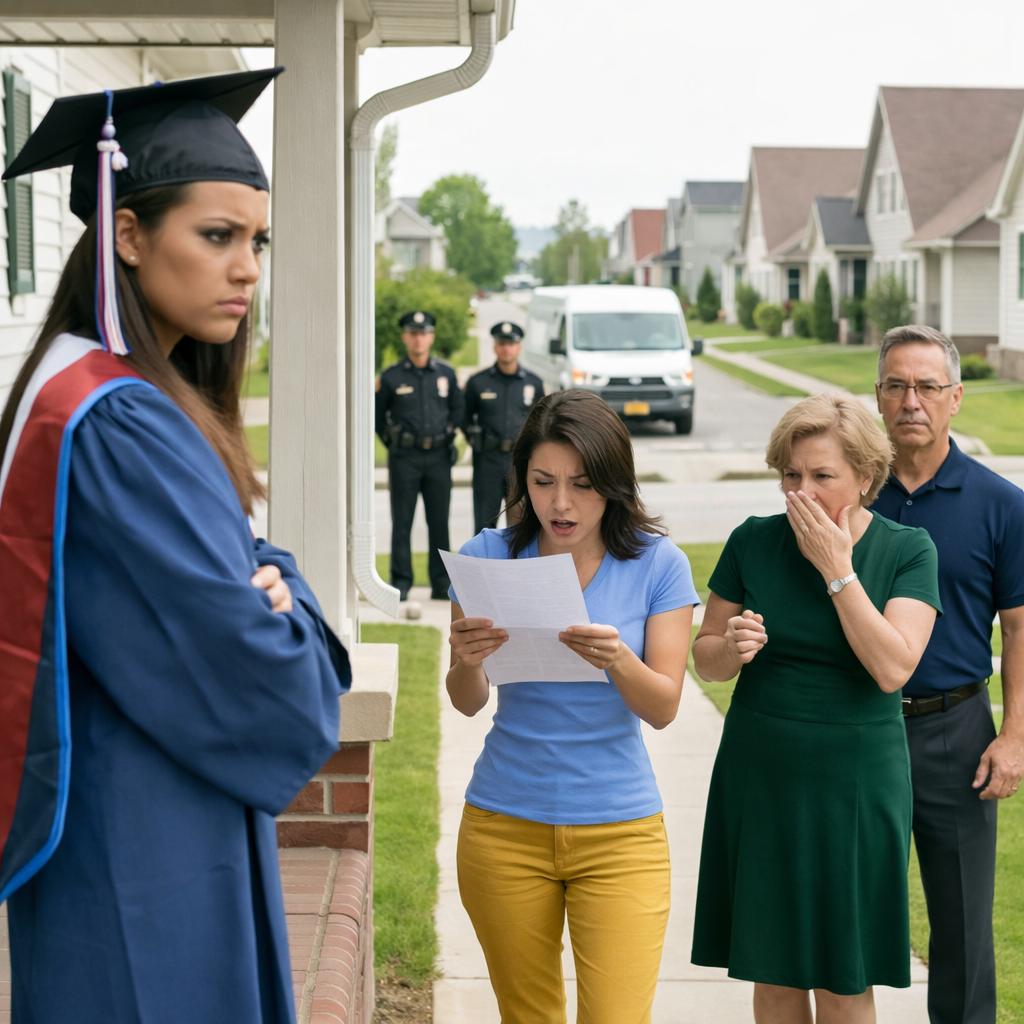
Just like the three car doors slamming in my driveway on that Tuesday morning.
For the next two years, I lived like someone was watching me.
Not in a paranoid way. In a practical way. Like you do when you’ve grown up learning that the moment you look too comfortable, someone will ask what you’re hiding.
I kept my studio apartment even after the house was legally mine. I told people at work I liked the location. I let my coworkers complain about rent and I joined in just enough to sound normal. I didn’t buy a new car. I didn’t change my clothes. I didn’t post anything online. I didn’t do the things people do when they come into money, because I knew that money wasn’t really mine until it was safe.
And safe, in my family, was never automatic.
On weekends, I drove to Riverside and sat in my grandparents’ empty house with the lights off, listening to the old wood settle. I opened drawers and found my grandmother’s folded dish towels, still smelling faintly of lavender soap. I found recipe cards in her handwriting tucked into cookbooks. I traced my grandfather’s initials carved into the underside of the porch railing, a mark he’d made decades ago when he fixed a loose board and didn’t want anyone to notice.