

Like the moment after a storm breaks, when the air feels scrubbed raw and everything is too still.
Lucas woke an hour later, rubbing his eyes and padding into the living room in socked feet. He stopped short when he saw my face.
“What happened?” he asked.
I knelt in front of him, bringing us eye to eye. “Dad was arrested,” I said gently. “The police took him into custody.”
His lower lip trembled. “Is he… bad?”
The word landed hard.
“He did bad things,” I said carefully. “Things that hurt people. Things that put us in danger. That doesn’t mean he didn’t love you. But it does mean he has to face consequences.”
Lucas nodded slowly, absorbing it in the way children do, like stacking blocks one at a time until the shape makes sense. Then he leaned forward and wrapped his arms around my neck, squeezing hard.
“I’m glad we didn’t go home,” he whispered.
“So am I,” I said, and felt it settle into my bones as truth.
The days that followed blurred together.
There were meetings with agents and attorneys, explanations delivered in careful language designed to be accurate without being overwhelming. I learned that Meridian Global Solutions was one of several shell companies. That Daniel’s “consulting” trips were handoffs and meetings and negotiations. That the safe in our closet had held more money at one time than I made in a year.
That our house, our furniture, our accounts were all considered part of the investigation now.
I was allowed to return to the house once, escorted, to retrieve personal items.
Walking through the front door felt like trespassing in my own life.
The air inside smelled faintly stale, like it had been sealed too tightly. Drawers stood open where strangers had searched. Closet boxes had been shifted. The safe in the back corner of our bedroom gaped open, empty, its existence alone a betrayal.
I moved through the rooms slowly, touching nothing unnecessary. Lucas’s toys were scattered where he’d left them. My coffee mug still sat in the sink. The normalcy of it all felt obscene.
I packed clothes. Photos. Lucas’s favorite books and the stuffed dog he’d slept with since he was two. I did not take the china. I did not take the art on the walls. Those belonged to a life that wasn’t real anymore.
When we left, I didn’t look back.
The house was seized within the week.
News broke shortly after. Daniel’s face appeared on screens and websites, his professional headshot repurposed into something sinister. Articles dissected the operation in language that made it sound calculated and sprawling and efficient. Millions moved through accounts. Years of deception.
Friends called. Neighbors texted. Distant relatives suddenly remembered my name.
I did not answer.
We relocated again after that. Another apartment. Another city. Same names, but a quieter place. A nonprofit job for me. A school counselor and therapist for Lucas. A routine built from scratch.
He had nightmares sometimes. Asked questions I didn’t always have answers for. But he laughed again too. Made friends. Learned to ride his bike without training wheels in a park where no one knew our story.
I learned how to breathe again.
The trial was scheduled for the following spring. I was told I’d likely testify. I didn’t fear it the way I thought I would. There was something clarifying about the truth once it stopped being hidden.
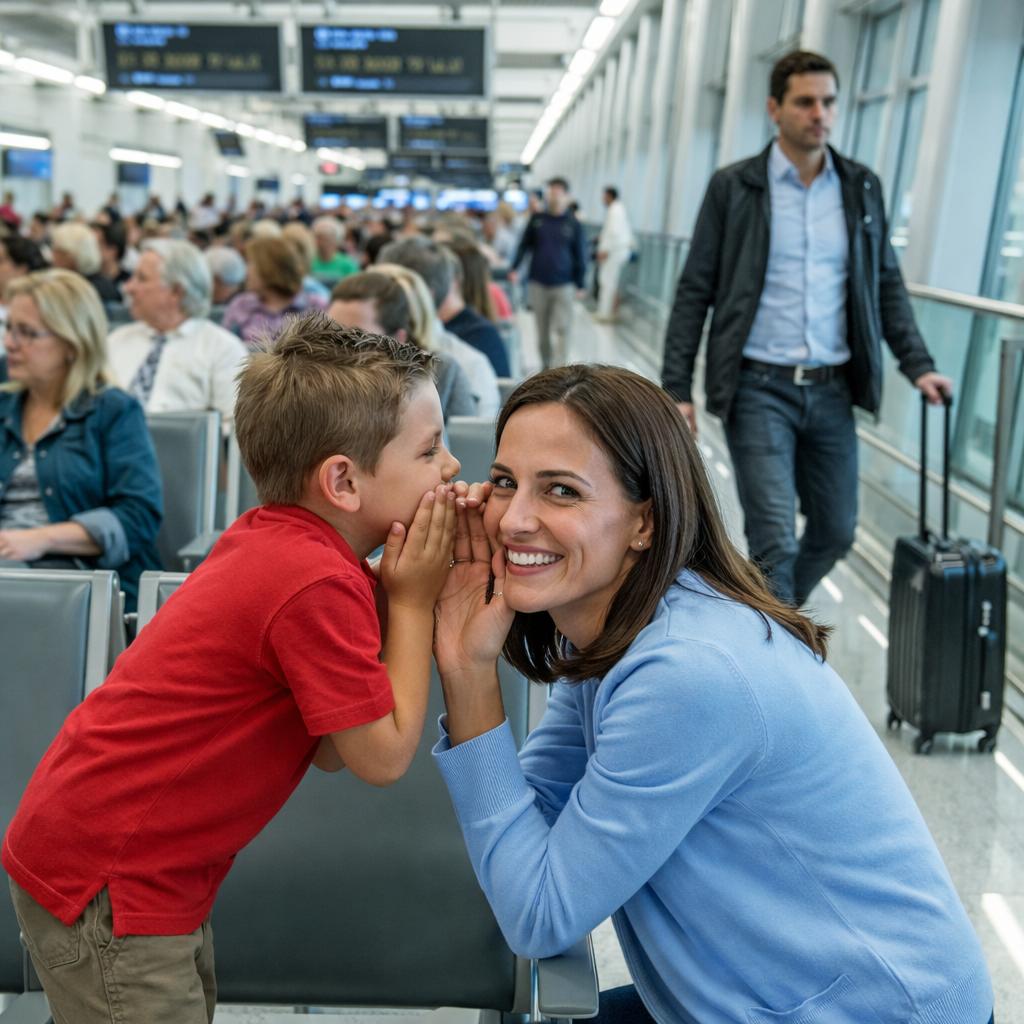
A year after that Thursday at Hartsfield-Jackson, Lucas and I stood in another airport, waiting to board a plane to visit my sister. A real vacation. One we’d planned openly, without lies.
As we shuffled forward in the security line, Lucas tugged my hand.
I looked down. “What’s up?”
“I’m glad I told you,” he said. “And I’m glad you listened.”
I crouched so we were eye to eye, ignoring the impatient travelers around us. “I will always listen,” I said. “Always.”
He nodded, satisfied, and turned back toward the line.
On the plane, he fell asleep against my shoulder, warm and solid and real. I stared out the window as we lifted into the sky, watching the ground fall away.
I thought about keys that didn’t belong. About lives that were performances. About the moment when routine nearly led us back into danger.
And I thought about the quiet courage of a child who noticed what I couldn’t, and trusted his fear enough to speak it.
We didn’t go home that day.
Because home isn’t an address. It’s not a house with a porch light left on. It’s not a routine that looks good from the outside.
Home is where you are safe.
Home is where the truth lives.
Home is where someone listens when you say something feels wrong.
And because I listened, my son and I were still here to build one.