

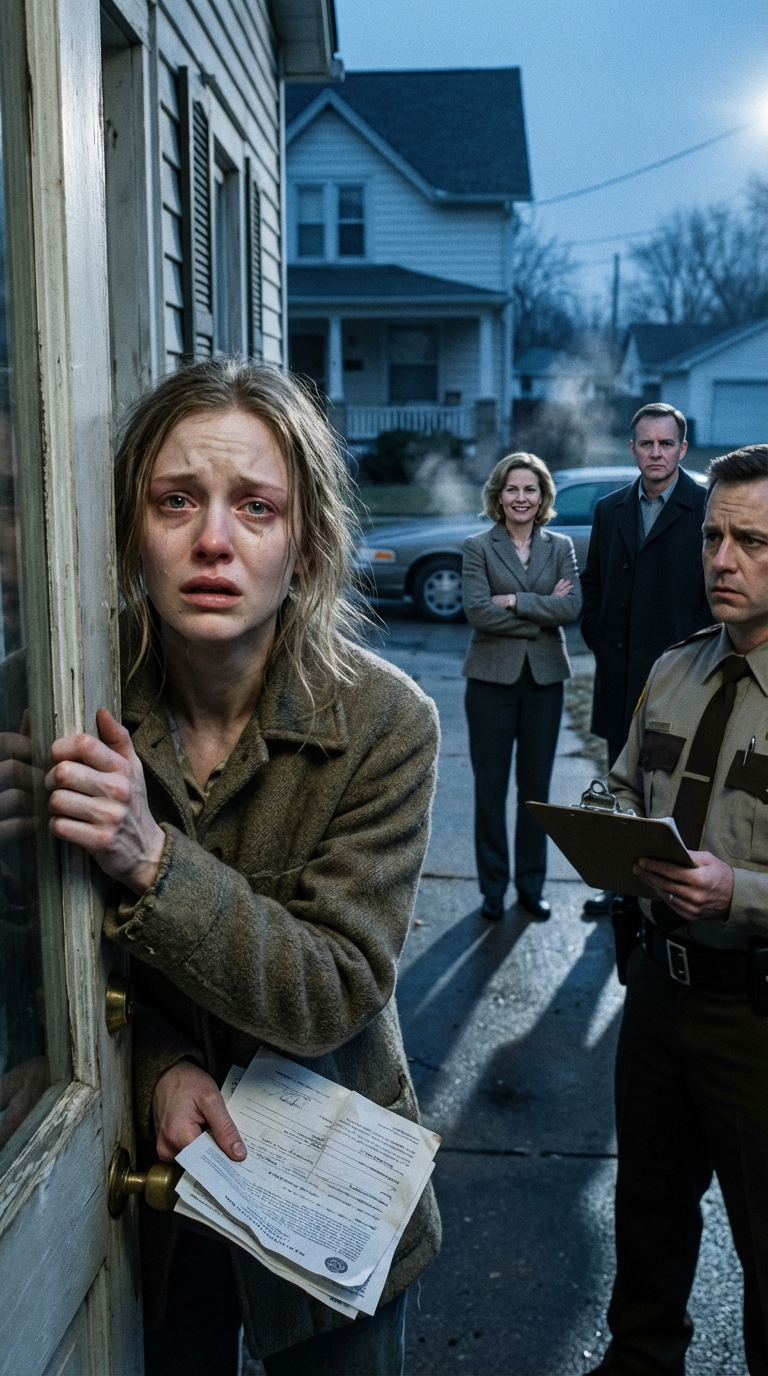
He hesitated, then lifted the top page and angled the clipboard so I could read it through the crack in the door. The bold header mocked me: WRIT OF POSSESSION. Below it, a case number, a court seal, and a judge’s signature I didn’t recognize.
I forced my pulse to slow down. I didn’t cry. I didn’t scream “Why?” at the figures across the street. I knew why. They didn’t need a reason that made sense to me; they only needed a reason that sounded acceptable to strangers.
I pointed a shaking finger at the top line. “Who filed this?”
Deputy Romero looked at the paper, then back at me. His expression shifted. It wasn’t pity anymore; it was recognition. “The plaintiff on this case is…” He paused, double-checking. “It was filed by Mark and Diane Ward.”
My parents. They hadn’t just threatened me. They had walked into a courthouse, dressed themselves in the costume of reasonable landlords, and turned me into a squatter in my own inheritance.
“When was this judgment entered?” I asked.
“Last week.”
“I was never served,” I said. “I’ve been here every day. No deputy, no certified mail, no notice taped to the door. Where was I served?”
Romero flipped a page. “Service address is listed as 128 Maple Terrace.”
The world tilted on its axis. Maple Terrace was a rental house my parents had lived in fifteen years ago. A place with a cracked driveway and a mailbox that leaned like a rotten tooth. I hadn’t set foot there since high school.
“That is not my address,” I said. “That is not where I live.”
“It’s what is on the return of service,” Romero said, his jaw tightening.
My mother called out again, her tone sweeter now, performing for the audience of one deputy. “We tried to do this the easy way, Tessa. You forced us.”
I ignored her. “Show me the return of service. Please.”
Romero flipped back a page. “Substituted service accepted by adult female occupant at Maple Terrace.”
Adult female occupant.
I looked across the street. My mother stared back, her face composed in a mask of tragic necessity. She had used an address she controlled, accepted the papers meant for me, and let the clock run out on a lawsuit I didn’t know existed.
“This house was my grandfather’s,” I told the deputy. “He left it to me.”
Romero held the papers tighter. He hated this. I could tell. “Ma’am, if you believe this order was obtained improperly, you need to contact the court immediately and file an emergency motion. I cannot give you legal advice.”
“I understand.”
“There’s one more thing,” he said, looking me dead in the eye. “This writ authorizes same-day possession. Without a judge’s stay, I have to clear this house by noon.”
Noon. Six hours.
I didn’t argue. Arguing would give my parents the scene they wanted—the hysterical daughter, the instability they claimed I suffered from. Instead, I built a record.
“Hold the paper steady, please,” I said.
I pulled out my phone and took high-resolution photos of every page. The case number, the seal, the signature, the false address. Then I stepped back and closed the door. I slid the deadbolt home. It wouldn’t stop them, but documentation might.
I grabbed my “Go Bag”—a fireproof pouch I kept in the bottom drawer. It held the boring things that become matters of life and death when family turns predator: my deed, my grandfather’s probate distribution letter, property tax statements, and my homeowner’s policy.
I called the courthouse clerk’s office the second they opened.
“Civil Division,” a woman answered, her voice brisk.
“I have a writ of possession being executed right now,” I said. “I was never served. I need to request an emergency stay and set aside a default.”
Keys clacked on the other end. “Case number?”
I gave it to her. A pause. “Ma’am, this is an unlawful detainer. Default judgment entered last week. Service return says accepted at Maple Terrace.”
“That is not my address. That is my parents’ old rental. My mother signed for it.”
“You need to file an emergency motion to stay enforcement,” she said, her voice softening just a fraction. “And a motion to vacate the default.”
“I have until noon.”
“Come now,” she said. “Bring proof of residence. Bring the deed.”
I hung up, grabbed my keys, and walked back to the front door. Deputy Romero was still waiting. My parents were still watching.
“I’m going to the courthouse,” I told the deputy through the crack. “I’m filing for a stay.”
“That’s what you need to do,” he nodded.
“You can file whatever you want!” my mother yelled, her voice dripping with poison disguised as concern. “It’s already done!”
“Pack your things!” my father shouted. “Don’t make this ugly!”
I looked at him, really looked at him, for the first time that morning. “You made it ugly when you lied to a judge,” I said.
I closed the door, walked out the back, hopped the fence, and got into my car. I refused to walk past them.