

He broke the silence first. “Just behave at the wedding. Don’t make it about you.”
The old command tone was still there—controlled, measured, stripped of feeling.
I turned my head slightly, studying him in the fading light. His uniform wasn’t on, but the stiffness in his shoulders was the same. There was always something military about his breathing, about the way he turned life into a set of rules no one else had agreed to follow.
I glanced again at the photograph, the hollow square where I’d been, and my lips curved into a faint, tired smile. “I won’t,” I said.
He didn’t respond. The clock ticked again, louder now, like the house itself was counting the seconds until I left.
I lingered a moment longer, letting the air sit between us. There were so many things I could have said—how the Navy he dismissed me from had built me instead, how silence had become my armor, how I had stopped needing him long before he realized it—but none of it would have mattered. His pride was a closed system. Every truth that didn’t fit was filtered out.
He reached for his gloves, signaling that the conversation was over. That was how he dismissed people without words, just a movement so small it carried the force of a door slamming shut.
As I turned to leave, the light shifted, slanting across the room, brushing dust off old furniture and finding the thin layer of tarnish on his medals displayed by the window. I wondered if he ever noticed how tarnish crept in no matter how much you polished it.
The hallway felt longer on the way out. My footsteps sounded too loud, each one echoing like a question that had already been answered. The front door resisted for a second when I pushed it open, the hinges groaning under the weight of memory.
Outside, the sun hit me full on—bright and relentless. The air smelled of salt and magnolia, heavy with the same southern sweetness that had once felt like suffocation. From the porch, I could see the Cooper River gleaming in the distance, its surface broken by the slow movement of a passing boat. The water shimmered gold under the light, calm and untouchable, nothing like the storm inside that house.
I paused at the top of the steps, looking back through the open doorway. He hadn’t moved, still there, upright, still guarding the illusion that control was the same as peace. The breeze stirred the white curtains, and for a fleeting moment, the fabric shifted just enough to frame the photograph again. The missing piece of my face caught the light like an old scar.
I closed the door softly. No slam, no sound of defiance—just finality. The click of the latch echoed through my chest as I walked down the path toward the street. I let the heat settle around me, the smell of river salt mixing with the faint scent of coffee that clung to my sleeve. Every step felt heavier and freer at the same time.
There was nothing left to argue, nothing to reclaim. He’d built his world out of rank and order, and I had learned to survive outside it.
As I reached the edge of the property, I looked back one last time. The red bricks glowed under the sunlight, the windows reflecting the water beyond. For a second, I thought I saw a figure move behind the curtain, rigid, solitary, small against the vast brightness outside. Then the wind shifted, and the curtain fell still again.
The river caught the light and scattered it across the horizon, a thousand fragments of gold trembling on the surface. I followed it with my eyes, tracing its slow curve south, somewhere down that line, beyond the gleam. The rest of the world was waiting—different air, different rules. Behind me, the house stood quiet, sealed in its own command. Ahead, the sunlight burned clean.
I didn’t look back again.
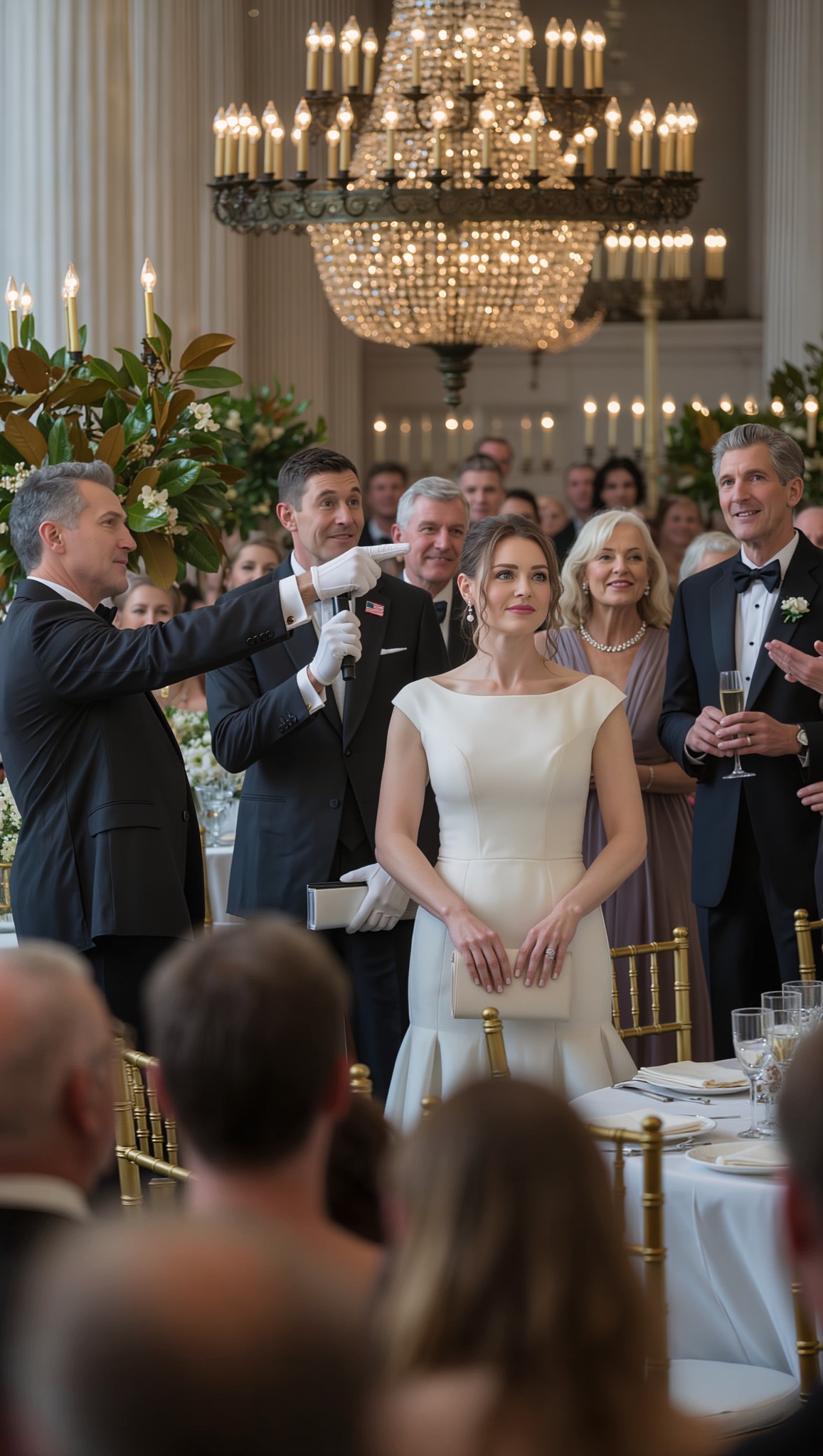
The ballroom glowed with the kind of warmth that felt rehearsed, soft amber light spilling over crystal glasses, white roses arranged in perfect symmetry, laughter rising and falling like a well-practiced melody. It was the kind of evening that looked effortless, which meant someone had worked very hard to make it that way.
I was seated at the far end of the long table where the light didn’t quite reach. The linen was spotless, the silver gleamed, and every smile along the table had the faint tremor of performance. From where I sat, I could see my father at the head of the table, posture rigid even without a uniform. His hand rested on his wine glass as though it were part of a drill.
Across from me, a woman in pearls leaned toward another guest, her voice a whisper wrapped in curiosity. “That’s her,” she said softly. “The Navy one. Never married.”
The words weren’t cruel. Not exactly. Just coated in sugar. I’d learned long ago that polite cruelty cuts deeper. It lets you bleed quietly without anyone having to notice.
Madison glanced at me from across the table. Her smile looked careful, as if she were still trying to balance on the line between sister and hostess.
“You look strong,” she said in that bright, brittle way southern women use when the air feels too tight.
“You look nervous,” I said, matching her tone for a heartbeat.
Her smile faltered. It was the smallest fracture, but it made the room feel a degree cooler. She turned back toward her fiancé, toward the safety of small talk.
Dinner stretched on. Forks touched porcelain. Laughter filled the gaps where honesty should have been. I cut my steak into neat, untouched pieces, the scent of roasted rosemary and butter heavy in the air. The wine glass in front of me remained full, untouched. Around me, people drank to old stories and half-true memories.
At the far end, my father rose, glass in hand. The shift was instant. Conversations halted, chairs adjusted, and the band lowered their music to a hum. His voice carried with the same precision it always had, a tone designed for command.
“Family,” he began, “is where we learn service. Some of us serve, others perform.”
A ripple of polite laughter drifted through the room. It wasn’t loud, just enough to sting. His eyes never left mine. The line sat there between us—sharp and deliberate.
I didn’t flinch. I didn’t look away. I only set my fork down carefully, aligning it with the knife, my movements exact and measured, the way I’d been taught discipline should look.
The silence that followed wasn’t mine, but it belonged to me all the same. I let it stretch until the laughter faded into discomfort. The air grew dense, thick enough that no one dared fill it.
He took a sip of his wine, satisfied.
I met his gaze, calm, steady. He waited for a reaction that didn’t come. And that was the thing about men like him: they mistook stillness for weakness, quiet for defeat.
The music returned, too cheerful for the mood it tried to rescue. I sat through dessert, through the clinking of silver spoons and the low hum of gossip, through the measured glances of people pretending not to watch the space between us.
When the plates were cleared and the first guests began to stand, I gathered my things slowly. I had learned to move without hurry. It unnerved people who expected you to rush away from discomfort. As I rose, the reflection of the chandelier caught the rim of my untouched wine glass, splintering the light into fractured gold.
Two versions of me looked back from that glass: the one sitting quietly at the edge of their world, and the one who had long ago learned how to command storms.
I was halfway to the door when I heard my name.
Blake Anderson, Madison’s fiancé, had stepped away from a cluster of guests and was crossing the room toward me. His expression wasn’t the polite curiosity I’d come to expect tonight. It was something sharper, something remembering.
“Were you ever in Djibouti?” he asked, voice low enough that only I could hear. “Operation Tidal Veil.”
I turned slightly, meeting his eyes. The chandelier light caught in them—bright, searching, uncertain.
“I commanded that op,” I said.
He froze for a second. The noise of the room fell away, replaced by the quiet recognition between two people who’d seen the same kind of chaos.
His voice dropped even lower. “Then I owe you my life.”
I studied him, not out of pride, but habit—the way you measure a man’s sincerity when words come too easily. “Does Madison know?”
“Not yet,” he said. “But she will.”
His tone held no threat, no pity—just respect, the kind that didn’t need ceremony or applause. He stepped back, gave a nod that felt more like a salute than a farewell, and returned to the others.
I watched him rejoin the conversation, his demeanor different now, quieter. I knew what that look meant. Once someone sees you through the lens of gratitude, they can never unsee it.