

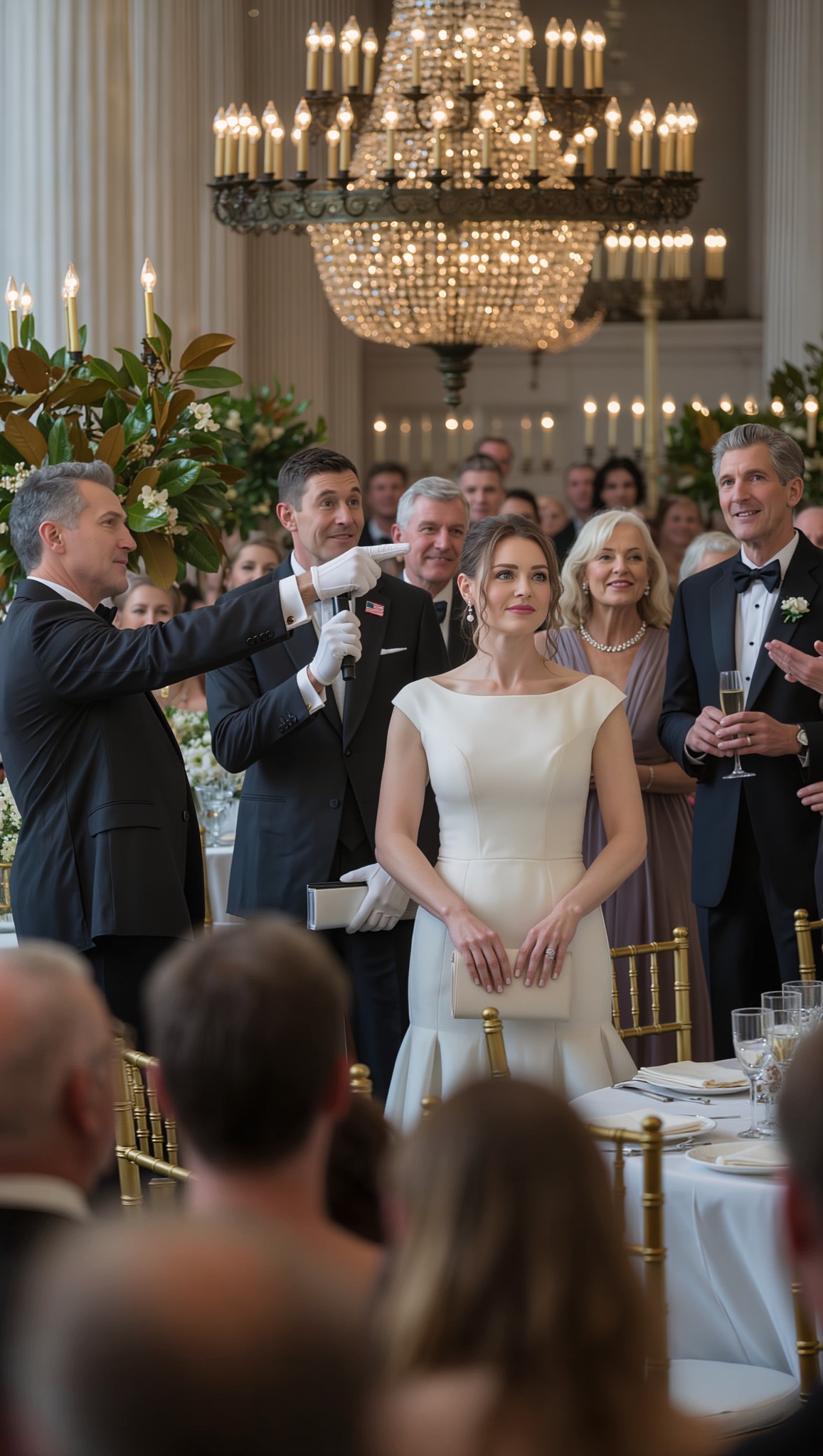
The chatter of the room swelled again. My father laughed at something across the table, his voice filling the space like old smoke. I caught the faintest reflection of him in the mirror behind the bar—the same proud angle of his jaw, the same stillness masking unease.
I reached for the door, my hand brushing the polished brass handle. Behind me, the orchestra struck up a livelier tune, as if the evening could still be saved by rhythm.
I didn’t turn back.
Outside, the night air felt clean, salt-sweet from the nearby river. The laughter inside muffled into a blur, like a distant memory I had already outgrown. I stood there for a long moment, watching the reflection of the chandelier dance in the glass doors. Every story inside that room would twist itself by morning. The polite laughter, the toast, the silence—it would all be rewritten to make everyone comfortable again.
But truth doesn’t vanish just because no one names it.
I stepped away from the hotel, heels clicking against the marble, steady and slow. Somewhere behind me, the last note of a trumpet lingered, thin and wavering, before it broke into silence. In that quiet, I felt it—the first shift of the tide, the beginning of something they would never be able to laugh off.
The morning air along the Cooper River was pale and thin, heavy with mist that clung to the grass and the carved stones alike. The cemetery sat at the water’s edge, quiet except for the low hum of cicadas waking in the distance.
I walked slowly between the rows, lavender stems in my hand, their faint scent carrying against the wind.
She was already there.
Madison stood beside the headstone, wrapped in a gray coat that didn’t suit the season, her hands buried in the pockets like she wasn’t sure what to do with them. She turned when she heard my steps.
“I shouldn’t have come,” she said, voice barely above the sound of the river.
“Neither should I,” I answered, and it wasn’t bitterness, just a truth that didn’t need defending.
For a moment, we stood in the stillness that follows after too many years of not knowing what to say. Then she reached into her coat and pulled out an envelope—thin, worn, the edges curled with age. Her hand trembled slightly.
“It’s from mom,” she said. “Dad told me to destroy it.”
The words hung there between us, fragile as paper itself.
I took the envelope carefully. The seal was brittle, almost ready to crumble. My mother’s handwriting slanted across the front—soft, deliberate, the kind of writing she used when she was trying not to shake. I opened it slowly, the sound of tearing paper louder than it should have been.
Inside, the ink had faded to a faint brown. I could still smell the faint trace of lavender oil—hers, always hers.
I read the first line, and the world around me seemed to still.
If I had been braver, I would have followed you out that door. Silence isn’t peace, it’s decay.
I stopped there.
The wind picked up, brushing against the paper, tugging lightly at the words like it wanted to take them away before I could finish. For a long while, I couldn’t speak. The sky was the color of tin, and the river shimmered silver beneath it. I thought about that kitchen all those years ago—her hands clutching the tin of cookies she never finished giving me, her eyes lowered, the silence that had sealed every goodbye we never said.
I folded the letter fully, pressing the creases along the same lines my mother had once made, maybe out of habit, maybe out of fear. My voice came out rough.
“She wanted to go with me.”
Madison didn’t answer. She didn’t have to. The look on her face told me she had read the letter too many times to pretend otherwise. The lavender in my hand felt suddenly heavier.
I knelt, laid it at the base of the headstone, and brushed the dirt from her name. My mother, who had lived her whole life inside someone else’s shadow, who had mistaken obedience for safety.
The silence between us stretched again until Madison finally broke it, her voice small and uncertain. “At first, I invited you for the inheritance.”
The honesty didn’t shock me. It just fit.
She kept her eyes on the ground. “But then Blake said who you were, what you did. I thought maybe we could fix things.”
I looked up at her. She had always been the one to flinch first, the one to soften after a storm. It wasn’t guilt on her face now. It was something closer to recognition.
“Peace isn’t a family project,” I said. “It’s something you practice.”
She nodded once, quick, ashamed. The wind pulled her hair across her face, and she let it stay there like a curtain she didn’t want to move.
We stood there—two women carved from the same house, but carrying opposite versions of silence. For the first time, I didn’t feel the need to fill it. The air itself seemed to understand.
After a while, I touched her shoulder just once, then stepped back. The river’s surface caught a strip of sunlight breaking through the clouds, bright enough to make me squint. I looked down at the lavender again, purple against the cold gray stone.
“She deserved more than this,” I said quietly.
Madison’s lips parted like she wanted to say something, but she didn’t. She only nodded again, her hands trembling in her pockets.
I looked past her toward the river. The water moved slowly, patient and endless, carrying pieces of light downstream. I imagined my mother standing at that same window years ago, watching the same current, wondering if silence really could keep a family intact. Maybe she believed that peace meant keeping the house from shaking, even if it meant she had to stop breathing.
I left the letter folded at the base of the headstone beneath the lavender. The wind caught the corner of the paper, flipping it slightly, but it stayed.
Madison finally spoke, barely a whisper. “He told me you wouldn’t come.”
“He’s been wrong before,” I said.
She gave a small broken laugh. It wasn’t much, but it was something human, something I hadn’t heard in years.
The light softened then—silver fading into pale gold as the clouds drifted. Somewhere behind us, a church bell rang from across the water, one long hollow note that seemed to echo through the stones.
I turned to go. Madison didn’t follow. She stayed by the grave, looking smaller than I remembered, shoulders curved like she was finally carrying something she’d tried too long to ignore.