

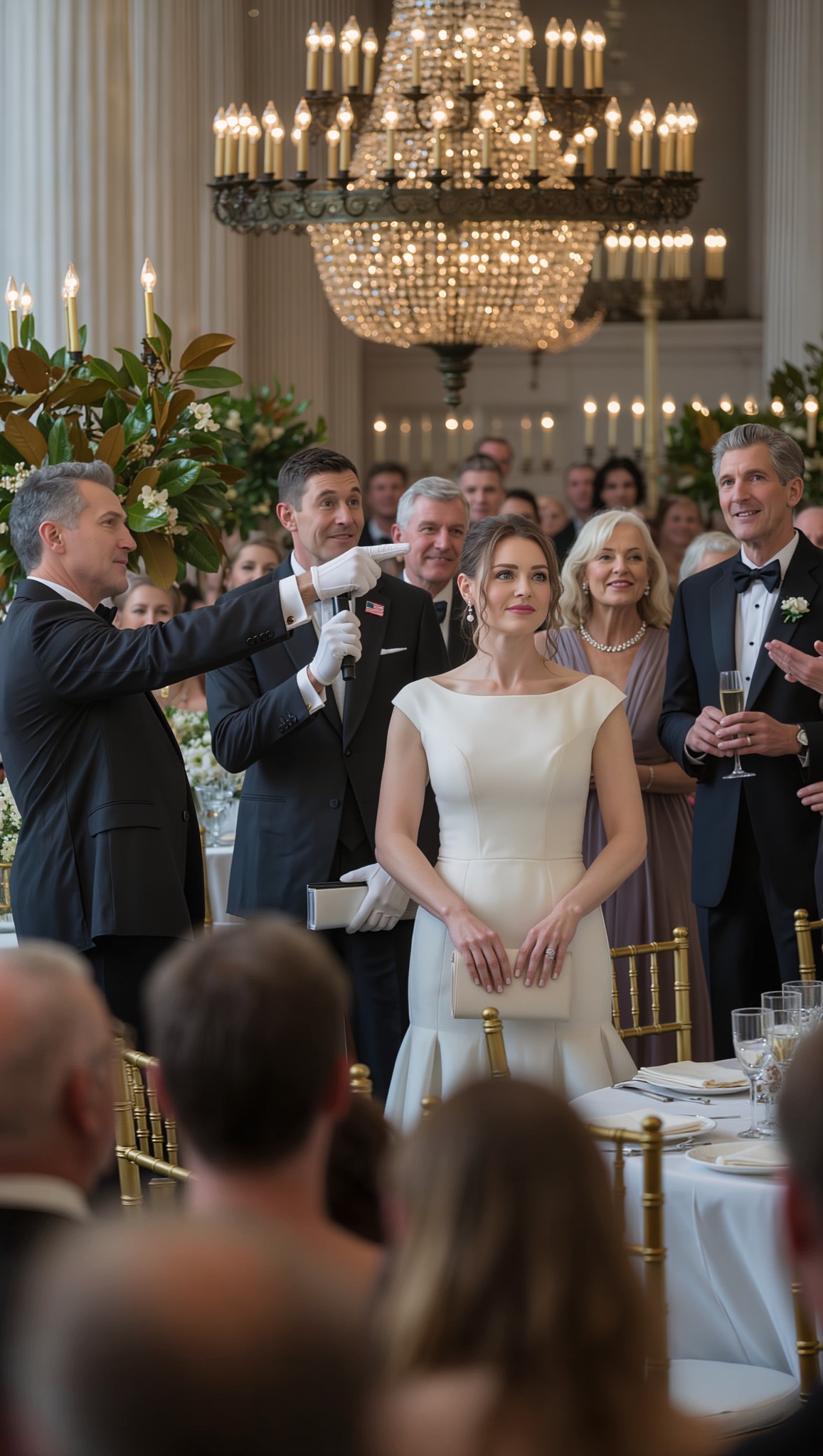
The hall stayed silent, waiting.
He exhaled, a short, unsteady sound, and pushed his chair back. The scrape of its legs against the floor was the loudest sound in the room. Slowly—painfully slowly—he rose. His hand trembled as he straightened, as though his body fought against what his soul already knew.
And then he lifted his arm.
It wasn’t graceful. It wasn’t quick. But it was perfect. A salute—steady, deliberate, precise. Every line of it told a story of surrender, of pride breaking, and something older, deeper, rising in its place.
Our eyes met.
For the first time in twenty years, we stood on level ground. There was no rank between us, no command chain, no father or daughter—only two people bound by the same blood, the same duty, the same silence that had cost too much.
In his gaze, I saw what apology looks like when words are too small to carry it. In mine, I let him see what forgiveness looks like when it’s earned through pain instead of asked for in comfort.
The hall seemed to pulse with light. The chandeliers reflected against the glass walls, casting fragments of gold across us both. It was as if two different times had collided in that moment—his world of rigid honor and mine of chosen strength, mirroring each other in fractured brilliance.
Somewhere near the back, a fork dropped onto a plate, the sound startling in its honesty.
The air trembled.
I returned his salute, my hand crisp, unwavering.
And then the world stopped for ten long seconds.
Nothing moved. The only sound was the quiet rhythm of breath, the collective heartbeat of every person in the room. The light softened, the gold dimming into silver as the sun finally disappeared beyond the river.
A single piano note broke the silence. Then two more—slow and deliberate. Three notes, steady as a heartbeat, fragile as peace.
When I lowered my hand, my father did too. His eyes glistened, though he would never let them fall. He sank slowly back into his chair, his face pale but calm. The applause that followed was soft, restrained, almost reverent. It wasn’t for victory. It was for something older, something truer.
The weight of a lifetime finally released.
I stayed standing a moment longer, letting the noise fade. Then I sat, the gold light fading from my sleeve. Blake caught my eye, a silent nod passing between us. Madison wiped her cheeks, her smile trembling. My father sat motionless, his hand still resting over his chest.
Someone nearby asked if I wanted to say something, to speak, to acknowledge the moment, to make it official.
“No,” I said quietly. “Everything’s already been said.”
The words echoed back to me, soft but steady. They sounded different now—less like resignation, more like peace.
The river glimmered beyond the glass, a long silver ribbon under the first breath of night. Inside, the chandeliers dimmed, and the piano faded into silence. The air felt lighter somehow, as if the building itself had exhaled.
Twenty years of war ended in fifteen seconds of silence.
And in that stillness, I finally understood.
Respect doesn’t roar. It arrives quietly when no one is demanding it anymore.
The night air over the Cooper River carried a soft chill, the kind that comes after a storm breaks and leaves everything cleaner. The house looked smaller than I remembered, its porch light glowing amber against the dark. I stood at the bottom of the steps for a long moment before I climbed them, my boots quiet against the old wood.
When I knocked, the sound was soft, almost hesitant.
The door opened after a pause. He stood there—no tie, sleeves rolled, eyes tired. His voice came low, fragile, but steady.
“I made coffee.”
“Then I’ll sit,” I said.
We walked into the kitchen together, the same kitchen where everything had once ended. The air smelled faintly of roasted beans and something older—dust, memory, time. The table was clean, two cups waiting, steam rising between them like a flag of truce.
He sat across from me, shoulders curved, hands wrapped around his cup as if it might keep them from shaking.
“I shouldn’t have said those things tonight,” he said finally.
“You said them twenty years ago,” I replied. “Tonight just gave them a microphone.”
He exhaled, a sound between a sigh and a confession. The clock ticked on the wall, marking seconds neither of us could reclaim.
“Were you ever scared?” he asked, his voice quieter now.
“Every time,” I said. “But I moved anyway.”
He nodded, looking down at the dark swirl in his cup. The silence filled the space between us—thick, alive, but not heavy this time.
After a moment, he spoke again, barely above a whisper. “I told myself I was protecting you when I pushed you out.”
“You were protecting your story,” I said. “That story cost all of us.”
He didn’t argue. He just sat there, eyes unfocused, the weight of understanding finally finding its place on his shoulders.
Then slowly he stood. His movements were careful, deliberate, as if afraid to break the fragile piece holding the room together. He crossed to the sideboard and opened a drawer from inside. He pulled out a small envelope, yellowed thin.