

Margaret’s expression shifted from disdain to calculation. She realized, in that second, that this wasn’t just a domestic dispute anymore. This was a liability.
“Call 911,” she barked at him, her voice devoid of empathy. “Now. Before she makes it worse.”
I lay on the floor, staring at the dust motes dancing in the afternoon sun, praying to a God I hadn’t spoken to in years. Keep her safe. Take me, but keep her safe.
The sirens came fast, cutting through the silence of the neighborhood. Or maybe time had slowed down, stretching every second into an hour. I remember the paramedics’ boots—heavy, black, reassuring—stomping into the entryway. I remember their hands on me, professional and gentle, their calm voices cutting through the fog of my panic.
“Ma’am, can you hear me? What is your name?”
“Lauren,” I croaked. “I’m six months along. Please… my baby…”
“We’ve got you, Lauren. Just breathe.”
They lifted me onto the stretcher. As they wheeled me out, I caught a glimpse of Ethan. He was standing in the corner, chewing his thumbnail, his eyes darting back and forth. He didn’t look at me. He was looking at his mother, waiting for instructions on what story they were going to tell.
The ambulance doors slammed shut, sealing me into a world of white light and beeping monitors. The engine roared to life. I stared at the ceiling of the rig, watching the IV bag sway with the motion of the road, terrified that the fluttering I usually felt in my belly had gone silent.
Chapter 2: The Facade Crumbles
The hospital was a sensory overload of antiseptic smells and urgent voices. They rushed me into an exam room, bypassing the waiting area. A nurse, her face a mask of focus, placed a Doppler monitor on my belly.
The silence in the room was suffocating. It lasted for five seconds. Ten. Fifteen.
Then—thump-thump, thump-thump, thump-thump.
The rapid, galloping rhythm of my daughter’s heartbeat filled the air. I sobbed, a guttural sound of relief and profound shame. She was alive. I hadn’t failed her yet.
“How did you fall, Lauren?” the doctor asked. He was looking at my chart, not at me. His tone was casual, but his pen was hovering over the paper.
The lie came automatically. It was a reflex, conditioned over two years of marriage. “I… I slipped,” I stammered. “I was wearing socks on the tile. I’m so clumsy.”
That was the script. Cover the bruises with concealer. Cover the holes in the drywall with art. Cover the truth with words that made Ethan look like a saint and me look like a disaster.
The doctor paused. He looked at the bruising on my cheek, the way my hand trembled. He didn’t say anything, but he didn’t write anything down either.
Suddenly, the door to the exam room flew open. It hit the stopper with a loud bang.
“Lauren?”
The voice was familiar, grounding, and terrifying all at once.
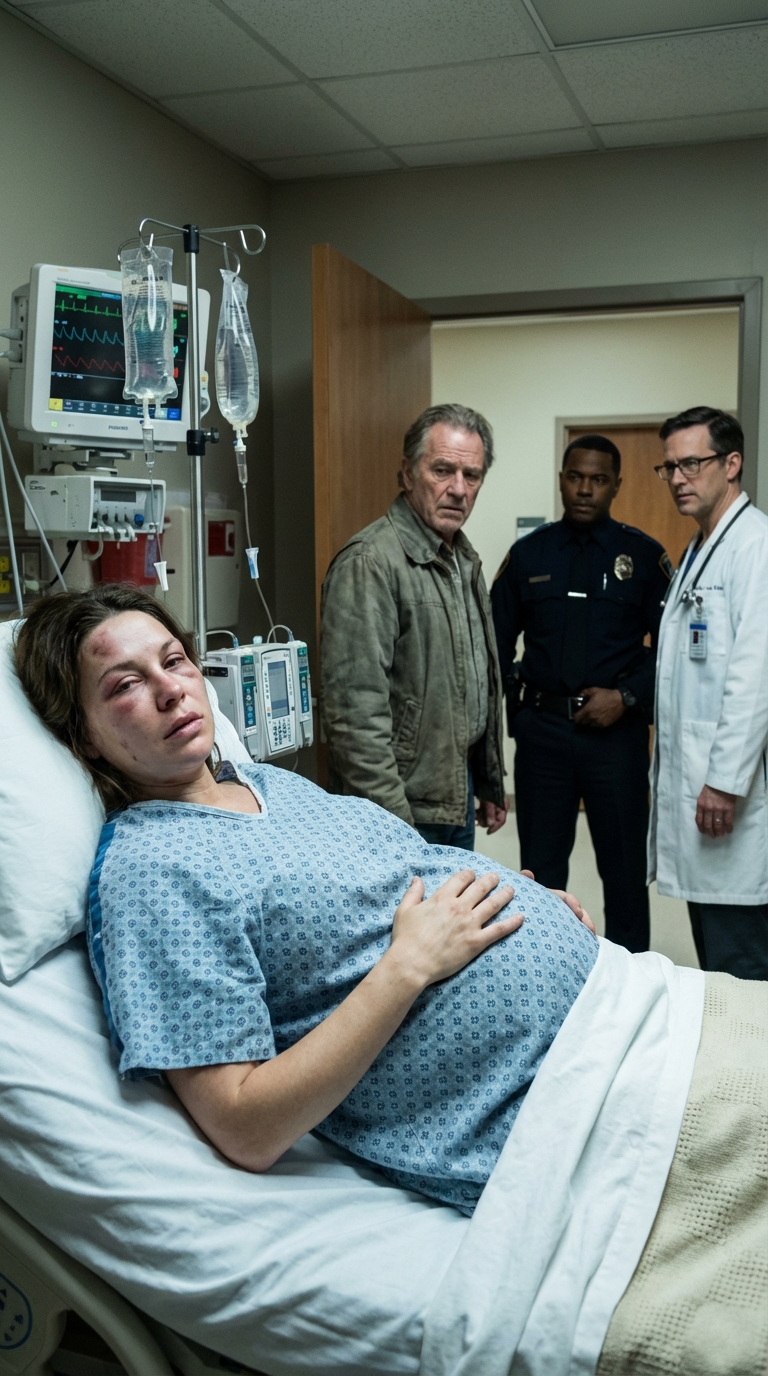
My father, David, stood in the doorway. He was wearing his work clothes—stained denim and a flannel shirt—looking like he had run every red light in the city to get here. He froze, his eyes scanning the room. He took in my swollen, purple cheek. The IV line in my arm. The hospital gown bunched around my waist. The sheer terror in my eyes.
His jaw clenched so hard I could see the muscle feathering.
He stepped into the room, filling the space with a kind of quiet, dangerous energy I had never seen in him before.
“Tell me everything,” he said.
It wasn’t a question. It was a command.