

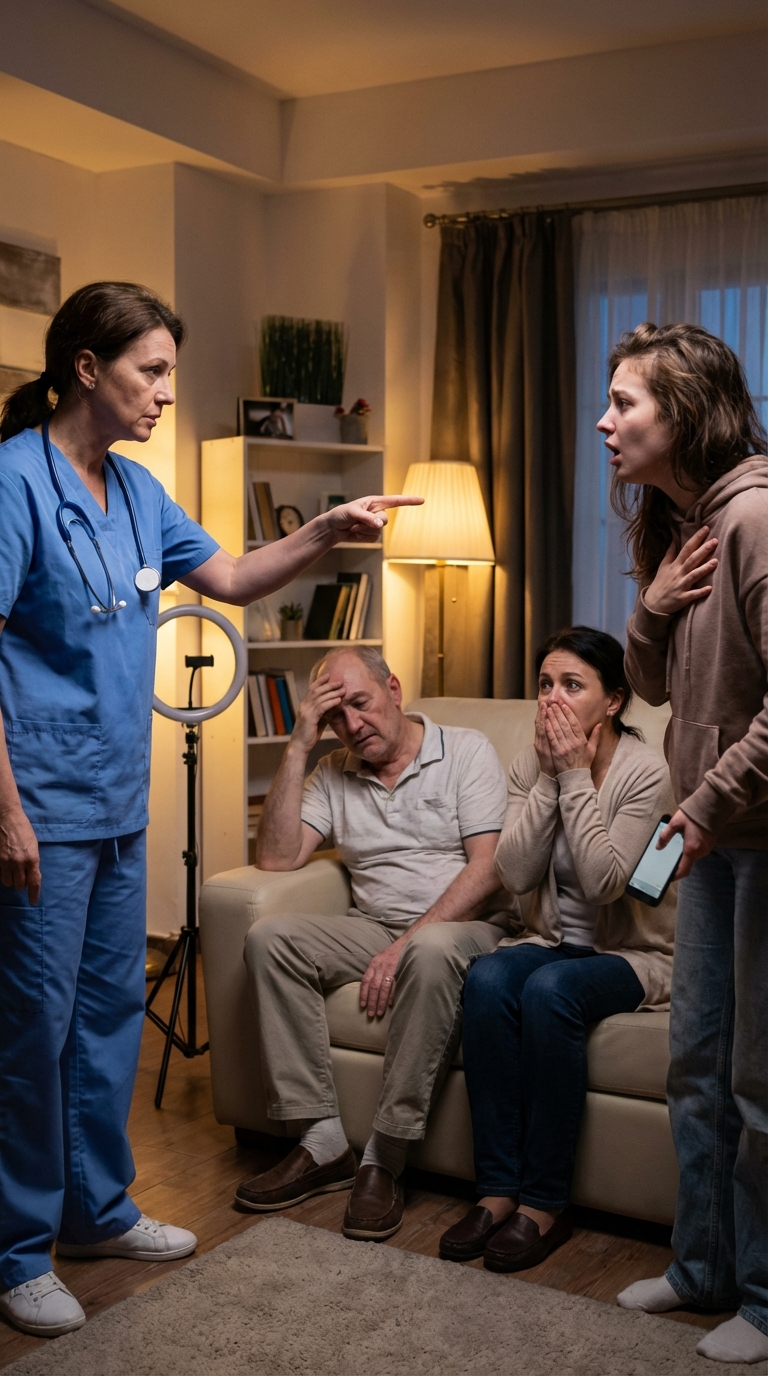
“It’s where she’s supposed to be,” my mom nodded, acting as if she had just solved a complex equation. “A girl needs her father.”
My hands started to tingle, the blood rushing away from my extremities. “Steven hasn’t seen her in six months. She barely knows him.”
“Biologically, he is her father,” my dad stated, clinging to the one fact he thought justified this madness.
“We had to make a decision,” my mom sighed, sounding exhausted by my existence. “You don’t have the outside perspective. You’re too close to it.”
“I am her mother!” I shouted, the volume finally breaking free. “That is the perspective!”
Allison stepped forward, pointing a manicured finger down the hallway toward Kora’s gutted room. “And besides, we need the space.”
I stared at her. “You need Kora’s room.”
“I work from home now,” Allison said, her voice taking on a whine. “I need an office. A studio. You can’t film content with a child running around making noise. It’s unprofessional.”
I looked from her to my mother. “You are turning my seven-year-old’s bedroom into a content studio?”
“We can’t have a child here in the house all the time,” my mom said, smoothing her apron. “It’s… disturbing. It disrupts the flow.”
Disturbing. My daughter’s existence was disturbing.
My dad added the final blow. “And you can’t take care of her properly. You’re always at that hospital. So why are you acting shocked? We did this for you.”
I felt something cold and clear settle into the center of my chest. It wasn’t anger. Anger is hot; anger burns out. This was something else. This was a glacier. This was the end of love.
I took a slow breath. “Excuse me,” I said.
I walked into the bathroom and locked the door. I gripped the porcelain sink until my knuckles turned white. I stared at myself in the mirror—scrubs stained with coffee, dark circles under my eyes, hair in a messy bun. I looked like a victim.
No, I thought. Not today.
I splashed cold water on my face. I dried it with a towel. I unlocked the door.
They were still in the hallway, murmuring to each other, probably congratulating themselves on their “tough love.” When I stepped out, I didn’t shout. I walked right up to them, invading their personal space.
“I want you out of my house within thirty days,” I said quietly. “All of you.”
The silence that followed was absolute. The fridge hummed. A bird chirped outside.
“What?” my mom laughed, a nervous titter. “Don’t be dramatic, Hannah.”
“I am not being dramatic,” I said. “I am being a landlord. You have thirty days.”
“It’s not your house!” my dad barked, his face flushing red. “It’s our house. We raised you here!”
“Actually,” I said, my voice dead calm, “it’s mine. Do you want me to get the deed from my room? Or do you remember the ‘formality’ we signed three years ago?”
Chapter 3: The “Formality”
They stared at me like I had grown a second head. It was almost funny. They had spent my entire life training me to be the “good one,” the compliant one. Allison was the star, the special one who needed protecting. I was the mule. I was the one who fixed things.
Three years ago, they were drowning. They were $68,000 in unsecured debt and nearly $20,000 behind on the mortgage. The bank was threatening foreclosure. Their credit was so ruined they couldn’t buy a toaster on a payment plan, let alone refinance a home.
They had sat me down at the kitchen table—the same table where they had just plotted to exile my daughter—and begged.
“We need you to sign some things,” my mom had said, tears in her eyes. “Just a formality. We have to put the house in your name to save it. You have good credit. We’ll pay the mortgage. It’s just on paper.”
I was skeptical. But I was the daughter who fixed things. I put in $24,000 of my own savings to catch up on the arrears. I took on a $2,350 monthly mortgage in my name.
And once the papers were signed? The gratitude evaporated. They stopped paying me back after three months. I covered it. I worked extra shifts. I moved in with Kora so they could “help” with childcare, which turned out to be them watching TV while Kora played alone in her room.
And now, they thought they could vote me out of my own life.
“I will send you legal papers shortly,” I told them.
I walked past them, grabbed my keys, and walked out the front door.
“You can’t do this!” my mom screamed from the porch. “Where are you going?”
I didn’t answer. I got in my car, my hands shaking so hard I could barely put the key in the ignition. I didn’t care about the house right now. I cared about one thing.
Steven.
I drove. I called him. Voicemail. I called again. Voicemail.
Panic started to claw at my throat. Steven was the kind of father who treated parenting like a hobby he tried once and quit. He didn’t have a car seat. He didn’t have a bed for her.
I called his mother, Susan.
She picked up on the first ring.
“Hannah,” she said. Her voice was ice cold.
“Do you know where Kora is?” I asked, hearing the crack in my voice. “My parents said she’s with Steven, but he isn’t answering. Is she okay?”