

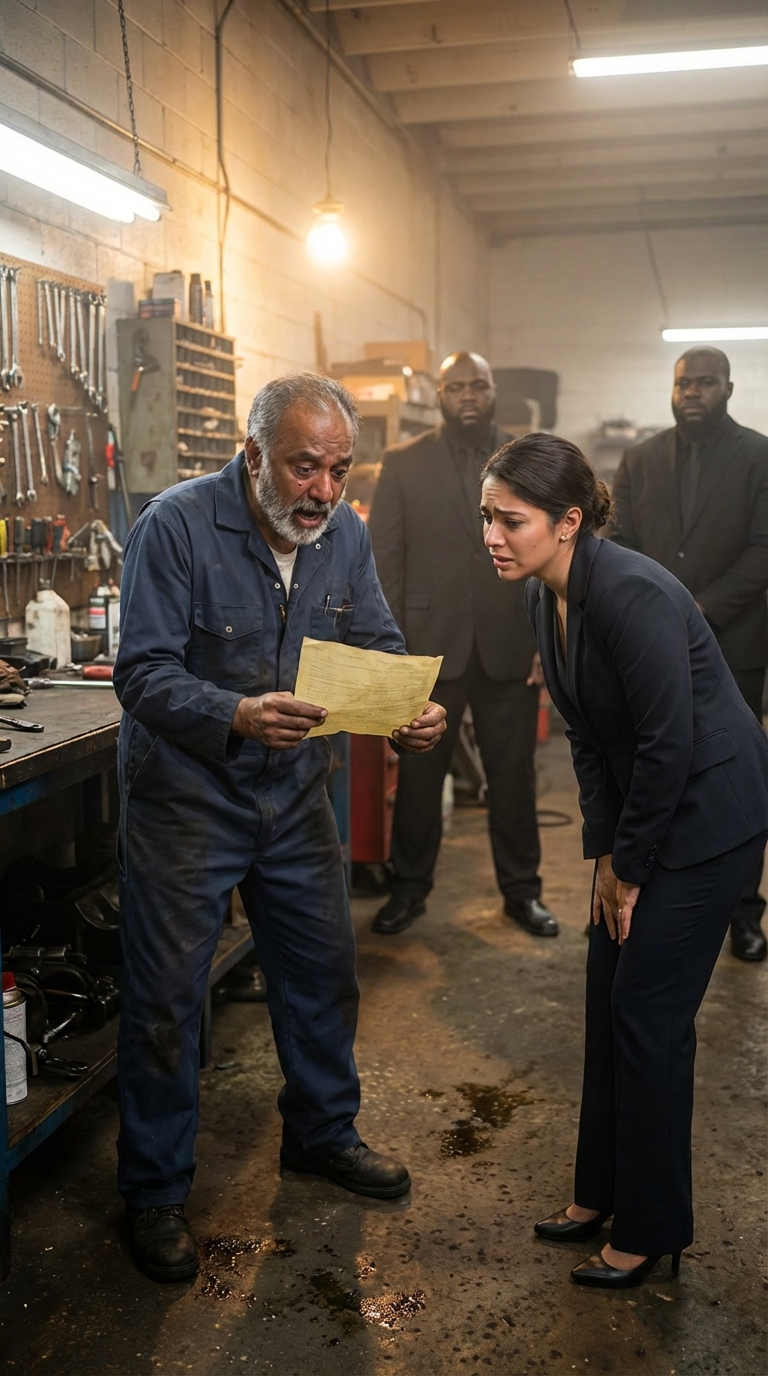
She was diagnosed with pancreatic cancer in 2012. We fought it with everything we had. I drained the savings. I mortgaged the shop. I sold my father’s vintage tools. But cancer doesn’t care about love or mortgages. She died on a Tuesday morning, holding my hand, leaving me with a silence in the house that was louder than any storm.
By December 2015, I was a hollow shell. The medical bills were a mountain I couldn’t climb. The bank finally lost patience. Foreclosure papers were taped to the door—a public scarlet letter of my failure.
Automax Supreme swooped in like a vulture. They offered to buy the property for pennies on the dollar, just enough to clear the debt, intending to bulldoze my father’s legacy to build an overflow parking lot. I had signed the Letter of Intent. It was over.
On my final afternoon—December 18th, 4:47 p.m.—I stood alone in the center of the garage. The bays were empty. The air smelled of stale oil and defeat. My son, Michael, had moved to Phoenix years ago to escape the slow decay of this town. I was alone.
Thirteen minutes. That’s all I had left as the owner of Patel Auto Service. Thirteen minutes until the keys were handed over to the bank rep.
I looked at the workbench where I used to eat lunch with Helen. I looked at the spot where I had fixed the Thornfield’s Buick. I felt a sob rising in my throat, a hot, jagged thing I couldn’t swallow.
“I’m sorry, Pop,” I whispered to the ghosts. “I tried.”
That’s when the bay sensors chimed. Ding-ding.
I wiped my eyes with a rag, expecting the bank lawyers to be early. I turned around, ready to surrender.
But it wasn’t a lawyer.
Three people stood in the doorway, silhouetted against the gray winter light. They wore coats that cost more than my car. In the lead was a young woman, elegant and sharp, her eyes scanning the grime of the shop with an intensity that unsettled me.
“Mr. Patel?” she asked. Her voice wasn’t corporate; it was trembling. “Joshua Patel?”
“That’s me,” I said, my voice raspy. “If you’re here from Automax, you’re early.”
She stepped forward, her heels clicking on the oil-stained concrete. She reached into her designer bag, my heart hammering a rhythm of dread against my ribs. But she didn’t pull out a lawsuit.
She pulled out a piece of paper. It was yellowed, fragile, and creased a thousand times. She smoothed it out on my workbench.
It was an invoice. Dated February 13, 1992.
Customer: Nathaniel Thornfield.
Total: $0.00
Note: Paid in Full.
I stopped breathing. The room spun.
“My name is Lily Thornfield Morrison,” she said, her eyes locking onto mine—those same walnut eyes from decades ago. “I was six years old the night you saved us.”
Cliffhanger: I stared at her, paralyzed by the sudden collision of past and present, but before I could ask why she was here, she spoke words that would shatter my reality completely: “Mr. Patel, we aren’t here to catch up. We are here to execute a will.”
Chapter 3: The Ghost in the Machine
I sank onto a stool, my knees suddenly made of water. Behind Lily stood two men—a lawyer clutching a briefcase like a shield, and a younger man who bore a striking resemblance to Nathaniel.
“A will?” I managed to choke out. “Is… are your parents…”
“They passed away in 2010,” Lily said softly, grief flitting across her face. “A drunk driver. They died instantly.”
My heart ached for them. To have all that life, all that potential, snuffed out. “I’m so sorry,” I whispered. “They were good people.”
“They never forgot you,” the brother, James, said. He stepped forward, holding a tablet. “Dad kept a journal. He wrote about you constantly. He called you ‘The Anchor.’ He said that night, when he was failing at his own business and terrified for his family, your kindness was the only thing that kept him from giving up.”
James tapped the screen and held it up. It was a scanned image of handwriting.
Feb 14, 1992: The mechanic didn’t ask for a dime. He barely had heat in his own shop, yet he gave us his dinner. If I ever make it—if this sensor patent works—I swear I will find Joshua Patel. I will not just pay him back. I will restore him, as he restored my faith.
“The patent worked,” Lily said, her voice gaining strength. “Dad developed an automotive safety sensor. It’s in almost every car on the road today. He sold the company for fifteen million dollars just before they died.”
Fifteen million. The number hung in the dusty air like a impossible dream.
“But here is the thing, Mr. Patel,” the lawyer interjected, opening his briefcase on the oily workbench. “The will was very specific. Nathaniel created a ‘Gratitude Trust.’ We were instructed to monitor you. Not to interfere, but to watch.”
“Watch me?” I felt a flush of embarrassment. “Watch me fail?”
“No,” Lily said fiercely. “To wait for the moment you needed us most. Dad wrote: ‘A man like Joshua won’t accept help when he’s standing. Help him only when he’s on his knees.’“
She gestured to the foreclosure notice on the floor, where I had ripped it down in anger earlier. “When that notice hit the county records three days ago, the trust activated.”
The lawyer pulled out a check. A cashier’s check.