
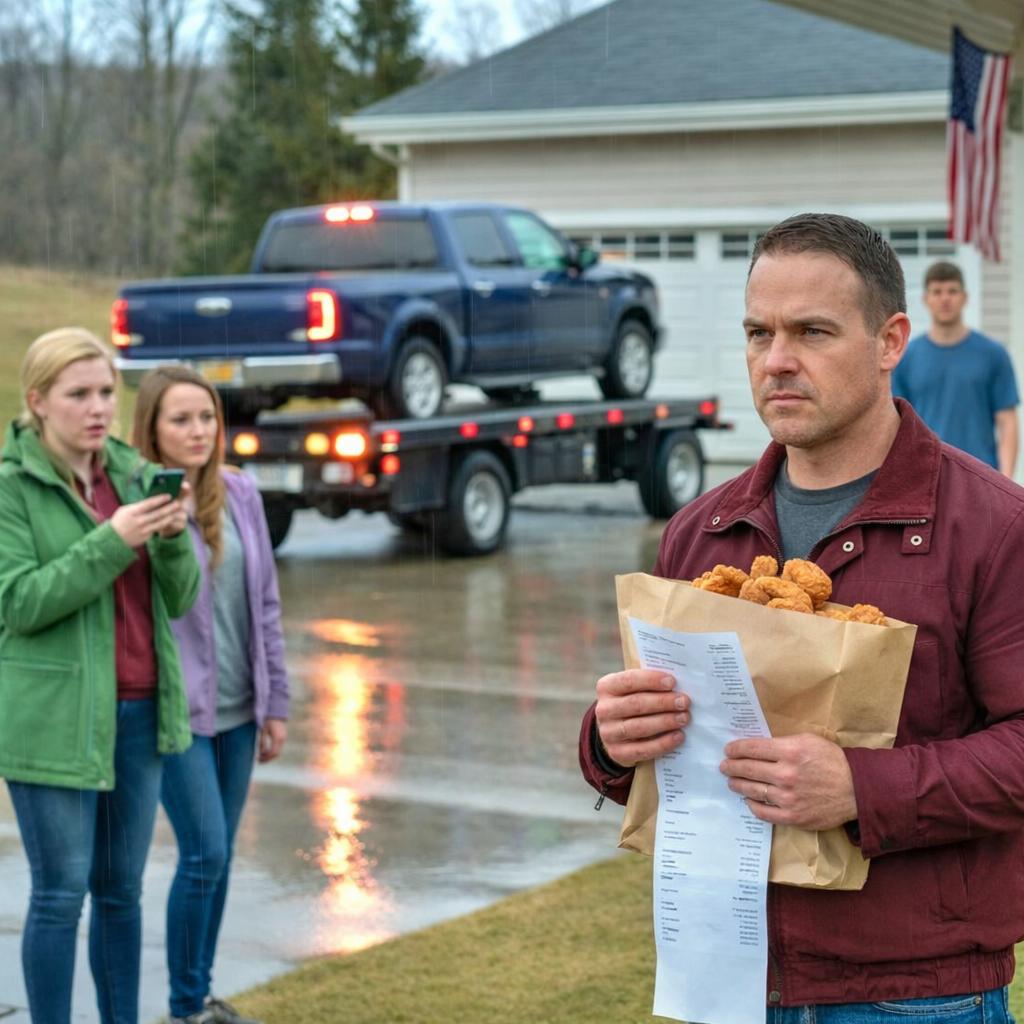
The bag of fried chicken from Ingles was still warm in my hand when I heard my stepson’s voice in the garage.
Not raised. Not angry. Casual.
“Yeah. I already cut the brake line.”
I stopped moving so abruptly my shoulder twinged. The paper bag crinkled softly, an obscene sound in the sudden stillness, and I tightened my grip until the grease soaked through and burned my palm.
For a second, my brain refused to process the words. They floated there, detached from meaning, like a sentence overheard in a dream. Cut the brake line. Those words belonged in crime shows, in news stories you shook your head at, not in my garage on Kuga Road with my truck parked ten feet away.
I leaned closer to the side door without touching it. Through the narrow crack where the frame didn’t quite seal, I saw the blue glow of a phone screen light up Trevor’s face. He stood near my workbench, shoulders loose, one foot hooked casually around the leg of an old stool. He looked comfortable. Relaxed. Like a man finishing a chore.
“Tomorrow,” he continued, voice steady. “He won’t make it to Monday.”
Then he laughed.
It wasn’t loud. It wasn’t manic. It was a small, amused exhale, the sound someone makes when a plan comes together. That sound slid straight down my spine and settled cold in my gut.
I waited for my body to react the way it should have. To shout. To run. To burst into the garage demanding an explanation. Instead, I stood there frozen, heart hammering so hard it felt like it might knock me forward through the door.
The garage smelled exactly the way it always had. Motor oil. Concrete dust. Cold December air seeping in through the cracks. Familiar smells that suddenly felt hostile, like witnesses that wouldn’t help me.
“You sure about this?” another voice crackled through the phone.
Deborah.
My wife.
Her voice was faint, distorted by the speaker, but unmistakable. She didn’t sound shocked. She didn’t sound horrified. She sounded… cautious. Like someone double-checking a reservation.
“Yeah,” Trevor said. “It’s done.”
I leaned my forehead against the siding and closed my eyes for half a second, willing myself not to make a sound.
“He won’t make it to Monday,” Trevor repeated, and there was satisfaction in his voice now.
I waited for Deborah to say my name. To say stop. To say what are you talking about? Anything that sounded like a conscience clawing its way to the surface.
Instead, she exhaled.
It wasn’t relief exactly. But it was close.
“Tomorrow,” she said. “Just be careful.”
Something inside my chest cracked.
My boot scuffed the concrete, barely a whisper of sound, but Trevor’s head snapped toward the door immediately. His body went rigid, every muscle alert.
I didn’t breathe.
For a long second, I thought he’d open the door and find me standing there with a bag of fried chicken and a face full of terror. I imagined trying to explain it away. Dropped my keys. Thought I heard something. Imagined the lie unraveling before I even had time to think.
But after a beat, Trevor relaxed. He turned back to the phone.
“Yeah. I’ll text you when it’s done.”
I backed away slowly, carefully, like I was stepping off a landmine. I eased the door shut until it rested without clicking, then moved fast around the side of the house, my heart pounding so loudly I was sure someone could hear it.
The neighborhood looked normal. Too normal.
Porch lights glowed softly up and down the street. Christmas wreaths already hung on doors, red bows bright against white siding. Mrs. Wallace’s dog barked once, then went quiet. Hendersonville doing what it always did, pretending danger only happened somewhere else.
My hands were shaking so badly I almost dropped my keys.
I walked down the sidewalk instead of straight to my car, forcing myself to slow my pace, to look like a man out for air instead of someone who’d just overheard his own murder being scheduled.
“Patience is my tool,” I whispered under my breath.
I’d said that line a thousand times over the years. Said it to apprentices when they rushed a job and stripped a screw. Said it when a system wouldn’t cooperate and frustration crept in. Slow down. Think. Don’t force it.
Now I needed it more than ever.
I got into my sedan and shut the door quietly. The engine stayed off. My breath fogged the windshield, each exhale shaky and uneven. My phone felt slick in my hand, my thumb hovering uselessly over the screen.
Call the police.
The thought came hard and fast, followed immediately by the next one.
What do I say?
Hello, officer, my stepson said he cut my brake line. No, I don’t have a recording. No, nothing has happened yet. No, I’m not injured. In a small town like this, that doesn’t end with sirens and handcuffs. It ends with sideways looks. With whispers. With people deciding you’re unstable.
Trevor would smile and say I’d been stressed lately. Forgetful. Paranoid.
Deborah would dab her eyes and say she was worried about me.
I couldn’t let that happen.
So instead, I opened my roadside assistance app and requested a tow.
The dispatcher sounded half asleep. “Pickup location?”
“My driveway,” I said, forcing my voice steady. “Silver Ford F-150. I need it towed tonight.”
“Is it drivable?”
“No,” I said. “Safety issue.”
“How soon do you need it?”
“As soon as possible.”
There was a pause. “Okay.”
“Please,” I added before hanging up, because even now, manners were muscle memory.
I sat there listening to the quiet tick of my cooling engine, my hands still trembling, my mind already shifting into something colder and sharper. Evidence. Timelines. Moves that keep you alive.
Trevor had asked me to co-sign a loan a few months back. Twenty-eight thousand five hundred dollars for “debt consolidation.” I’d looked at the paperwork and said no, explaining calmly what I’d learned about debt over a lifetime of fixing other people’s messes.
He’d smiled then. A slow, empty smile.
“You always think you’re better than me,” he’d said.
That was when the house changed. Subtle at first. Deborah stopped talking when I walked into rooms. Meals went quiet. Peace became my responsibility alone.
Now I understood what letting it go meant to them.
Headlights swept down the street. The tow truck rumbled to a stop in front of my house, chains clinking softly in the cold. The driver was a thick-set man in a beanie, breath puffing white as he climbed down.
“You the one who called?” he asked, knocking on my window.
“Yes.”
He glanced at the truck. “What’s wrong with it?”
I swallowed. “Brake problem. Taking it to a friend’s place to get checked.”
“At this hour?” he asked, eyebrow lifting.
“I’m up,” I said. “He’s up. It’s important.”
He shrugged, the universal gesture of a man who’s seen everything and wants to see nothing more, and got to work. The winch whined. The cable rattled like chains. My truck rolled onto the flatbed, obedient and helpless.
That truck had been mine long before Deborah and I ever shared a bank account. I’d driven it through snowstorms and bad years and good ones. Watching it disappear down the street felt like losing the last piece of the life I thought I had.
The driver handed me a clipboard. “Sign here.”
My pen shook, but I forced my hand steady. He studied my face.
“You alright, man?”
“I’m fine,” I said. “Just tired.”
As the truck pulled away, my phone buzzed.
Deborah: Where are you?
Trevor: Did you move the truck?
I didn’t answer.
Not yet.
Instead, I drove.
Thirty minutes through dark mountain roads to Asheville, my headlights cutting through curves I’d driven a hundred times before. Eugene Carter’s house sat quiet at the end of a gravel drive, porch light flicking on as I pulled in.
Eugene came out in flannel and sweatpants, gray hair flattened from sleep.
“Thomas?” he said.
I killed the engine. “Eugene, I need your help.”
He looked at my face, then nodded once. “Bring it here.”
Inside, the house smelled like black coffee and old leather. I told him what I’d heard. He didn’t interrupt. Didn’t argue. Just listened, jaw tightening.