

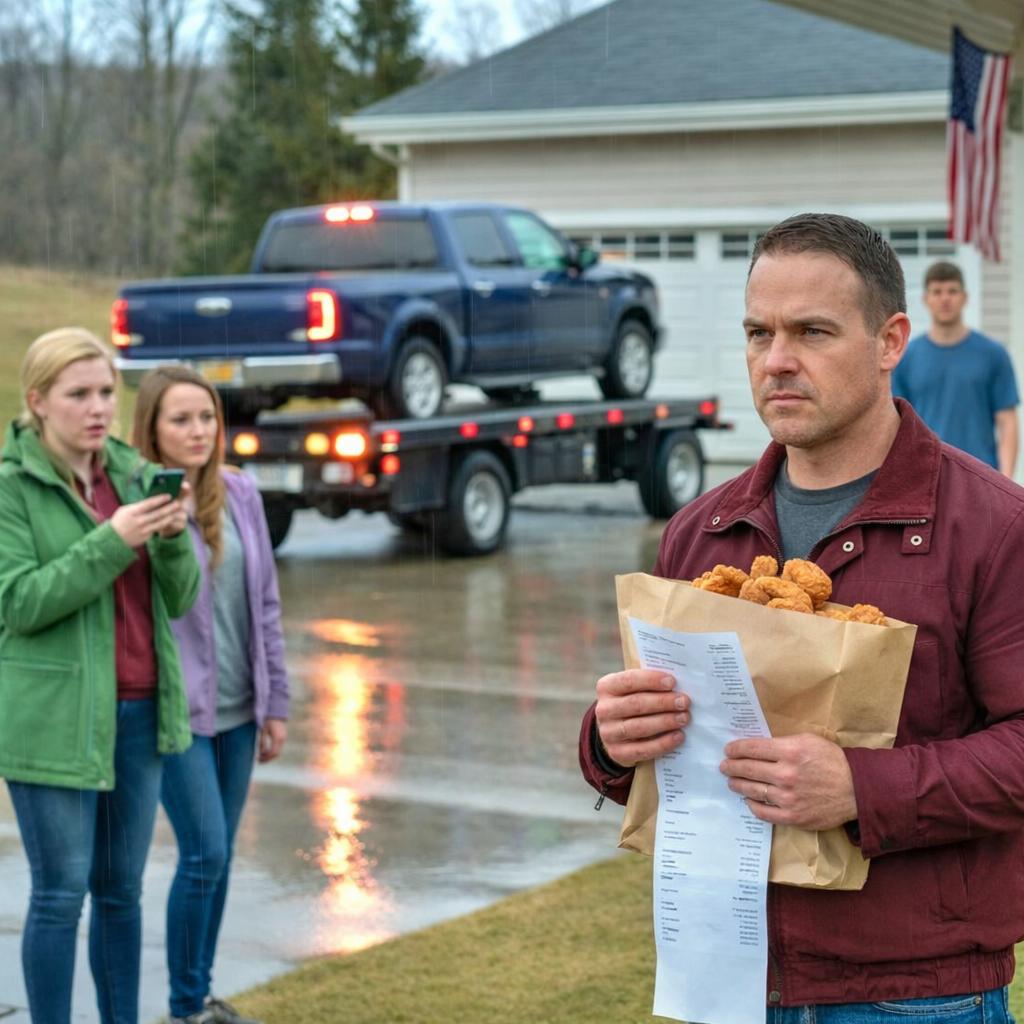
“You accusing Trevor?” he asked carefully.
“I’m saying I’m not driving that truck,” I replied. “And I want it checked by someone I trust.”
Eugene stood. “I’ll look. But if this is what you think it is, I’m putting it on stands.”
When the tow truck arrived, Eugene slid under the truck with a flashlight. I stood in the doorway, heart pounding, watching his boots stick out from beneath the chassis.
“Thomas,” he called. “Come look.”
I crouched beside him. The brake line was cleanly severed. Straight cut. No corrosion. No fraying.
“That’s deliberate,” Eugene said quietly. “That’s someone trying to kill you.”
The words landed heavy and final.
I didn’t cry. I didn’t shout. I just sat down hard on a stool and stared at the floor.
“You okay?” Eugene asked.
“I don’t feel like I won,” I said.
He shook his head. “You didn’t. You survived.”
And that, I realized, was going to have to be enough.
I didn’t sleep that night.
I lay on Eugene’s couch staring at the ceiling fan as it chopped the dark into slow, rhythmic pieces. Every creak of the house sounded like a footstep. Every passing car outside made my pulse jump. When I closed my eyes, I saw the brake line again. Clean. Straight. Deliberate.
At around four in the morning, Eugene came out with two mugs of coffee. He set one on the side table without asking.
“You did the right thing,” he said quietly, lowering himself into the armchair across from me.
“I keep replaying it,” I admitted. “Every little thing I missed. Every moment I explained away.”
Eugene nodded. “That’s what people do when the ground falls out from under them. Doesn’t mean you’re stupid. Means you trusted your family.”
That word felt strange now. Family.
By sunrise, Eugene had the truck up on stands, the cut line tagged and photographed from three angles. He didn’t touch anything more than he had to. He called the sheriff’s office himself and reported suspected sabotage. When the deputies arrived, he spoke calmly, like a man who knew how to keep his emotions from muddying facts.
I watched from the doorway as they took notes, snapped pictures, asked Eugene questions about when he’d last seen Trevor.
“Two nights ago,” Eugene said. “He stopped by to borrow a socket set. Seemed fine.”
Seemed fine. That was the problem. Trevor always seemed fine.
When the deputies left, Eugene locked the garage and handed me a spare key.
“You’re staying here,” he said. Not a suggestion.
I didn’t argue.
By midmorning, my phone started buzzing in earnest. Calls from Deborah. Messages from Trevor. Missed calls stacking like bricks. I let them pile up untouched.
Then Deborah switched tactics.
Her first voicemail was soft, almost sweet.
“Thomas, honey, where did you go? You scared me last night. We need to talk.”
The second was sharper.
“You can’t just disappear. This is your home too.”
The third dropped the mask completely.
“If you’re trying to frame my son for something, you’re making a huge mistake.”
I forwarded every message to Elizabeth Garrett without responding. Elizabeth replied with one line.
Do not engage. Let them talk.
That afternoon, Detective Warren called to confirm what Eugene already knew. The cut was consistent with a tubing cutter. Not road debris. Not corrosion. Not an accident.
“Do you feel safe returning home?” he asked.
“No,” I said simply.
“Good. Then don’t.”
By evening, Hendersonville had decided who the villain was.
Deborah’s Facebook post went up just after dinner. Long. Emotional. Carefully worded. She didn’t accuse me directly of anything concrete. She didn’t need to. She let implication do the work.
Please pray for my family. Thomas left last night in a fit of anger. My son is being accused of something unthinkable. Lies can destroy a family faster than any accident.
Within minutes, the comments poured in.
Praying for you.
So sorry you’re dealing with this.
Some men can’t handle losing control.
Eugene showed me the post without comment. I stared at the screen until my hands went numb.
In a town this size, truth didn’t spread fastest. Stories did.
The next day, I went back to the house with a deputy to collect clothes and personal documents. Deborah agreed to stay elsewhere during the visit. Walking through the front door felt like stepping into a stranger’s life.
The air still smelled like her lavender candles. My boots were still by the door where I’d left them. The house looked exactly the same, which somehow made it worse.
I packed methodically. Clothes. Paperwork. Old photos I couldn’t bring myself to leave behind. That was when I noticed the nightstand drawer didn’t sit right.
It was subtle. Something you’d only notice if you’d opened it a thousand times.
I pulled it all the way out and reached into the cavity beneath.
My fingers brushed plastic.
A phone.
Cheap. Lightweight. Prepaid.
I pressed the power button. The screen lit up immediately. No password. Two apps. Messages and Calls.
The message thread with “G” went back months.
I sat on the edge of the bed and read until my chest felt hollow.
I can’t wait to start our life together.
It won’t be a divorce. Just be patient.
The house will be mine. Plus the retirement account.
It’ll be handled soon.
Handled.
The timestamp on the last message made my skin crawl. Two days before the night in the garage.
I called the deputy back into the room and handed him the phone. He didn’t ask questions. He bagged it.
That night, Detective Warren called again. His voice had changed. Less cautious. More certain.
“We’re expanding the investigation,” he said. “Stay where you are.”
The final piece fell into place the next day.
I was sorting through the garage with Elizabeth present, documenting tools and inventory, when I noticed a small red light blinking near the ceiling. One of the security cameras I’d installed after a neighbor’s shed was broken into months earlier.
I’d forgotten about it.
The app was still on my phone.
My hands shook as I opened it and scrolled back to the night in question.
11:47 p.m.
The video loaded.
Trevor entered the garage first, looking over his shoulder. Then Deborah followed, arms crossed.
“You sure about this, Mom?” Trevor asked.
Deborah stepped closer. Calm. Focused.
“Make it clean,” she said. “No fraying. It has to look like normal wear.”
I heard the snip of the cutter. Clear as day.
“When’s he driving it next?” she asked.
“Tomorrow,” Trevor replied.
“The sooner this is over, the better,” Deborah said.
Three minutes and forty-seven seconds.
Elizabeth watched the video once, then again.
“This is attempted murder,” she said flatly.
When the arrest came, it was fast.
Trevor first. Then Deborah.
I didn’t feel relief. I felt empty.
In the weeks that followed, I stayed in a cheap motel off I-26, then moved into a small apartment overlooking the French Broad River. Quiet. Locked. Mine.
I went to therapy because my blood pressure demanded it and because I needed somewhere safe to put the thoughts that kept looping in my head.
I learned that survival doesn’t feel heroic. It feels shaky. It feels like grief mixed with gratitude.
One year later, I stood on my balcony drinking coffee and watching the river move steadily past. My phone buzzed once.
Unknown number.
You destroyed everything.
I deleted the message without replying.
Some conversations end when you choose silence.
And for the first time since that night in the garage, I breathed without fear.
The trial wasn’t as dramatic as the night in the garage.
It didn’t have that electric, cinematic shock of hearing your own death described like a chore. It didn’t have the sudden clarity of a flashlight beam on a severed brake line. It didn’t even have the wild, church-lady energy of Hendersonville gossip.
The trial was slow.
Methodical.
It was the law doing what it does best when it’s done correctly, which is to take something chaotic and brutal and strip it down to facts that can’t be argued with. Dates. Photographs. Chain of custody. Audio. Intent.
Elizabeth warned me in the beginning that it would feel unreal.
“You’re going to walk into a courtroom and hear people talk about your life like it’s a file,” she said. “You’ll want to stand up and shout, but that’s not how this works. The truth will speak if you let it.”
I sat in the back row for most of it. Not because I was afraid, but because sitting close felt like standing too near an open flame. I had to watch without burning.
Deborah entered each morning in the same navy blazer, hair smooth, face composed. She wore her silver cross necklace like a statement. She wanted the jury to see a woman of faith, a grieving wife, a mother defending her son. She wanted that story to land before the evidence did.