

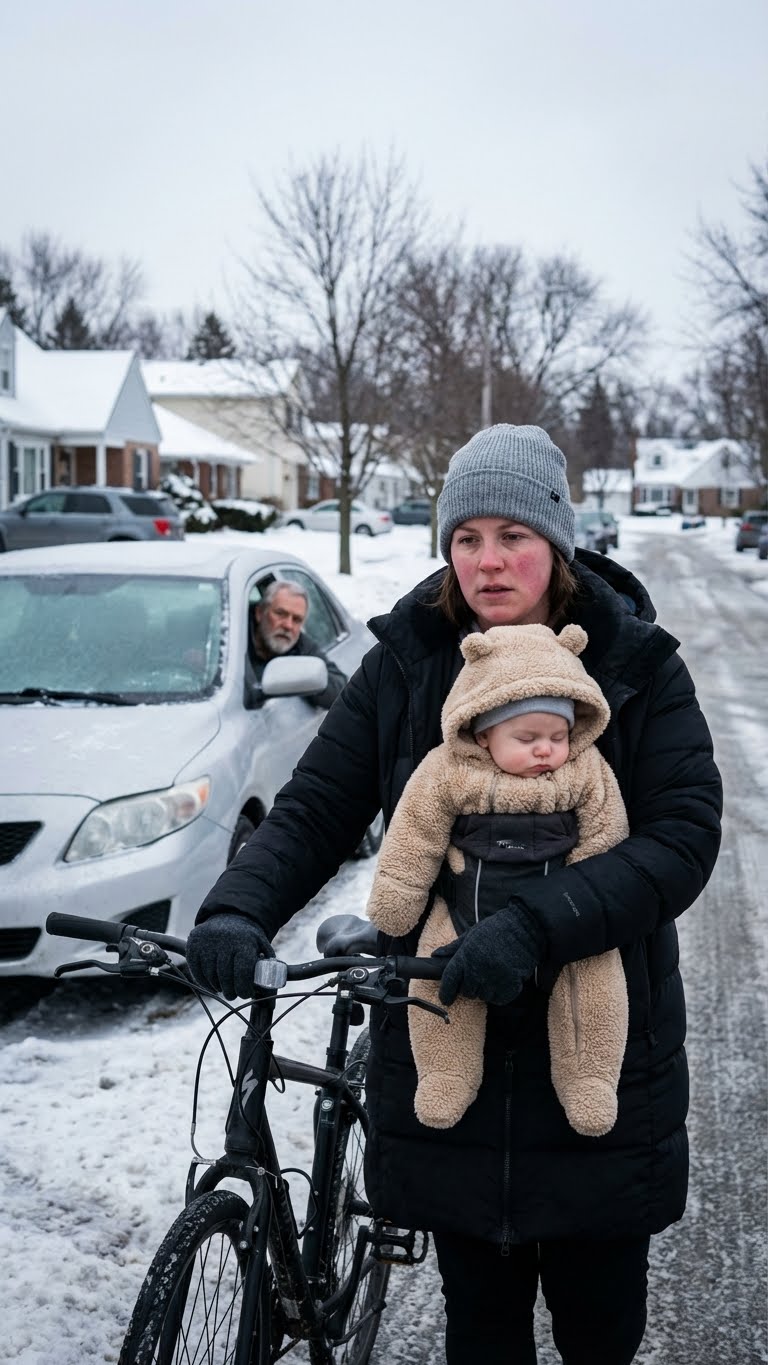
My legs felt disconnected from my body as I climbed into the sedan with Ethan pressed close. Warm air wrapped around me, smelling faintly of leather and some expensive cologne I couldn’t name. Ethan made a soft sound and relaxed against my chest. The bicycle was left behind in the snow. Something about that—leaving it there like a discarded version of myself—made my eyes burn.
Grandpa Victor didn’t ask anything right away. He stared out the window as we pulled away from the curb, jaw tight, hands folded as if he was holding something back. The silence was worse than interrogation. It gave my mind room to spiral.
If he went to my parents’ house, they’d spin a story. They always did. They’d tell him I was unstable. Postpartum. Overreacting. Grateful but “confused.” They’d say I misunderstood. That they were “helping.” They were very good at sounding reasonable. They were even better at making me sound irrational.
Finally, Grandpa Victor spoke without looking at me. “Olivia,” he said, voice low. “This isn’t just about the Mercedes, is it?”
I froze. Ethan’s warmth against me anchored me in place, but fear still climbed my spine. If I told the truth, my parents could retaliate. They could call Ryan overseas. They could tell him I was unsafe. They could threaten custody. They’d already hinted at it whenever I pushed back.
But Grandpa Victor’s eyes—when he finally turned them toward me—didn’t feel like judgment. They felt like a spotlight.
And Ethan—this tiny person breathing steadily against my heart—made the decision for me. This child’s future could not be ruled by that house.
I took a breath. “Grandpa,” I said, and my voice surprised me with how steady it was. “This isn’t a family issue. It’s a crime.”
His eyes sharpened, like he’d been waiting for exactly that sentence. I didn’t cry. I didn’t dramatize. I did what I’d learned to do in survival mode: I gave facts.
The Mercedes—given to me for my marriage and Ethan’s birth—kept “for safekeeping.” The keys held by my mother. The car “assigned” to Mary so it wouldn’t “go to waste.” My mail redirected or “sorted” without my consent. Bank alerts mysteriously turned off. My debit card “managed” because I was “recovering” and “exhausted.”
And the withdrawals. Large ones. Too large. My mother had told me it was for groceries, diapers, household expenses. But the numbers didn’t match. And I’d been too sleep-deprived, too isolated, too ashamed to confront it.
As I spoke, my voice got stronger. Each detail made the situation feel less like a fog and more like a pattern. Grandpa Victor listened without interrupting.
When I finished, he said one thing to the driver. “Head to the police station.”
The words hit me like a slap. My panic flared. “Grandpa—wait. Please.”
He turned, calm and terrifying. “What.”
“I—” My throat tightened. “They’re my parents. If we do this… they’ll—Ryan… Ethan…”
He reached over and closed his hand around mine—firm, grounding. “Olivia,” he said, voice like stone. “They are using the word family as a shield while stealing the future of you and Ethan.”
I blinked hard.
“This is no longer a family matter,” he continued. “As you said—this is a crime.” Then, softer—still firm, but human: “And from this moment on, you and Ethan are under my protection.”
Something inside me cracked open. Not weakness. Relief. The kind that makes you realize how long you’ve been holding your breath. I nodded once.
“Okay,” I whispered. “Let’s go.”
The police station was fluorescent-lit and smelled like old coffee and winter coats. Before we even walked in, Grandpa Victor made a call in the car, voice clipped and precise. When he hung up, he looked at me. “I just spoke to your lawyer,” he said. “He’ll meet us here.” My lawyer. I almost laughed at how surreal it sounded.
We were brought into a private room where a female officer met us—mid-forties, hair in a tight bun, eyes tired in the way only people who’ve seen a thousand lies can be tired. At first, she had that procedural look. The domestic dispute, family drama look.
“So,” she said, pen poised. “Tell me what happened.”
My voice trembled at the beginning. Accusing my parents felt like stepping off a cliff. But Ethan shifted in my arms, and the weight of him—warm, real—kept me talking. As I moved from the Mercedes to the money, the officer’s expression changed. The pen moved faster. The questions got sharper.
“Did they give you an explanation for the withdrawals?”
“‘Household expenses,’” my mouth tasted bitter. “But I was told there wasn’t enough for my own needs.”
“And do you recall signing any power of attorney?”
“No,” I said. “Never.”
Grandpa Victor, who had been silent, spoke. “Officer,” he said calmly, “I gifted my granddaughter a trust of one hundred fifty thousand dollars. For her and her child’s future. Documents should have been delivered directly to her.”
The officer’s pen paused.
Grandpa Victor turned to me, eyes narrowing. “Olivia—did you receive those documents?”
My blood went cold. I shook my head slowly. “No,” I whispered. “I didn’t even know it existed.”
The room changed. It wasn’t subtle. The officer’s posture straightened. Her eyes sharpened with something like anger. This was no longer “parents helping their daughter.” This was concealment. Exploitation. Theft with planning.
“We’re opening an investigation for theft, fraud, and—based on your descriptions—coercive control,” she said, her voice now firm. The phrase landed like validation I didn’t know I needed. Coercive control. A name for the thing that had been choking me for months.
As we left the station, the sky bruised purple, I realized we were heading not towards my parents’ house, but toward my grandfather’s estate. For the first time in a year, my body began to unclench. Inside, a room was already prepared with a crib. Problems in Grandpa Victor’s world didn’t linger; they were solved.