

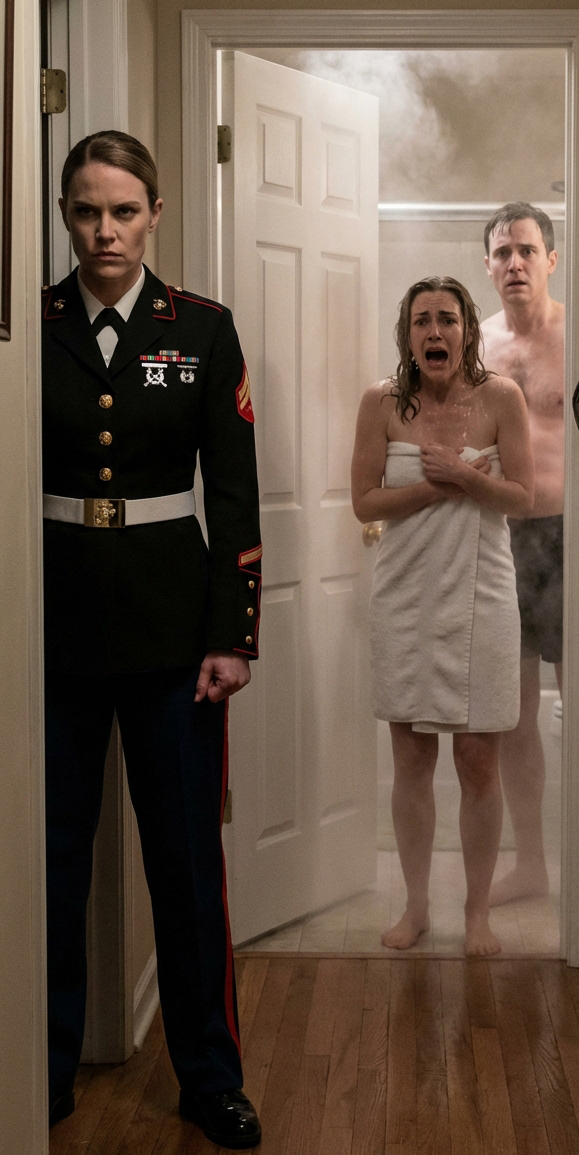
Elena scrambled up, clutching her clothes to her chest. “David! David, wait!”
She ran past me, smelling of fear and sweat, and bolted down the hall. I heard her stumbling, shouting his name into the night air.
Then, there was silence. Just the drip, drip, drip of the faucet Mark had left running.
Mark sank onto the edge of the bathtub, burying his face in his hands. His shoulders shook. He looked small. He looked pathetic. I tried to find the love I had felt for him on the plane ride over. I searched my heart for it, digging through the wreckage, but there was nothing. It had been incinerated.
“Sarah,” he mumbled into his hands. “I can fix this. We can fix this. Counseling. I’ll do anything.”
“Stand up,” I commanded.
He looked up, startled by the tone. It was the voice I used for junior Marines who had failed a direct order.
“Sarah…”
“Stand up!” I barked.
He stood, clutching his towel.
“I am going to make this very simple for you,” I said, my voice steady. “I am going to a hotel tonight. I am going to report back to base in the morning to process my leave paperwork. I will be back here on Monday at 0800 hours.”
I leaned in, my face inches from his.
“When I walk through that door on Monday, I want you gone. I want your clothes gone. I want your books gone. I want every trace of you scrubbed from this house. If I find so much as a sock, Mark, I will burn it on the front lawn.”
“You can’t do this,” he pleaded. “This is my house too. We’ve been married ten years!”
“You voided that contract,” I said. “You didn’t just cheat on your wife, Mark. You betrayed a Marine who was deployed. You know how the community looks at that. You know what happens to men who do that.”
His face paled. He knew. In our town, in our circle, he was socially dead.
“I’m not throwing our marriage away,” I said, looking at the ring on my finger. I pulled it off. It felt heavy. I dropped it into the sink, right next to his toothbrush. “I’m discarding a compromised asset.”
I turned around and walked out of the bathroom. I didn’t look back.
I walked to the kitchen, grabbed my duffel bag, and walked out the front door.
The night air was cool. Down the street, I could see David sitting on his front porch steps. Elena was nowhere to be seen—locked out, or perhaps chasing her own shadow. David was just sitting there, head in his hands, staring at the asphalt.
I paused at my car. I wanted to go to him, to offer comfort. But we were both open wounds right now. Anything we said would just be bleeding on each other.
I got in my car, started the engine, and drove away. I didn’t cry until I hit the highway on-ramp. And even then, they weren’t tears of sadness. They were tears of rage.
Chapter Five: Scorched Earth
The next month was a blur of administrative violence.
I approached the divorce the way I approached a logistics operation. I hired the most aggressive lawyer in Virginia. I froze the joint accounts before Mark had finished packing his bags. I changed the locks, the passwords, and the garage codes.
Mark tried to reach out. He sent long, rambling emails about “demons” and “loneliness.” He tried to gaslight me, saying I was cold, that my dedication to the Corps had driven him to it.
I forwarded every email to my lawyer without reading past the first line.
I heard through the grapevine what happened to them. Small towns are like echo chambers; nothing stays secret.
David had filed for divorce the morning after the incident. He was swift and absolute. He didn’t scream, he didn’t fight. He just erased Elena from his life. She had moved in with her sister two states away, apparently telling people that her husband was “emotionally unavailable.”
Mark was living in a depressing studio apartment near the airport. He had lost most of our mutual friends. When you cheat on a deployed soldier, you don’t just lose a spouse; you lose the tribe.
One Saturday afternoon, six weeks later, I was in the garage, boxing up the last of Mark’s tools to donate to Goodwill. I was sweating, angry, and listening to loud rock music.
I saw a shadow fall across the driveway.
I turned, a tire iron in my hand—old habits die hard.
It was David.
He looked different. He had lost weight. His hair was a little longer, and he had a beard coming in. He didn’t look like the soft, cookie-baking teacher anymore. He looked harder.
He was holding a Tupperware container.
“I come in peace,” he said, raising a hand, eyeing the tire iron.
I lowered my arm and let out a breath. “Sorry. Reflex.”
“I heard you were shipping out,” he said, walking up the driveway. “San Diego?”
“Camp Pendleton,” I corrected. “Promotion. And a change of scenery.”
“Good for you,” he nodded. He held out the container. “I made these. Oatmeal raisin. I know they’re your favorite. I didn’t want you to leave without… well, without knowing that someone here still gives a damn.”
I took the container. The plastic was still warm.