

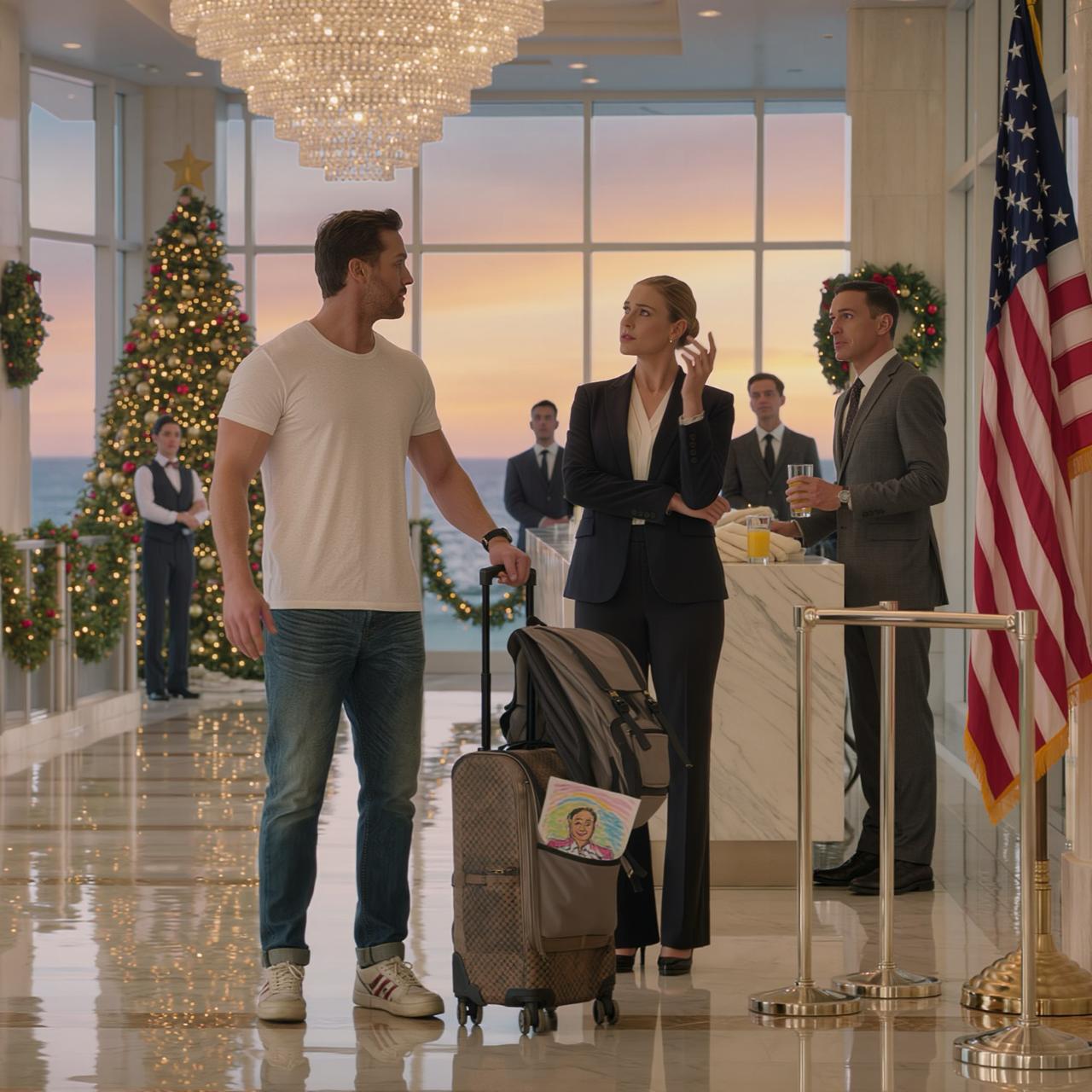
He forced his voice to stay calm. “Hi. I have a reservation under Carter. I’d like to check in.”
The receptionist’s expression remained neutral, but his eyes did a quick scan from Noah’s face to his clothes and back, like he was reading a label. His fingers moved slowly over the keyboard. Slower than they needed to.
He clicked, stared at the screen as if it were reluctant to cooperate, then finally spoke in a flat voice. “Check-in is at three. You’ll need to wait about two more hours.”
Noah blinked. The answer wasn’t the problem. Policies existed. Schedules existed. He understood that.
The way it was delivered was the problem. The lack of apology. The lack of effort to soften the inconvenience.
He kept his tone polite. “I understand. I just drove three hours. Is there any chance the room is ready early? Even a little early would help.”
The receptionist didn’t even pretend to consider. “No, sir. Policy is policy. You’ll need to wait.”
Noah swallowed the response rising in him. He was tired. The kind of tired that made the smallest slight feel heavier.
He nodded once. “Is there a lounge area I can sit in? Somewhere to rest?”
Before the receptionist could answer, the automatic doors behind Noah opened with a soft whoosh.
The sound that followed was different from Noah’s squeaky suitcase. Smooth wheels. Expensive wheels. The quiet glide of luggage that had never known a cracked sidewalk.
Noah turned slightly.
A man in his fifties walked in wearing a tailored gray suit, the kind that hung perfectly at the shoulders. His shoes were polished to a mirror shine. A designer briefcase swung casually from his hand like it weighed nothing. He carried himself with the ease of someone who never wondered whether he belonged.
And the lobby changed around him.
The bellman straightened as if pulled by a string. His phone vanished into his pocket. He pushed off the luggage cart and approached with a bright smile, voice suddenly warm.
“Good afternoon, sir. Welcome back to Silver Harbor. May I take your luggage?”
The suited man handed over the briefcase without breaking stride. The bellman accepted it with two hands, like it was something fragile.
Behind the desk, the receptionist’s face softened into something nearly cheerful. “Mr. Wittman, welcome. We’ll have you checked in right away.”
A staff member appeared at Mr. Wittman’s side as if summoned by air, holding a small tray with a folded warm towel and a glass of fresh orange juice. The scent of citrus drifted faintly across the lobby.
Noah stood there, suitcase handle in his hand, and watched the choreography unfold.
It wasn’t subtle. It wasn’t even complicated. It was the simplest equation in the world.
Money in. Smiles out.
Noah felt a tightness behind his ribs. Not rage yet. Something quieter. A heavy disappointment that settled like a stone.
He turned back to the receptionist.
“Excuse me.”
The receptionist looked over, already half turned toward Mr. Wittman’s file on the screen. “Yes?”
Noah kept his voice even. “He just walked in. You’re checking him in immediately. But you told me I have to wait two hours. Can you explain why?”
The receptionist hesitated. For the first time, a crack appeared in his composure. His fingers stopped moving. He glanced toward Mr. Wittman, then back to Noah, eyes flickering with discomfort.
“Well,” he said, dragging out the word, “Mr. Wittman is a VIP member. Priority check-in privileges.”
Noah let the answer settle. He understood loyalty programs. He understood tiers and perks.
He also understood the way the staff had ignored him before he’d even spoken, the way their eyes had dismissed him based on nothing but fabric and scuffs.
He leaned forward slightly. “I made a reservation. I paid in full. I’m not asking for special treatment. I’m asking to be treated with the same basic respect.”
The receptionist shifted. He cleared his throat. “I don’t have authority to override policy, sir. If you’d like, I can call the manager.”
Noah held his gaze. “Yes. Please do.”
The receptionist picked up the phone. His voice dropped lower as he spoke, as if Noah weren’t standing there. He hung up and gestured vaguely toward the side of the lobby. “Someone will be with you shortly.”
Noah stepped back and waited.
He didn’t sit. He didn’t scroll his phone. He stood with his suitcase like a marker planted in the marble.
A corner of his son’s drawing peeked out from the side pocket of his backpack. Noah’s eyes caught it, and for a moment his mind slipped away from the lobby and into a kitchen table scattered with crayons, his son hunched over paper, tongue stuck out in concentration.
Noah felt the familiar tug of responsibility. The quiet vow he’d made when the world had shifted and left him holding the role of mother and father both.
How he handled moments like this mattered.
Footsteps clicked across the floor, sharp and purposeful. Noah turned.
A woman approached from behind the desk area, heels striking marble in a rhythm that sounded like impatience. She wore a tailored blazer, hair pulled into a tight bun, makeup perfectly controlled. Her expression was already set before she reached him, like she’d decided what he was before hearing him speak.
She stopped a few feet away and looked him over from head to toe. Her gaze lingered on his sneakers, on the worn suitcase, on the tired lines at the corners of his eyes.
“I’m Sophie Langford,” she said. Her voice was professional, but there was an edge beneath it. “Operations manager. What seems to be the problem?”
Noah met her eyes. “I’m here to check in. I was told I need to wait two hours, but another guest who arrived after me was checked in immediately. I’m asking for the same consideration, or at least an explanation that doesn’t make me feel like I’m invisible.”
Sophie’s expression did not soften. She glanced briefly toward the receptionist, then back to Noah.
“Mr. Wittman is a VIP guest,” she said, as if that alone should end the conversation. “Our policies allow early check-in for loyalty members. You booked a standard room. If you’re unhappy, you’re welcome to cancel.”
Noah felt something shift. The words were polite enough, but the tone was dismissive. The look in her eyes was sharper than her smile.
He kept his voice steady. “I’m not unhappy with policy. I’m unhappy with the way I’m being treated. I drove three hours. I asked politely. I was brushed off. Then the lobby lit up when someone in a suit walked in. I’m not asking for champagne. I’m asking for basic respect.”
Sophie’s jaw tightened. She took a small step closer, lowering her voice like she was granting him a private lecture.
“This is a five-star luxury resort,” she said. “We cater to a certain clientele. If you don’t understand how that works, perhaps this isn’t the right place for you.”
The word clientele landed like a slap all by itself. Noah’s cheeks warmed, but he held his expression calm. Inside, he could feel his patience fraying at the edges.
He spoke carefully. “Are you saying you treat people differently based on how much money you think they have?”
Sophie’s eyes flashed. “I’m saying we follow our policies. And we prioritize guests who have earned certain privileges.”
Noah’s voice remained even, but firmer now. “Then you should apply those policies without disrespect. Because right now, it feels like you’re judging me by my clothes.”
Sophie crossed her arms. Her posture hardened. “I don’t have time for this,” she said. “If you want to complain, file a review online. Otherwise, you’ll wait like everyone else.”
Noah stared at her for a beat.
He heard the distant clink of glassware from a lounge area. He heard the soft swish of someone’s dress as they walked past. He noticed, suddenly, that a few nearby guests had slowed, curiosity drawing them closer in that quiet way people do when drama enters an otherwise polished space.
Noah reached into his pocket and pulled out his phone.
Sophie tilted her head, a mockery of curiosity on her face. “Who are you calling?” she asked, voice dripping with sarcasm. “Your lawyer?”
Noah didn’t answer. He brought the phone to his ear and waited for it to connect. His hand was steady.
He could feel Sophie’s anger building beside him like static. He could sense her frustration at not being able to dominate the conversation, at not being able to make him shrink.
Then everything happened in a breath.
Sophie’s patience snapped. Her face flushed red. Her hand lifted, fast and sharp.
The slap cracked across Noah’s cheek.
The sound was loud enough to steal the air from the lobby. It echoed off marble and glass. Conversations stopped mid-word. Footsteps halted mid-step. Even the soft music seemed to shrink back.
Noah’s head turned slightly with the impact. Heat bloomed across his skin. For half a heartbeat, his vision blurred at the edges.
He didn’t flinch.
He didn’t curse.
He didn’t raise his voice.
He turned his head back slowly and looked at her.
Sophie stood there breathing hard, as if she’d been the one struck. Her eyes were wide, daring him to react, daring him to give her a reason to justify what she’d done.
Noah’s phone line clicked.
A voice answered.
Noah’s voice was calm, clear, controlled, like someone delivering a simple instruction. “I need you to terminate Sophie Langford,” he said. “Effective immediately. And I want the entire front desk team on this shift placed under review. I’ll explain in person when you arrive.”
Sophie’s mouth opened. A laugh burst out of her, short and disbelieving. “You can’t,” she began. “You can’t just…”
Her own phone rang.
The sound was shrill in the stunned silence. Sophie jerked as if the ringtone burned. She fumbled it out of her pocket and looked at the screen.
Her face drained of color.
The display read: Executive Office.
Her hand trembled as she answered. “Hello?”
Noah watched her expression change in real time. Her eyebrows lifted. Her lips parted. Her eyes darted to him, then away, as if she couldn’t bear to look at what she’d created.
“Yes,” she whispered.
Her throat bobbed as she swallowed. “I understand.”
The phone lowered slowly to her side. Her fingers looked stiff around it, like her hand no longer belonged to her.
The lobby remained frozen, everyone waiting for the next sound to break the spell.
Noah slipped his phone back into his pocket. He picked up his suitcase. The plastic handle creaked softly.
Without another word, he walked toward the elevators.
Behind him, Sophie stood in the middle of the marble floor like someone who’d forgotten how to move. The receptionist stared as if watching a building collapse. The bellman, suddenly aware of his own earlier indifference, looked ready to disappear.
Even Mr. Wittman, sitting with his orange juice untouched, watched with wide eyes, the pleasant VIP treatment forgotten.
Noah pressed the elevator button. The light blinked.
In the quiet, Noah became aware of the sting on his cheek, the heat spreading under his skin. He could feel the pulse there, a steady reminder.
He also felt something else, deeper, colder.
A disappointment that wasn’t just about this moment. It was about what it revealed. About how easily people slipped into cruelty when they thought it came without consequences.
The elevator doors slid open with a soft chime. Noah stepped in and turned.
Sophie finally found her voice, thin and breaking. “Wait,” she said. “Please. There’s been a misunderstanding.”
Noah looked at her for a moment. He didn’t see a professional manager anymore. He saw someone who had made a choice, and only regretted it now that it had cost her.
He didn’t answer.
The doors closed.
The elevator rose smoothly, carrying him up through the quiet layers of the building. Noah stared at his reflection in the mirrored panel, his face calm except for the faint flush on his cheek.
He thought of his son, and the way the kid watched everything Noah did, as if collecting lessons.
He let out a slow breath and forced his shoulders to drop. Whatever came next, he would handle it. He always did.
When the elevator opened on his floor, the hallway was quiet, carpet muffling his footsteps. The air smelled faintly of linen and lemon polish. Noah walked to his door, slid the key card through the reader, and stepped into his room.
The space was exactly what the brochures promised. Neutral tones. Clean lines. A wide window facing the ocean. Sunlight spilled across a neatly made bed and a small seating area with a table and chair.
Noah set his suitcase down and stood still for a moment, listening.
No raised voices. No footsteps rushing. No alarms.
Just the distant, steady hush of waves.
He went to the window and looked out at the water. The sea stretched wide and calm, glittering under the lowering sun. For a moment, the beauty of it felt almost absurd after what had happened downstairs.
He rested his forehead lightly against the glass, cool against the warmth of his skin.
He didn’t want conflict. He hadn’t come here for a showdown. He’d come to breathe.
But he couldn’t unsee what he’d seen.
In the lobby below, Sophie’s world had already begun to fall apart.
She stood in the same spot after the elevator doors closed, phone still hanging at her side. The executive voice in her ear replayed in her mind, firm and final, as if spoken by someone who had issued a hundred such decisions and felt nothing.
Eight years she’d worked here. Eight years of proving herself, of managing chaos, of smiling through guests who treated her like furniture. She had been efficient. She had been praised. She had kept things running.
And now, in less than ten minutes, it was ending.
Guests watched her. Staff watched her. The marble floor beneath her suddenly felt too hard, too slick, like it might send her sliding.
She tried to swallow, but her throat felt tight.
“Wait,” she said again, louder this time, voice cracking with desperation. “Please. We can talk about this.”
Noah was gone. The elevator had swallowed him.
Sophie’s eyes darted around, searching for something to grab onto. Control. Authority. Anything.
The receptionist behind the desk looked like he might faint. His hands hovered over the keyboard, useless now. The bellman had taken a step back, avoiding her gaze. The security guard shifted his weight, suddenly aware that his earlier indifference might be part of what came next.