

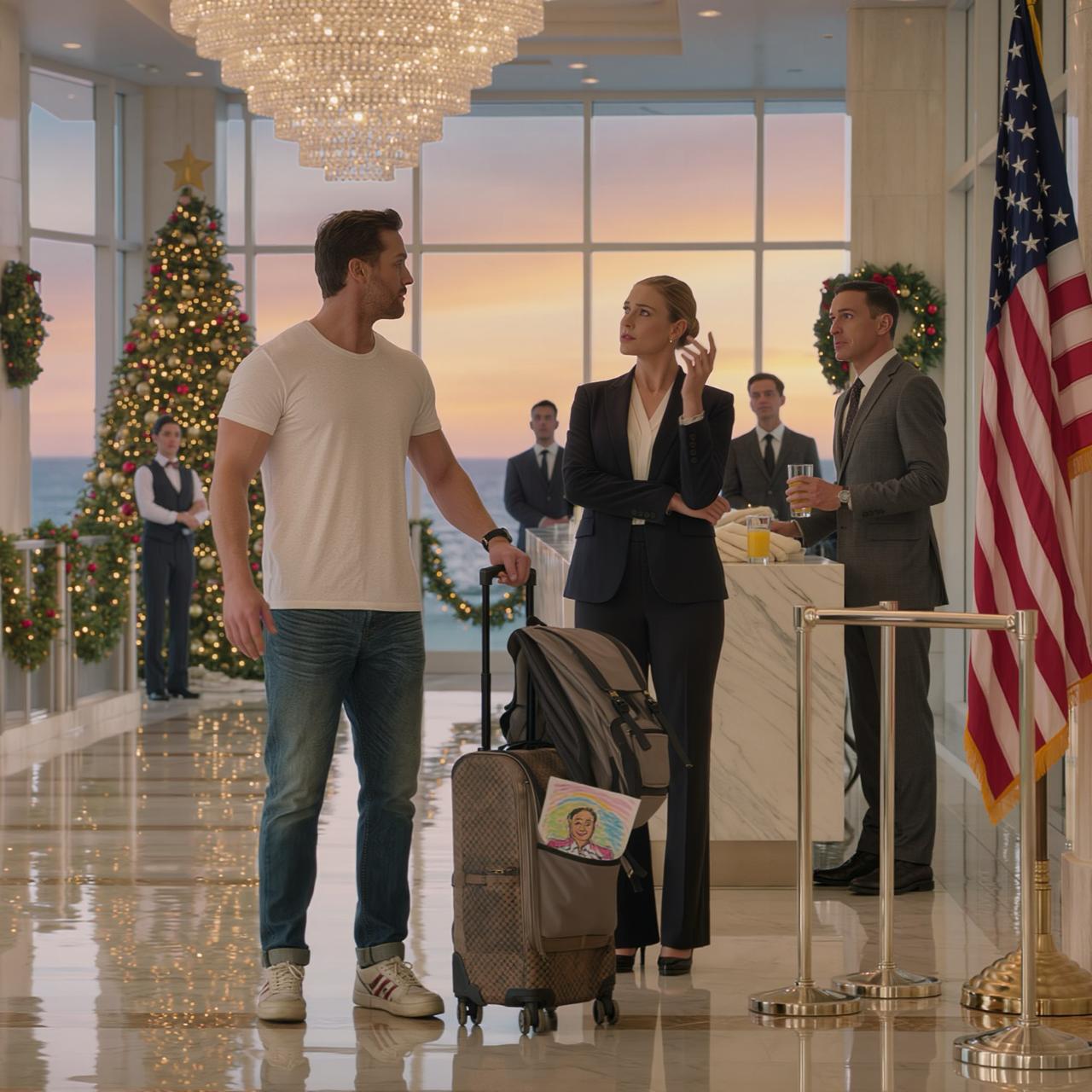
Sophie turned toward the desk, voice sharpening as fear tried to dress itself up as command. “Call someone,” she snapped. “Call the regional director. Call whoever you have to call.”
The receptionist fumbled for the phone with shaking fingers. “I… I think…” His voice faltered. He glanced at Sophie, then away, as if afraid she might strike him too.
Before he could finish, another phone rang. Not the desk phone. The lobby phone line reserved for internal operations.
The receptionist answered, face pale. He listened for a moment, then went even paler, as if the blood in his body had simply decided to leave.
He hung up slowly and looked around at the staff who had gathered, drawn by the earlier crack of the slap.
“We’ve all been called to the conference room,” he said, voice barely above a whisper. “Right now.”
The words hit like cold water.
Sophie’s stomach dropped. She pictured the conference room in her mind, sterile and bright, the kind of place where decisions were made without emotion. She pictured suits. Clipboards. Documentation.
The incident had been witnessed. It had been heard. There was no arguing it away.
Her legs felt unsteady, but she forced herself to move. She smoothed her blazer automatically, a reflex of professionalism that suddenly felt like dressing up for an execution.
Staff fell in behind her as if pulled by gravity. The receptionist. The bellman. The security guard. A few others from guest services who had watched from a distance and done nothing.
They walked down the hallway like a procession, the soft click of Sophie’s heels echoing unevenly. The polished beauty of the resort no longer felt like a luxury. It felt like a stage built to display their humiliation.
Inside the conference room, the air was cooler than the lobby, almost cold. A long table stretched through the center. Chairs sat neatly aligned on either side, as if waiting for people who still believed order could protect them.
A man stood at the head of the table.
Dark suit. Tight mouth. Eyes that held no warmth at all.
Sophie recognized him instantly, and dread curled deeper in her stomach.
Regional director. The kind of person who didn’t show up unless something was already on fire.
He didn’t offer greetings. He didn’t ask for explanations.
He waited until they were all seated, and then he spoke with a voice like a locked door.
“As of this moment,” he said, “Sophie Langford, you are terminated.”
Sophie’s breath caught. The words didn’t feel real, not at first. They felt like a sentence spoken in someone else’s life.
The regional director continued, tone clipped and practiced. “Your access has been revoked. Security will escort you from the premises within fifteen minutes.”
Sophie opened her mouth. No sound came out. Her hands trembled under the table, fingers curling into her palms.
He turned his gaze to the others. The receptionist’s shoulders collapsed inward. The bellman stared at the tabletop as if he could disappear into the grain.
“The rest of you are suspended pending investigation,” the regional director said. “We will be reviewing security footage. We will be documenting every detail of what happened, and we will be examining guest feedback for patterns of discriminatory behavior.”
The phrase discriminatory behavior made Sophie flinch, as if struck again.
The director’s eyes swept the room. “Silver Harbor is a luxury resort. That does not mean we treat people as less than human. What happened today was unacceptable. It was a failure of leadership, a failure of judgment, and a failure of basic decency.”
Sophie’s throat tightened. She stared at the table, at her own hands, at the faint imprint of her manicure against her skin.
Some part of her wanted to stand up and shout that it wasn’t fair. That she’d been stressed. That she’d been trying to uphold standards. That difficult guests came in every day and chipped away at her patience.
But the memory of the slap rose up, bright and undeniable.
She had raised her hand. She had done it in front of everyone. She had done it because she could, because she thought she could, because she thought he had no power.
And now the people in this room looked at her as if she were a stranger they regretted ever trusting.
The regional director’s voice remained steady, cold. “Is that clear?”
No one spoke. Heads nodded, small and defeated.
Sophie felt the room spinning slightly, like the floor had tilted. Her mind raced ahead to bills, to rent, to the way her life depended on this job more than she’d admitted to herself.
She forced herself to look up. “Please,” she whispered, and hated how small her voice sounded. “I can explain. I… I made a mistake.”
The regional director didn’t blink. “You made a choice,” he said. “And the choice has consequences.”
The door opened behind her.
A security officer stepped in, expression neutral, as if escorting people out was just another task on a long list.
Sophie stood slowly. Her chair scraped lightly against the floor, the sound slicing through the stillness.
She wanted to say something to the staff she’d managed, something that would make her feel less alone. But their eyes avoided hers. They had already started rewriting the story in their heads, distancing themselves from her, from the stain of what she’d done.
Sophie walked out.
The hallway lights seemed too bright. The carpet felt too soft under her feet, like a cruel imitation of comfort.
When she reached the lobby again, it looked unchanged. Chandeliers still sparkled. The ocean still flashed through the glass. Guests still drifted through the space, some laughing softly, some talking about dinner reservations.
But Sophie felt like she was walking through a world she no longer belonged to.
The security officer kept a respectful distance beside her, close enough to guide, far enough to pretend this wasn’t an escort.
She stepped outside into the sun, and the warmth hit her face like an insult. The breeze off the ocean tugged at her bun, loosening a few strands of hair. She suddenly felt exposed, not in a glamorous way, but in the raw way of someone whose mask had been ripped off in public.
She was led toward the employee lot.
Her car sat there waiting, ordinary and small, like a reminder that she had never been as untouchable as she’d pretended.
She opened the door, slid into the driver’s seat, and shut it.
For a moment, she just sat there, hands hovering over the steering wheel, breathing unevenly. Her heart hammered as if she’d been running.
She stared straight ahead, vision blurred by tears she refused to let fall.
Inside the resort, the investigation was already moving. Documentation. Footage. Witness accounts. The kind of corporate accountability that arrived swiftly when the right person made the right call.
And upstairs, Noah Carter stood by his window, cheek still warm, watching the ocean as if the waves could teach him how to let go of what people did when they thought no one important was watching.
He didn’t know how long it would take for corporate to arrive in person.
He only knew the call had been made.
And the clock was already running.
Noah stood with one hand braced against the window glass, his breath fogging a small circle that vanished as quickly as it formed. Outside, the ocean moved with a patience that felt almost personal, wave after wave folding into itself, never rushing, never apologizing. The horizon had the soft blur of late afternoon, the sky sliding toward gold.
He pressed his tongue against the inside of his cheek, tasting metal where the slap had landed. Heat still pulsed across his skin, not unbearable, just insistent. A reminder.
He wanted to feel relief. He wanted to feel the clean satisfaction of justice served, a neat conclusion. Instead, his chest felt heavy, as if his ribs were holding too much air.
He had not come here to make an example of anyone.
He had come here to sleep.
Noah turned away from the window and walked into the room, taking in details the way he always did when he entered a space he might need to understand quickly. The lamps were placed with intention. The furniture was positioned to steer movement. The bed was made with hospital corners, tight and precise, as if mess itself was forbidden here.
He set his suitcase on the luggage stand and unzipped it partway. A faint smell of detergent rose from his folded clothes, the familiar scent of home clinging stubbornly to fabric. He paused when he saw the edge of his son’s drawing, bright colors peeking out like a secret.
He slid it free carefully.
Two stick figures on a beach. One taller, one smaller. A sun in the corner, exaggerated and cheerful, rays like a crown. His son had scribbled waves in looping blue lines and added tiny dots for shells, as if the ocean couldn’t exist without treasures in it.
Noah’s throat tightened.
He had promised his boy a few days that were just theirs. No calls. No meetings. No problems to solve. He had promised it with the confidence of a parent who believed he could keep the world from intruding.
Then the world had walked right up and slapped him in the face.
He propped the drawing against the lamp on the desk. The paper made the room feel less like a hotel and more like a place where someone lived, even if only temporarily. Noah stared at it a moment longer, then pulled out his phone.