

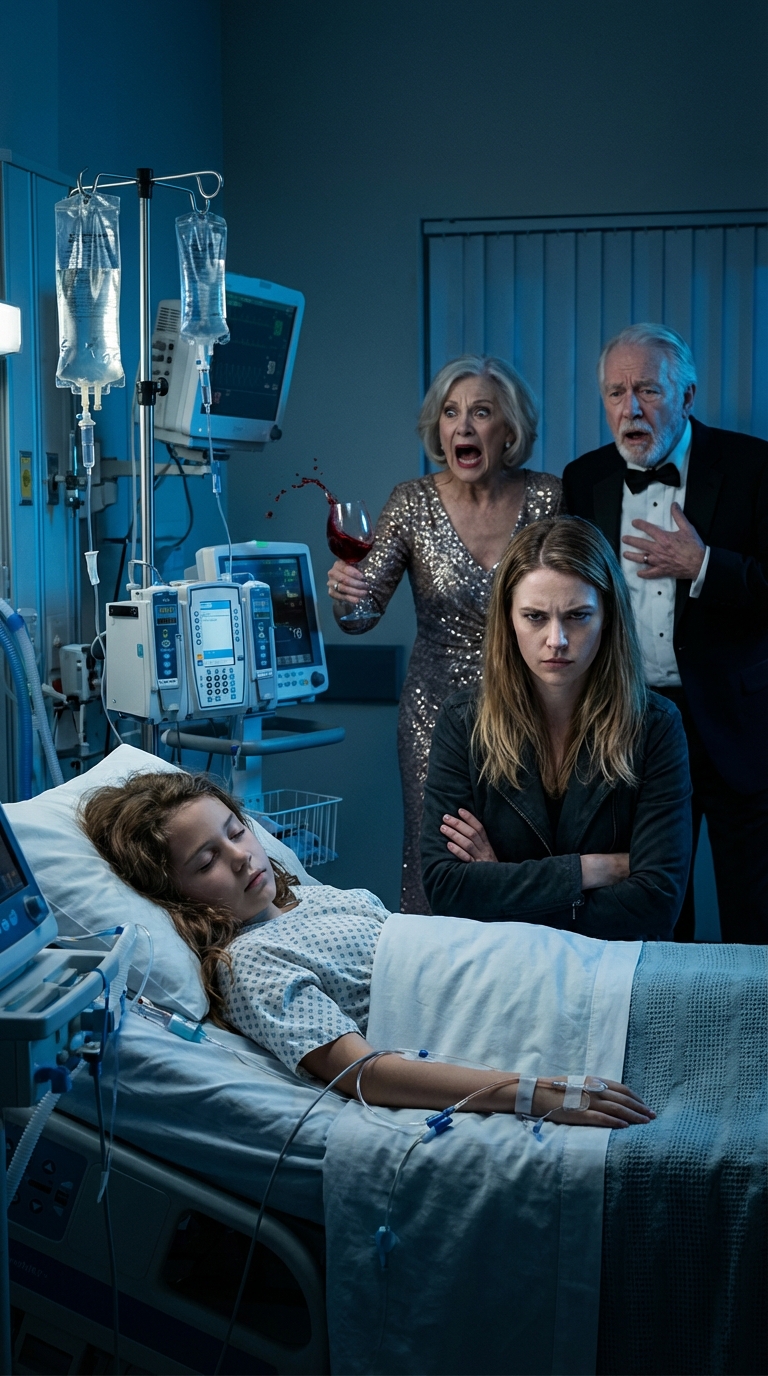
The Cost of Being Family
Chapter 1: The Sound of Sterile Silence
The hospital room was too quiet. It wasn’t the peaceful, restorative quiet of a sleeping house after a long day. It was a heavy, pressurized silence that pressed against your eardrums, amplifying the things you didn’t want to hear.
The machines hummed with a detached, mechanical indifference. A heart monitor beeped at steady, rhythmic intervals—beep… beep… beep—a digital metronome counting down the seconds of my fear. Overhead, the fluorescent lights flickered just enough to induce a migraine, casting long, antiseptic shadows across the linoleum floor.
And in the middle of it all, swallowed by a bed that looked far too large for her seven-year-old frame, lay Mia.
My daughter.
Her favorite stuffed rabbit, a tattered thing named “Mr. Hops” with one ear permanently folded over, was tucked tightly beneath her arm. Her dark hair was plastered to her forehead, damp with the sweat of a fever that refused to break. Every few minutes, she would shift, her face scrunching in discomfort, fighting a battle inside her own body that I couldn’t fight for her.
She opened her eyes—glassy, unfocused—and looked at me. She forced a smile. It wasn’t her usual smile, the one that crinkled her nose and showed the gap in her front teeth. It was a weak, fragile thing, an offering to make me feel better.
“Mommy,” she whispered. Her voice sounded like dry leaves scraping over concrete. “Did I miss school today?”
I swallowed hard, tasting the metallic tang of old coffee and anxiety. “Just today, baby,” I said, reaching out to brush a wet strand of hair from her face. My hand was trembling, just a little. “You’ll catch up. Don’t worry about the spelling test right now.”
She nodded, satisfied with the lie, and closed her eyes again.
Three days earlier, she had been a hurricane of energy, running barefoot through the living room, laughing too loud, spinning until she collapsed on the rug in a fit of giggles. That night, the headache started. By midnight, she was burning up, radiating heat like a furnace. By early morning, her breathing had turned into a terrifying, shallow rasp.
I remembered carrying her to the car, her small arms clinging to my neck with a desperate strength. “I don’t feel good,” she had murmured into my shoulder.
“I know,” I had whispered back, gripping the steering wheel until my knuckles turned white. “Momma’s here.”
The emergency room at St. Jude’s had been a blur of chaos. Nurses moving with efficient speed, doctors speaking in those calm, practiced tones that are designed to mask alarm. Let’s keep her overnight. Just to be safe. We need to monitor her oxygen saturation.
Overnight became one night. One night became two. Two became three.
On that first terrifying night, after the sedatives finally pulled Mia into a restless sleep, I stepped out into the hallway. The air smelled of rubbing alcohol and floor wax. I pulled my phone from my pocket, my fingers hovering over the contact named Mom & Dad.
I didn’t call because I needed money. I didn’t call because I needed medical advice. I called because, stupidly, stubbornly, I still believed that family showed up when the world fell apart. Especially your mother.
I dialed. My mother answered on the third ring, her voice light, distracted.
“She’s in the hospital, Mom,” I said, my voice cracking slightly. I paced near the vending machines, hugging my cardigan tight around my body. “It’s pneumonia, complicated by a secondary infection. She’s scared. She keeps asking for you. Can you and Dad come by? Even just for ten minutes?”
There was a pause on the other end. I could hear the television in the background—a cooking show, pans sizzling.
Then, my mother sighed. It was that specific sigh she used when I wore a dress she didn’t like or chose a career she didn’t understand.
“Oh, honey,” she said, her voice dropping an octave. “We’d love to, really. But hospitals are just… breeding grounds, aren’t they? We don’t want to catch anything. You understand, right? Your father’s immune system isn’t what it used to be.”
I stopped pacing. I stared at a vending machine, looking at a bag of pretzels without seeing it.
“She’s your granddaughter,” I said. The words felt heavy, clumsy. “She’s seven. She’s asking for Nana.”
“Yes, and we love her dearly,” she replied, the dismissal sharp in her tone. “But we’re not young anymore. We have to be careful. Let us know when she’s discharged. We’ll send a card.”
“A card,” I repeated, numb.
“Keep us posted,” she said cheerily. “Love you!”
The line went dead.
I stood there for a long time, listening to the dial tone, wondering at what point “caution” had mutated into indifference. I looked back through the glass of Mia’s room. She was so small. And I felt the ancient, hollow ache of a daughter realizing her mother wouldn’t come.
But the real blow hadn’t landed yet. That was just the warm-up.
Chapter 2: The Invoice for Indifference
The next morning, the sun rose grey and bleak. Mia woke up groggy, blinking at the IV in her arm, at the wires taped to her chest, at the unfamiliar acoustic tiles of the ceiling.
She looked at the door immediately.