
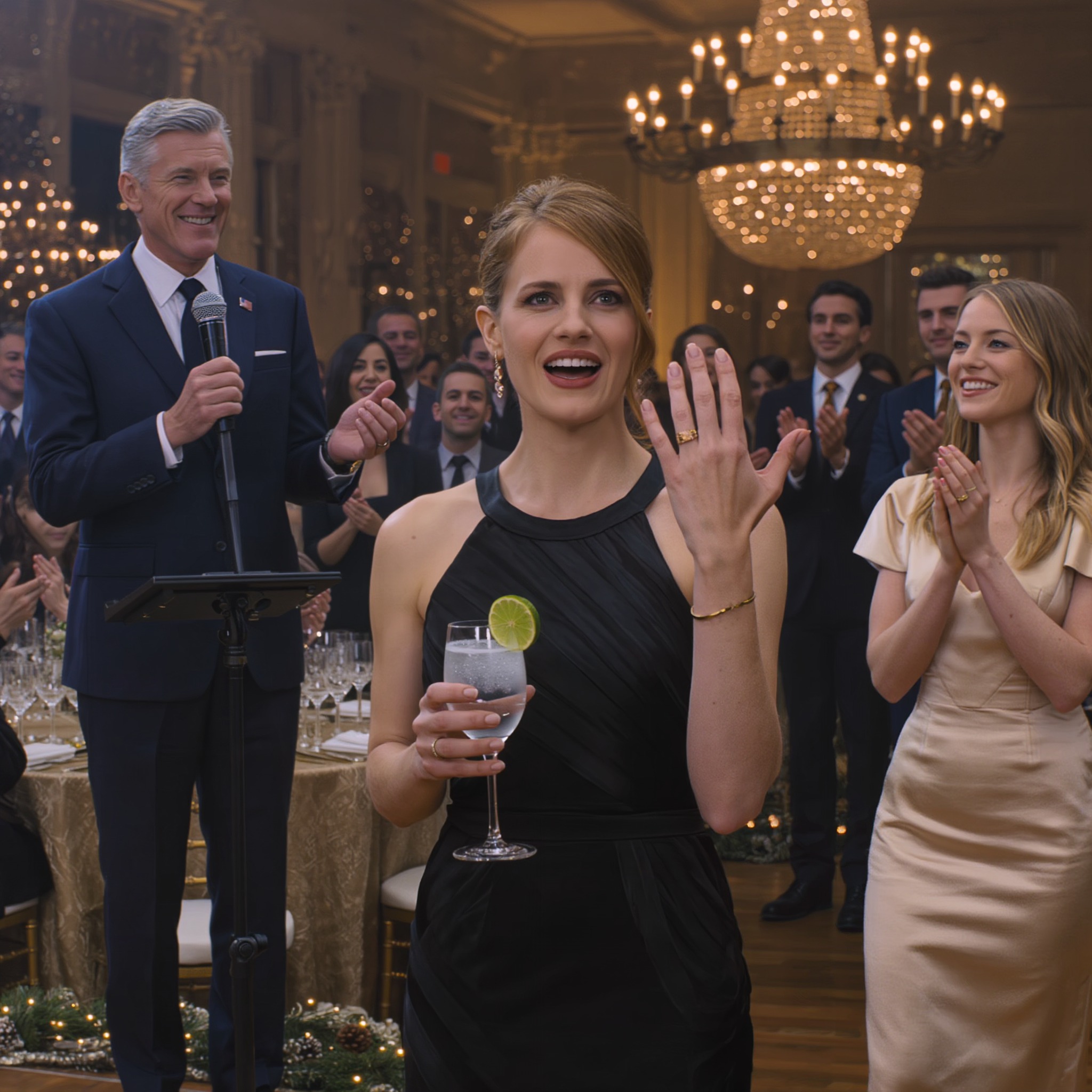
Rachel stepped forward. “Mr. Mercer, did you know that your daughter is—”
My father cut in smoothly. “Yes, we’re aware. But tonight isn’t about her. Tonight is about Tyler and his future.”
His future. His career. His success. Always his.
A man nearby—one of my father’s golf buddies, I recognized vaguely—cleared his throat. “Harold, I didn’t realize you had a daughter. You’ve never mentioned her.”
My father’s smile tightened. “We’re a private family, George. Myra chose a different path than the rest of us. She’s independent.”
Independent. The word dripped with dismissal.
“Perhaps too independent,” he added, lowering his voice just enough that only those closest could hear, but loud enough to make his point. “Some children want to be part of the family. Others…” He shrugged. “Others don’t have anything to contribute.”
The air around me went cold.
I had spent twelve years building a career, saving lives, earning every credential through sweat and sacrifice, and in three sentences my father reduced all of it to nothing.
Rachel stared at him like she’d never seen him before. And maybe she hadn’t. Not the real him.
I felt the old familiar urge to shrink, to apologize, to disappear. For eighteen years I had lived under this man’s roof and learned that survival meant silence. For twelve more, I had built a life where his opinion didn’t matter.
But standing there in that glittering ballroom, surrounded by strangers who thought my father was a great man, I realized something.
I was done shrinking.
I took a breath, then another. My heartbeat slowed to the steady rhythm I used before surgery—calm, focused, precise.
“I’m not leaving, Dad.”
My father blinked. “Excuse me?”
“I came to celebrate my brother’s engagement,” I said. “I’m going to stay, have a glass of water, and congratulate the happy couple.”
I smoothed the front of my dress. “That’s what family does, isn’t it?”
His face tightened. “Myra, you don’t have to—”
“I don’t have to introduce myself to anyone,” I said. “You don’t have to acknowledge I exist. I’m used to that.”
I met his eyes without flinching.
“But I’m not leaving because my presence makes you uncomfortable.”
For a moment, no one spoke.
Then I turned and walked to the bar, my heels clicking against the marble floor with a confidence I had earned in operating rooms and overnight shifts and years of proving myself to people far more intimidating than Harold Mercer.
I ordered sparkling water with lime. The bartender slid it across the counter with a small nod. I took a sip and watched the party continue around me—the forced laughter, the air kisses, the elaborate dance of wealthy people pretending everything was fine.
I didn’t need to make a scene. I didn’t need to expose anyone. I just needed to stand my ground.
And from across the room, I saw Rachel watching me with something that looked like respect.
She started walking toward me again, but my mother intercepted her path.
“Sweetheart, let me introduce you to some of our friends from the club,” Mom said brightly, steering Rachel toward a group of older women dripping in pearls.
Then my mother doubled back to me, her smile fixed but her eyes pleading. She gripped my elbow, her fingers trembling slightly.
“Myra, honey. Please don’t do this. Not tonight.”
“Don’t do what, Mom?” I asked. “I’m just standing here.”
“You know what I mean.” She glanced over her shoulder, checking if my father was watching. “Your father is already upset. Tyler is nervous. This is supposed to be a happy night.”
“And my presence ruins that,” I said.
She didn’t answer. She didn’t have to.
“Mom,” I said quietly, “do you even know what I do for a living?”
Her eyes dropped to the floor.
“You know I work at Johns Hopkins,” I said. “You know I’m a surgeon. You’ve known for years. Why have you never told him?”
“Your father wouldn’t…” she trailed off. “He wouldn’t have believed me. He’d already made up his mind about you.”
“So you just let him?” I asked.
“I didn’t have a choice.”
“You had a choice every single day, Mom,” I said. “You just didn’t take it.”
Her eyes glistened. For a moment I saw the mother I remembered from childhood—the one who used to sneak me extra dessert and tell me I could be anything I wanted. That woman had disappeared a long time ago.
“I know you’ve done well for yourself,” she whispered. “I’m proud of you. I just can’t…”
“Can’t what?” I asked. “Say it out loud?”
She squeezed my hand once, then let go.
“Please,” she whispered. “Just go home, Myra, before things get worse.”
“They’re already worse, Mom,” I said. “They’ve been worse my entire life.”
I watched her walk away, and for the first time I didn’t feel angry.
I just felt sad.
I drifted to the corner of the ballroom near the floor-to-ceiling windows that overlooked the golf course. Outside, landscaping lights cast golden pools across pristine grass. I could see the outline of luxury cars in the parking lot—Mercedes, BMWs, a few Porsches—the world my father desperately wanted to belong to.
Inside, 150 people laughed and clinked glasses and celebrated a future that had nothing to do with me.
I looked down at my ring, the Johns Hopkins crest catching the light, and thought about the day I earned it. The ceremony was small, held in a conference room with bad coffee and fluorescent lighting. My classmates had families filling the seats—parents dabbing tears, siblings snapping photos.
I sat alone in the third row.
When they called my name, I walked up, shook the dean’s hand, and accepted my ring with no one to witness it. Afterward, a janitor setting up chairs for the next event said, “Congratulations, Doc.”
He was the only person who acknowledged my accomplishment that day.
I pressed my thumb against the ring now, feeling its weight.
What was I even doing here?
I had spent twelve years building a life that didn’t require their approval—a life filled with colleagues who respected me, patients who trusted me, work that mattered. Why was I standing in a corner at my brother’s engagement party, hoping for something I knew I’d never get?
Through the glass, I watched a couple stroll arm in arm toward the garden—happy, oblivious, normal.
Maybe I should just leave. Let them have their perfect night.
Then my phone buzzed.
A text from Dr. Kevin Chen, a colleague back at Hopkins: Hey, Myra. Random question. Your brother Tyler—did he finish his residency? Just saw him at a pharma conference. Thought he was still in training.
I stared at the screen and everything changed.
I read the message three times. Thought he was still in training.
Tyler wasn’t in training. According to my mother’s updates—the few she shared—Tyler was finishing residency and about to become a doctor any day now. That was the story. The narrative my father broadcast to anyone who would listen.
But Kevin had just seen Tyler at a pharmaceutical sales conference.
Not a medical conference. A sales conference.
I opened a browser on my phone and searched: Tyler Mercer Fizer.
Three results: a LinkedIn profile, a company directory listing, a conference speaker bio from six months ago.
Tyler Mercer, medical sales representative, Fizer, Inc. No residency. No medical license. No “doctor” in front of his name.
He had dropped out two years ago, based on the dates.
My father had spent $180,000 on Tyler’s medical education, and Tyler hadn’t even finished. He’d quietly pivoted to pharmaceutical sales and never told anyone.
For two years, he had been lying to our entire family.