
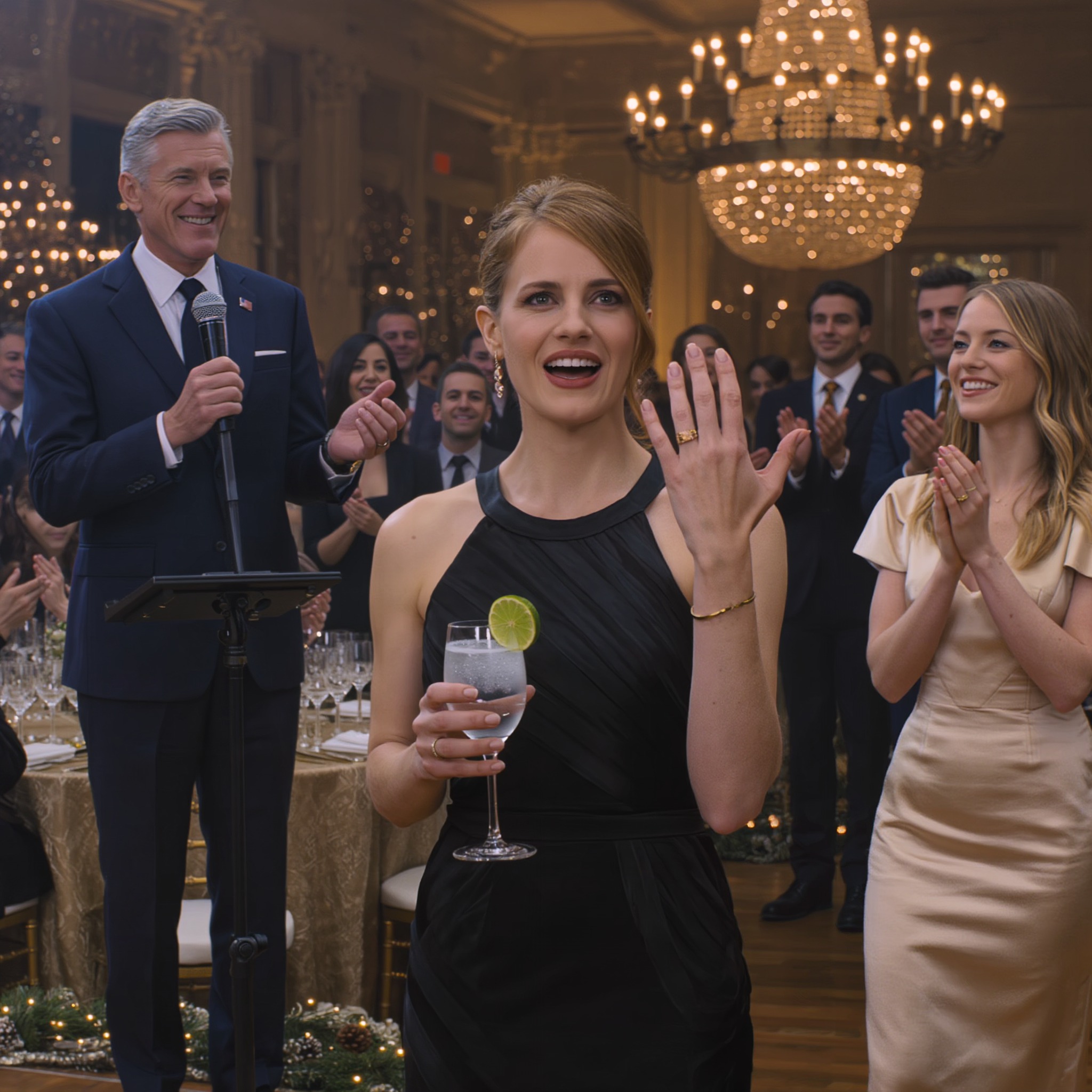
Rachel nodded and walked toward the stage. The MC—one of my father’s friends who had been managing the evening’s program—tapped the microphone.
“Ladies and gentlemen,” he said, “if I could have your attention, please. Our beautiful bride-to-be, Rachel Porter, would like to say a few words.”
Polite applause rippled through the room.
Rachel climbed the three steps to the small stage, her cream silk dress catching the light. She looked every bit the perfect fiancée—poised, beautiful, gracious—but I could see her hands trembling slightly as she adjusted the microphone.
One hundred fifty guests turned their attention to her. My father stood near the front, beaming with proprietary pride. Tyler positioned himself at the base of the stage, ready to gaze adoringly at his bride.
“Thank you all for being here tonight,” Rachel began, voice clear and steady. “I’m so grateful to celebrate with Tyler’s family and friends.”
My father nodded approvingly.
“Before I talk about Tyler,” Rachel continued, “I want to share something personal—something that shaped who I am today.”
A murmur of interest passed through the crowd. This wasn’t the standard thank-you speech they were expecting.
“Three years ago,” Rachel said, “I was in a car accident. A semi ran a red light and hit my driver’s side door at fifty miles an hour.”
Gasps. Sympathetic murmurs.
“I was rushed to Johns Hopkins with serious injuries,” she continued. “The doctors told my parents I had a twenty percent chance of surviving the night.”
Rachel paused, letting the weight of her words settle over the room.
“But I did survive because of one person,” she said. “One extraordinary surgeon who operated on me for seven hours and refused to give up.”
I felt eyes beginning to shift. People looked around, wondering where this was going.
Rachel’s gaze locked on me.
“That surgeon is in this room tonight,” she said.
The ballroom went silent.
“Her name,” Rachel said, voice unwavering, “is Dr. Myra Mercer. She’s a cardiothoracic surgeon at Johns Hopkins Hospital—one of the best in the country.”
She pointed toward me and 150 heads swiveled in my direction.
“She’s also Tyler’s sister.”
The silence exploded into whispers.
I stood frozen in my corner, heart pounding, as Rachel continued.
“I didn’t know this until tonight. Tyler never mentioned that his sister was a doctor. In fact, his family introduced her to me as someone who works in hospital administration.”
Her voice sharpened.
“But that’s not true. Dr. Mercer isn’t an administrator. She’s a surgeon. A brilliant one. The woman who gave me a second chance at life.”
My father’s face had gone pale. Tyler looked like he wanted the floor to swallow him whole.
“What’s even more confusing,” Rachel went on, “is that just a few minutes ago, Mr. Mercer stood on this very stage and introduced Tyler as the only successful child in the family.”
She let that sink in.
“I’d like someone to explain to me how that makes sense.”
The room held its breath.
“How does a family ignore the daughter who became a surgeon while celebrating the son who—”
She stopped herself. Took a breath.
“I’m sorry,” she said. “I didn’t come up here to attack anyone. I came up here because the truth matters to me. And the truth is that Dr. Myra Mercer saved my life. Without her, I wouldn’t be standing here.”
Rachel looked at me again, tears glistening in her eyes.
“Myra,” she said gently, “would you please come up here? I’d like everyone to meet the woman who made my future possible.”
Every eye in the room was on me.
I had two choices: shrink or stand.
I chose to stand.
I walked through the parted crowd, my heels clicking against the marble with each step. Whispers followed me like a wave.
“That’s the daughter.”
“Harold never mentioned a daughter.”
“A surgeon at Hopkins?”
“Why would they hide that?”
I climbed the steps and stood beside Rachel. She reached for my hand and squeezed it.
From the crowd, a man’s voice called out.
“Dr. Myra Mercer?” A tall man stepped forward, recognition dawning on his face. “Howard Brennan. I attended your presentation at the American Heart Association conference last spring. Your research on minimally invasive mitral valve repair was exceptional.”
More murmurs. More turning heads.
“Thank you,” I said simply.
Rachel leaned into the microphone.
“For those who don’t know—and apparently that includes Tyler’s own family—Dr. Mercer is board-certified in cardiothoracic surgery. She’s published in peer-reviewed journals. She’s saved countless lives, including mine.”
Then she turned to face my father, who stood motionless near the front, his expression a mask of barely controlled fury.
“Mr. Mercer,” Rachel said, calm but firm, “I mean no disrespect, but I have to ask: why did you tell this room that Tyler is your only successful child? Your daughter is standing right here.”
My father’s mouth opened, closed, opened again.
“This is hardly the time or place,” he said stiffly.
“It seems like exactly the right time and place to me,” Rachel replied. “You chose to celebrate Tyler’s success publicly. Why can’t we acknowledge Myra’s?”
Someone in the back started clapping. Then another. Then another.
Within seconds, half the room was applauding—not for my father, not for Tyler, but for me, and I hadn’t asked for any of it.
The truth had simply found its way into the light.
Rachel handed me the microphone.