

Forty-five minutes. I had forty-five minutes to find someone to watch my children while doctors cut me open.
I fumbled for my phone with shaking hands. Blood smeared across the screen as I pulled up my parents’ number. It rang four times.
“Myra.” Dad’s voice was impatient. “We’re about to leave. What is it?”
“Dad, I need help.” The words tumbled out between gasps of pain. “I was in an accident. I’m being taken to the hospital—surgery. Please. I need you and Mom to watch the twins just for a few hours.”
Silence on the line. Then, “Hold on,” and I heard muffled voices—my mother’s tone sharp and annoyed, Vanessa’s laugh in the background—before the line went quiet.
Then my phone buzzed with a text notification.
Family group chat.
The message was from my mother: “Myra, you’ve always been a nuisance and a burden. We have Taylor Swift tickets with Vanessa tonight. We’ve been planning this for months. Figure it out yourself.”
I read it twice, three times. The words didn’t change.
A second message appeared from Dad: “You’re a doctor. You’re used to hospitals. Don’t make this into a bigger deal than it needs to be.”
Then Vanessa. Not words. Just a laughing emoji.
That was it. That was all I was worth to them—a laughing emoji while I lay bleeding in an ambulance.
Marcus was watching me. I didn’t realize he could see my screen until he spoke, careful.
“Myra,” he said. “What did they say?”
I couldn’t answer. Something had cracked open inside me, and it wasn’t just the internal bleeding.
“I need a phone,” I whispered. “A phone with internet. Mine’s dying.”
He handed me his without question. I searched emergency nanny services, found one with twenty-four-hour availability, called, and explained the situation in clipped professional sentences. Yes, I would pay triple the rate. Yes, I would provide the babysitter’s contact for handoff instructions. Yes, I authorized payment immediately.
It was done in four minutes.
Marcus was still watching me when I handed back his phone. He didn’t say anything. He didn’t have to.
“Can you screenshot those messages?” I asked from my phone before it died.
He nodded slowly. “Yeah. I can do that.”
I closed my eyes as the ambulance pulled into the hospital bay. The pain was overwhelming now, but it wasn’t coming from my abdomen anymore.
From that hospital bed, with an IV in my arm and fear in my heart, I made the easiest decision of my life.
The surgery took four hours. Ruptured spleen. Internal bleeding. Another few minutes and I might not have made it.
I spent five days in the hospital—five days of IV drips, morphine haze, and nurses checking my vitals every few hours. Not one call from my parents, not one text, not one visit. The emergency nanny service was expensive, but worth every penny. They coordinated with my regular sitter, kept Lily and Lucas safe and fed, and sent me daily photo updates.
Strangers took better care of my situation than my own family.
On day three, I asked the nurse for my laptop.
“Are you sure you’re up for it?” she asked. “You should be resting.”
“I need to take care of something.”
My hands were steady as I logged into my banking app. Eight years of recurring transfers stared back at me, regular as clockwork: $2,400 on the first of every month, $800 on the fifteenth. I canceled them all. Then I opened my phone settings and blocked my father’s number, my mother’s, Vanessa’s.
There was no dramatic moment, no tears, no second guessing. It felt like setting down a weight I’d been carrying so long I’d forgotten it was there.
Marcus stopped by later that afternoon. He’d checked on me every day, bringing coffee and quiet company.
“How are you feeling?” he asked.
I looked up at him, and for the first time in years, I told the truth. “Better. For the first time in eight years, I actually feel better.”
He didn’t push for details. He just nodded like he understood.
I knew the fallout was coming. My parents would notice the missing money. They would rage and cry and demand explanations. But I didn’t expect what came next.
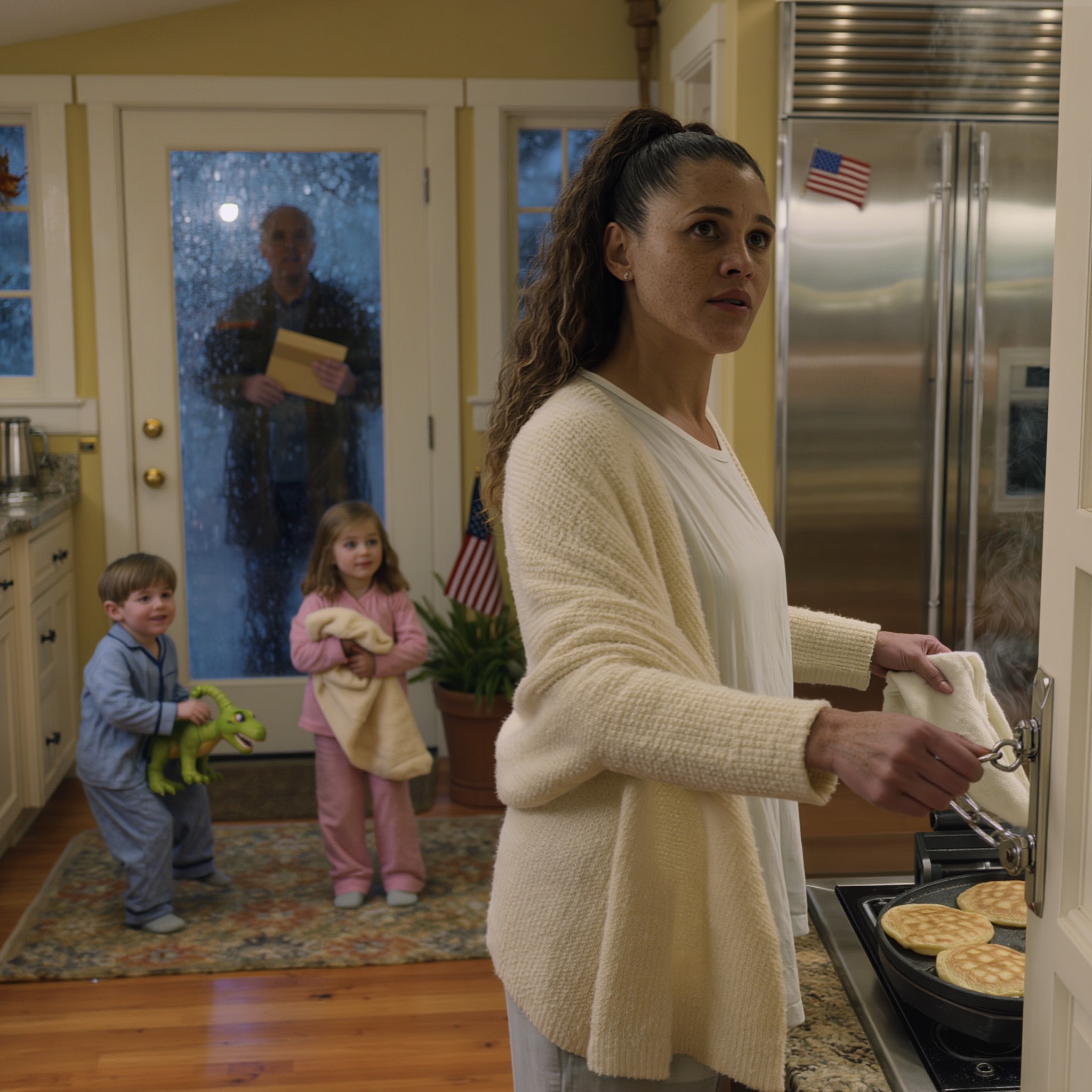
Two weeks after my surgery, I was finally home, moving slowly, still sore, but alive. It was a Saturday morning, and I was making pancakes for Lily and Lucas, their favorite weekend treat.
The kitchen smelled like butter and maple syrup. Lucas was trying to stack his toy blocks. Lily was helping by knocking them down.
Then came the knock—three sharp raps on my front door.
I wiped my hands on a dish towel, my heart rate spiking. If it was my parents, I wasn’t ready. I didn’t know if I’d ever be ready. I looked through the peephole, and my breath caught.
Standing on my doorstep was a tall man in his seventies—silver hair neatly combed, sharp blue eyes I remembered from childhood, a posture that still carried the authority of forty years on the federal bench.