

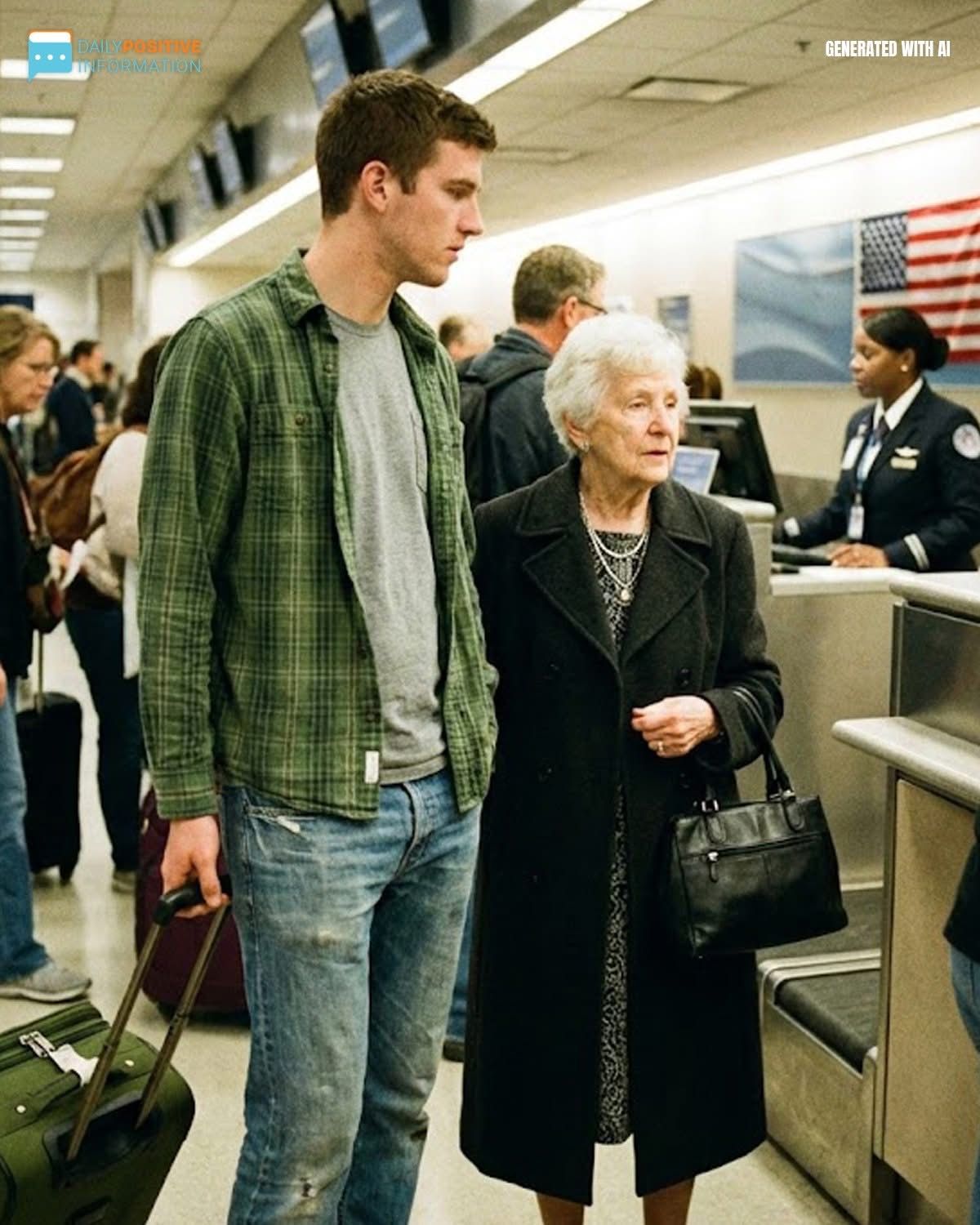
I stood there with my grandmother in that busy terminal, surrounded by the noise of rolling suitcases and gate announcements and other families excitedly preparing to board planes to wonderful destinations.
My grandmother didn’t say anything at first. She just stared at the spot where her children had disappeared into the security line, as if the floor had opened up and swallowed them whole.
“Grandma,” I said softly, my throat so tight I could barely speak. “Let’s go home.”
She nodded slowly, like someone waking from a nightmare.
I led her away from the check-in counter, pulling her old suitcase behind us. She walked like she was moving through water, every step heavy and uncertain.
We made our way through the automatic doors and back out into the sticky Georgia heat, joining the taxi queue where yellow cabs pulled up in an endless loop.
I waved one down and helped her into the back seat.
“Tuloma, Tennessee,” I told the driver, giving him the address of her little wooden house.
As we pulled away from the airport, the massive terminal building receding in the rearview mirror, my grandmother watched planes taking off through the window, her eyes distant and empty.
For a long time, the only sounds were the engine, a faint country song playing on the radio, and the steady rhythm of tires over highway seams.
Halfway through the drive, she finally spoke.
“Is it because I’m poor, Calvin?” she asked, her voice barely above a whisper. “Because I’m old? Because I don’t fit into their world anymore?”
Her words cut straight through me like a knife.
I wanted to scream, to tell her no, that she was worth more than all of them combined, that the problem wasn’t her—it was them. But all I could do was squeeze her hand.
“No, Grandma,” I forced out past the ache in my throat. “It’s not your fault. They don’t deserve you. They never did.”
She nodded, but I could tell she didn’t believe me. The hurt was too deep, too fresh, too absolute.
We rode the rest of the way in heavy silence—a silence filled with all the things neither of us knew how to say.

The phone call that changed everything
By the time the taxi pulled up in front of her house, night had fallen completely. The porch light flickered on automatically, casting a yellow pool across the steps and illuminating the marigolds still blooming stubbornly in the darkness.
I paid the driver and carried her suitcase inside.
The familiar smells wrapped around us—cookies and old wood and laundry detergent. It should have felt comforting, like coming home. Instead, the house felt heavier and quieter than I’d ever known it.
She lowered herself into her armchair and reached for the framed family photo on the side table—the one with my parents, Aunt Paula, their spouses, my cousins, and me all smiling at the camera.
She held it so tightly her hands shook.
I knelt down in front of her chair.
“Grandma,” I said, my voice breaking completely, “I won’t let them hurt you again. I promise you that.”
She forced a small smile—the kind that’s trying to protect the other person more than express any real feeling.
“Calvin, go get some rest,” she said gently. “It’s late.”
“I’m not going anywhere,” I answered firmly. “I’m staying right here with you.”
She didn’t argue. She just leaned back in her chair and stared at that photograph like she was trying to reconcile the smiling faces in the frame with what had just happened at the airport.
I spent that night half-awake on the couch, listening to the old house creak and settle, thinking about my parents somewhere over the Atlantic Ocean right now, reclining in their airplane seats while flight attendants served them wine.
They thought this would all just blow over. That I’d get over it and move on.
They were completely wrong.
I woke up early the next morning while the light outside was still gray and uncertain.
My grandmother was finally asleep, breathing evenly down the hall. I stepped out onto the front porch, the boards cool under my bare feet. The marigolds swayed gently in the morning breeze, their bright yellow petals a stubborn burst of hope against the fading white paint.
I pulled out my phone and started searching.
I didn’t know exactly what I was looking for at first. I just knew that what my parents had done felt wrong in a way that went far beyond hurt feelings or family drama.
This wasn’t just a bad decision or a misunderstanding.
They had deliberately taken advantage of someone who trusted them completely.
After scrolling for several minutes, I found the website for Adult Protective Services in Tennessee. The page explained how they investigated financial, physical, and emotional abuse of vulnerable adults.
My heart pounded as I read through the descriptions.
It was like the words had been written specifically for my grandmother’s situation. They talked about family members who pressured elderly relatives into giving up their savings, about fraud disguised as “gifts,” about manipulation and deceit.
I wrote down the phone number with shaking hands.
But then doubt crept in like poison.
These were my parents. My aunt and uncle. Did I really want to drag my own family into an official investigation? To involve the state, courts, lawyers, and strangers in our private business?
I looked back at the little house and thought about my grandmother standing in that airport, publicly humiliated and discarded like trash.
I thought about thirty thousand dollars that were supposed to keep her safe in her old age, now floating somewhere over the Atlantic Ocean in the form of first-class seats, luxury hotels, and expensive meals.
If I did nothing, what would stop them from doing this again? To her? To someone else?
I dialed the number before I could talk myself out of it.
What do you think about Calvin’s story? Share your thoughts in the comments on our Facebook page, and if this resonated with you or reminded you of someone who needs to hear it, please share it with your friends and family. Sometimes the hardest thing we can do is stand up for the people who can’t stand up for themselves.