

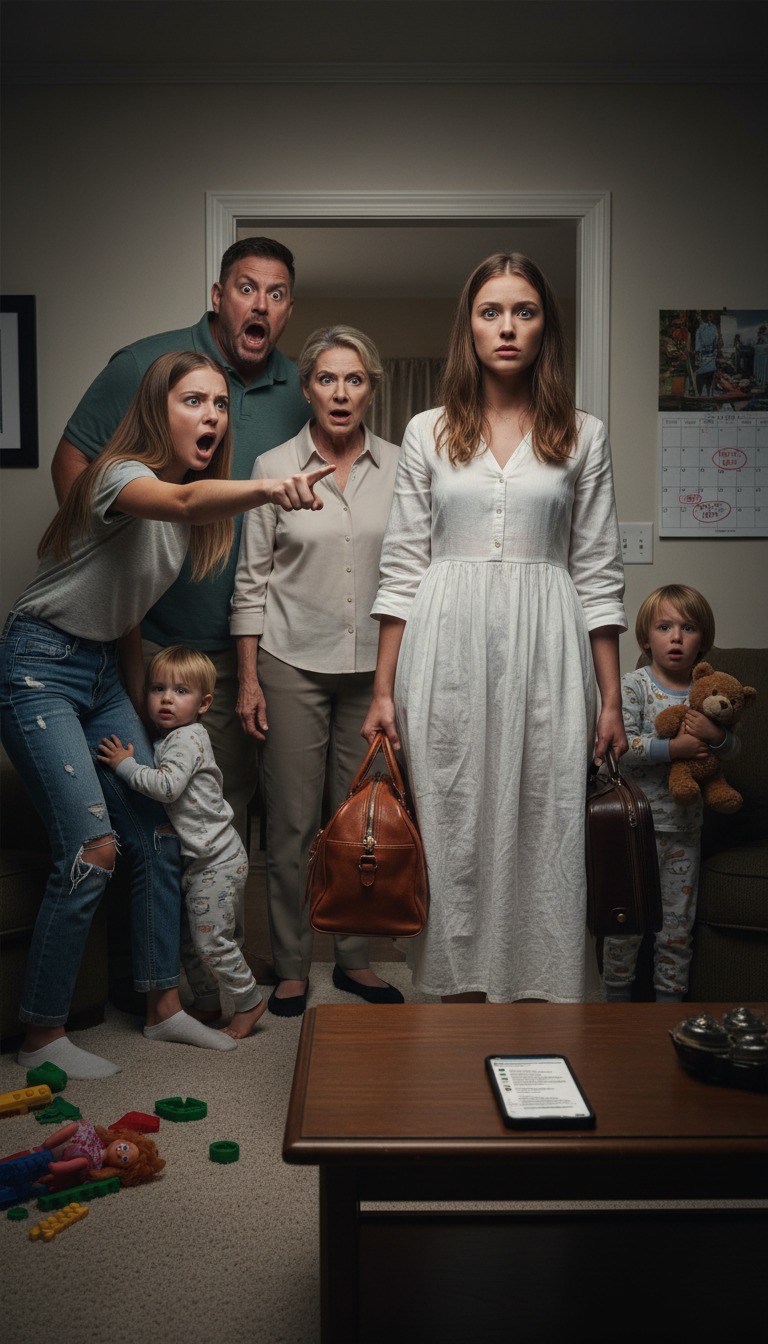
“Oh my god,” Mom gasped, stepping over a pile of books. “Claire, are you hurt?”
“I’m fine,” I said. I felt hollowed out. “You need to see this.”
I sat them down on the couch—the only piece of furniture Melissa hadn’t violated—and cast the footage to the TV.
Mom watched Melissa drink from the carton. She watched her sister shove the laptop into the bag. But when Melissa dumped the jewelry box—the one Mom had hand-picked for me—Mom let out a sound that was half-sob, half-scream. She staggered back, clutching Dad’s arm.
Dad didn’t make a sound. His face went gray. His jaw worked furiously, grinding his teeth. He watched his eldest daughter destroy his youngest daughter’s home, and I saw the “family first” philosophy crumble in real-time.
The officers were professional, efficient. They took photos. They dusted for prints, though the video made it redundant.
“You identified the suspect as your sister, Melissa Vance?” the officer asked, pen poised over his notebook.
“Yes.”
“Do you want to press charges?”
The room went silent. I could feel my mother’s desperate hope radiating off her, the plea to handle this “in-house.”
I looked at the empty spot where my passport used to be. I thought about the text: Buying them off. I thought about her walking into my home, my sanctuary, and deciding she was entitled to loot it because I wouldn’t provide free labor.
“Yes,” I said. “I want to press full charges.”
The detectives obtained a search warrant for her suburban home within hours. The video evidence was undeniable.
They found my laptop in her linen closet, buried under towels. They found my passport in her junk drawer, next to takeout menus, as if my citizenship was a triviality. They found the necklace in her own jewelry box.
When they brought her in for questioning, the detective told me she tried to spin it.
“I was just checking on the place,” she had claimed, indignant. “I was borrowing a few things. We’re sisters. We share everything. She’s blowing this out of proportion.”
Then they showed her the video.
The detective said her face didn’t show remorse. It showed annoyance. She was angry she had been caught, not that she had done it.
News travels fast in the suburbs. Melissa worked as a shift manager at a big-box retailer. When her arrest record hit the public log—Burglary, Grand Theft—she was fired immediately. You can’t handle cash registers when you’re stealing from your own blood.
The court date arrived two months later. I sat on the left side of the aisle. My parents sat with me. Melissa sat on the right, alone with her public defender.
She had to plead out to avoid jail time. The sentence: Felony probation, restitution, 200 hours of community service, and a mandatory protective order.
When the judge asked if she had anything to say, Melissa finally turned to look at me. Her eyes were dry, hard stones.
“I was just tired,” she told the court, her voice wavering with practiced victimhood. “I do everything for everyone. I work. I raise kids. Claire gets to run around the city, planning parties and going on luxury vacations. I just wanted her to understand what it feels like to lose something. To feel helpless.”
A ripple of unease went through the courtroom. She wasn’t confessing to theft; she was confessing to a vengeance born of jealousy.
“That,” the judge said, looking down over his glasses, “is the justification of a predator, not a sister.”
When we walked out of the courthouse, the sun was shining, but the air felt different. Cleaner. Sharp.
In the weeks that followed, the silence in my life changed. It wasn’t just the absence of noise; it was the presence of peace.
There were no frantic texts. No guilt-laden voicemails. The no-contact order was a legal shield, but the emotional wall I had built was stronger.
I joined an online support group for estrangement. I learned vocabulary for what I had experienced: Financial abuse. Enmeshment. Narcissistic injury. Reading other people’s stories—stories of brothers who stole inheritances, cousins who demanded loans—made me realize I wasn’t the villain. I was a survivor who had finally stopped digging her own grave.
My relationship with my parents is… evolving.
They drive into the city on Sundays now. We eat at the diner on the corner. Dad complains about the parking; Mom asks about my work events.
Occasionally, the ghost of Melissa sits at the table with us.
“We’re sorry,” Dad said one afternoon, staring into his black coffee. “We should have listened when you said no. We enabled her.”
“I know,” I said. I didn’t offer forgiveness immediately. Trust is a currency, and they were currently overdrawn. But they were making payments.
I never went back to being the “Fun Aunt.” I send gifts to my niece and nephew—books, art supplies, things Melissa can’t pawn—but I send them via mail. I don’t visit the house. I don’t let those kids see me as a doormat.
The biggest lesson in all of this was ugly, but vital: “We are family” is not a get-out-of-jail-free card.
Shared DNA does not entitle someone to your time, your money, or your peace of mind. Real family doesn’t punish you for succeeding. Real family doesn’t break into your sanctuary because you set a boundary.
Calling the police on my sister was the hardest thing I have ever done. There are nights I wake up and wish it had been a stranger. But then I look at my front door, bolted and secure, and I know I did the right thing.
Setting boundaries doesn’t make you heartless. It means you finally realized that you are worth protecting. Even if the person holding the knife shares your last name.
And if someone in your family was standing in my shoes—if your sibling raided your home because you refused to serve them—what would you tell them to do? Would you really ask them to forgive and forget for the sake of “peace”? Or is there a line that, once crossed, burns the bridge forever?
Our team at Revenge Mangan is dedicated to crafting meaningful, emotional, story-based scripts that keep viewers engaged while still feeling real. All of our revenge stories are entirely fictional and created with the goal of sharing life lessons and positive educational messages with our audience. This script highlights the importance of personal boundaries, showing viewers that saying no, even to family, is sometimes necessary for mental health and safety. It also teaches that love does not mean accepting manipulation or abuse and that actions have real consequences even inside a family. Through this family revenge story, viewers are encouraged to reflect on respect, responsibility, and what healthy family relationships should truly look like.
Like and share this post if you find it interesting.