

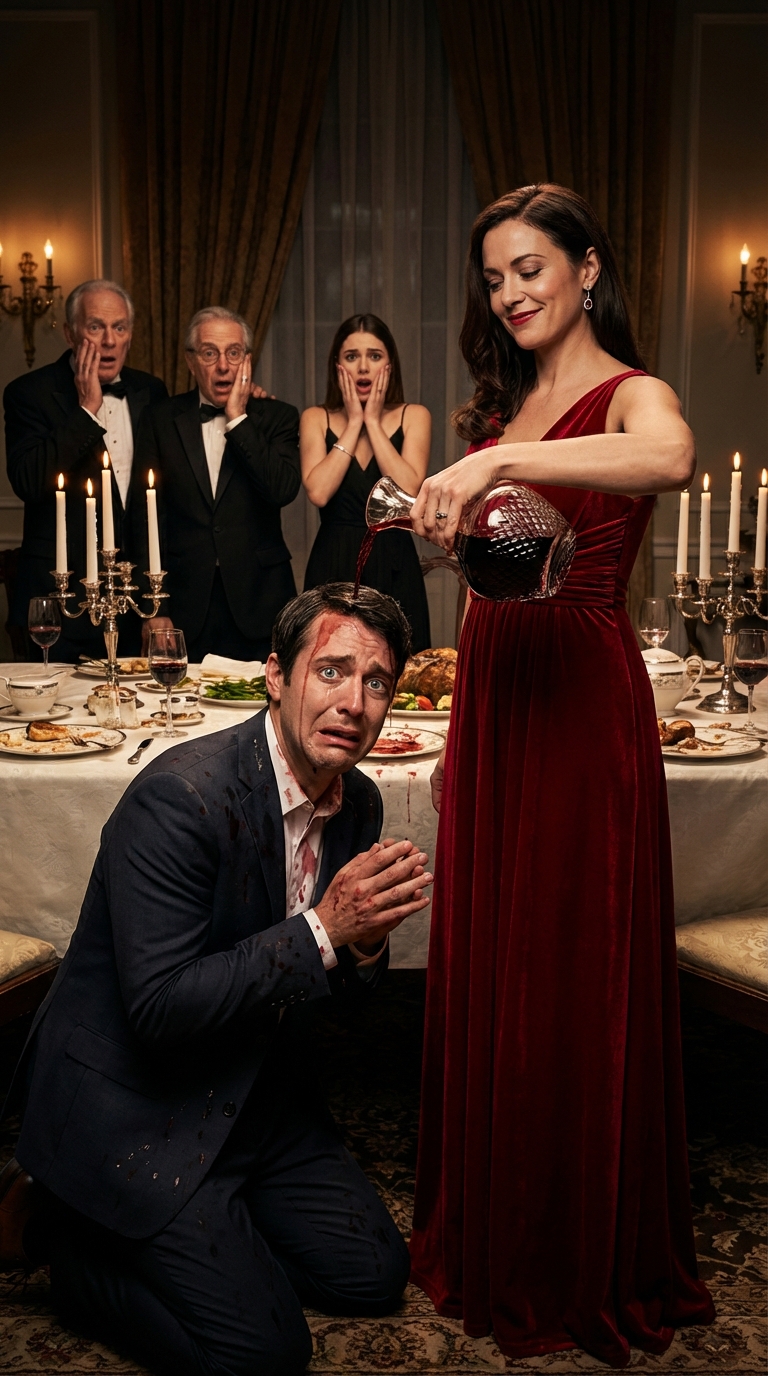
The Uninvited Truth
My name is Joanna Miles. I am twenty-six years old. And if there is one fundamental law that governs the ecosystem of my family, it is this: Image is the currency, and truth is the tax. Unfortunately, I am always the one forcing them to pay the bill.
I wasn’t surprised when the world learned to laugh at me. I grew up with it. It was the background radiation of my childhood—the raised eyebrows at the dinner table, the subtle comments about my dress size, the pitying looks that screamed, “Why can’t you just try harder to be like everyone else?”
But nothing—not a lifetime of passive-aggressive commentary—prepared me for that Sunday evening.
A man who barely knew me, my sister’s polished new boyfriend, leaned back in his mahogany chair, swirled his Cabernet, and asked if I was “still unemployed” like it was the punchline to a joke he had been dying to tell all night.
Everyone laughed. My mother covered her mouth to hide a smile. My father nodded, a gesture of silent camaraderie with the bully. And for a fleeting, dangerous moment, I almost let it slide. I almost swallowed the humiliation the way I had swallowed every criticism for the last two decades.
But the thing about humiliation is that it has a breaking point. Sometimes, it hits you exactly when you are finished pretending you don’t feel it. And sometimes, the person who thinks he holds the entire world in the palm of his hand accidentally says one sentence—just one—that exposes more about himself than he ever intended.
Because while he kept talking, acting like he understood the corporate world better than I ever would, he mentioned a detail that didn’t fit. A specific regulatory acronym that didn’t belong in his department. It was a tiny slip, a hairline fracture in a perfect façade.
It made me stop breathing for half a second.
I didn’t call him out that night. I didn’t raise my voice. I didn’t flip the table. I just watched him talk. I let everyone enjoy their laugh at my expense. I waited quietly until the moment his own words would circle back to strangle his carefully constructed reality.
Before I tell you what he said, and the nuclear fallout that occurred when I finally walked out of my sister’s wedding, drop a comment below. Tell me, what time is it for you right now? And where are you watching from? I want to see how far this story travels.
The dinner took place on a suffocatingly quiet Sunday evening.
I drove back to my parents’ house with that familiar, iron-band tightness in my chest—the somatic response that always surfaced whenever I crossed the invisible border into their neighborhood. Their street looked exactly the same as it had when I left for college: manicured lawns cut to military precision, matching mailboxes, and houses pretending that nothing unpleasant ever happened behind their heavy oak doors. The illusion was intact. Polished. Rigid.
I parked my beat-up sedan behind my father’s pristine SUV, took a deep breath that rattled in my lungs, and stepped inside.
My mother stood by the kitchen island, arranging salad plates like she was setting up a showroom rather than a family meal. She greeted me with a smile that felt more like a checklist item being ticked off than an expression of joy.
“You’re cutting it close, Joanna,” she said, her eyes flicking to the clock. She didn’t ask how I’d been. She didn’t ask about my life. She implied that arriving five minutes before dinner signaled a deep-seated character flaw.
I had grown used to comments that hovered in the grey zone between polite and critical. My presence was tolerated, never celebrated.
My father sat at the head of the table, reading through a stack of mail. He acknowledged me with a curt nod—the bare minimum effort required to avoid being overtly rude. There was no warmth. No “Good to see you.” Just the acknowledgment of a disruption.
I took my seat quietly, folding my hands in my lap, trying to make myself as small as possible.