

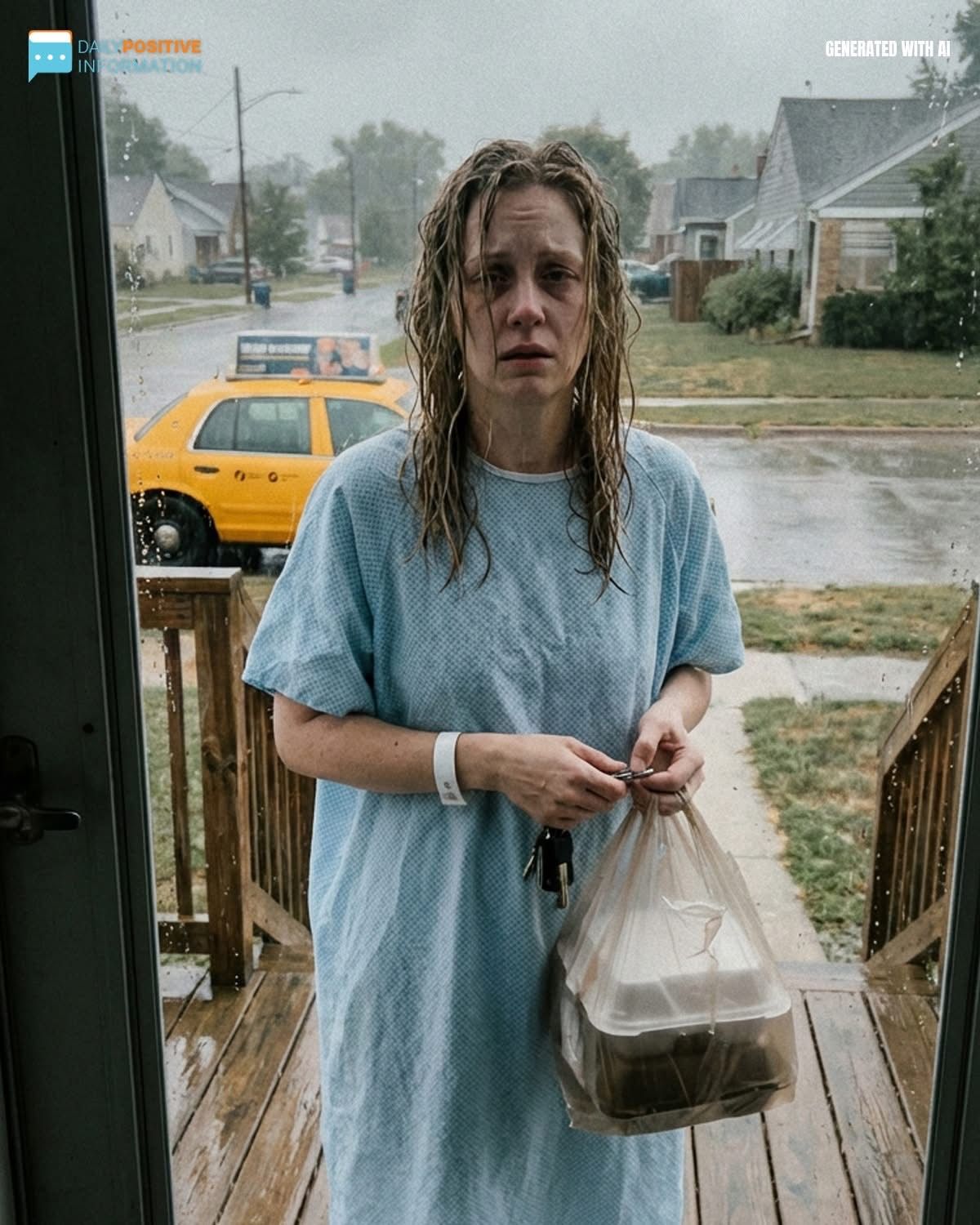
The taxi driver hesitated before pulling away from the curb outside the beautiful two-story colonial house in the quiet suburb of Ridgewood, New Jersey. He glanced in his rearview mirror at the elderly woman standing on the sidewalk, leaning heavily on a wooden cane, a small overnight bag from the hospital sitting at her feet like an abandoned child.
“Are you absolutely sure you’re okay, ma’am?” he called through the open window, genuine concern in his voice. “It doesn’t look like anyone’s home. I can wait with you if you’d like.“
Martha Miller forced a smile that didn’t reach her eyes, even as the cold October wind cut through her thin hospital-issued jacket and made her bones ache. “I’m fine, young man. Really. My son must have just stepped out for a moment. Thank you for your concern.“
As the yellow taxi pulled away and disappeared around the corner, the fragile smile vanished completely from Martha’s seventy-two-year-old face. She stood alone on the sidewalk in front of the house where she’d lived for forty years, feeling more abandoned than she’d ever felt in her entire life.
She had just spent fourteen days in the cardiac ward at Valley Hospital recovering from what the doctors had carefully called a “minor cardiac event”—which was medical speak for a heart attack that could have killed her if the neighbor hadn’t found her collapsed in her garden and called 911. Fourteen days of hospital beds and beeping monitors and nurses checking her vitals every few hours while she waited for her only son to visit.
He never came.
She had called Owen three separate times to tell him she was being discharged and needed a ride home. He hadn’t answered any of the calls. She’d left voicemails. She’d sent text messages that she’d painstakingly typed out with her arthritic fingers on the smartphone Owen had given her last Christmas and never bothered to teach her how to use properly.
Nothing. Complete silence.
Now she stood in front of the house—her house, the beautiful colonial with the wraparound porch and the oak trees in the front yard that she and her late husband Arthur had bought in 1983 when Owen was just a baby. This was the place where they had celebrated every Christmas and Thanksgiving for four decades. This was where Owen had learned to ride a bike on the driveway. This was where Arthur had taken his last breath just six months ago, holding Martha’s hand and whispering that he loved her.
Martha walked slowly up the brick pathway that Arthur had laid himself thirty years ago, her legs trembling with the weakness that comes from two weeks in a hospital bed. She reached into her worn leather purse for her house key—the same key she’d carried on the same keychain for forty years.
She slid it into the lock on the heavy oak front door.
It didn’t turn.
She frowned, pulling the key out and examining it to make sure she hadn’t somehow grabbed the wrong one. No, it was definitely her house key. She tried again, jiggling it gently. The key wouldn’t even slide all the way into the lock. She stepped back and looked more closely at the brass hardware on the door.
It was new. Shiny, completely scratch-free, and utterly unfamiliar. Someone had changed the locks.
Confusion began to set in, followed almost immediately by a cold, crawling dread that started in her stomach and spread through her entire body. And then she saw it.
Taped to the heavy oak door with what looked like regular Scotch tape was a piece of white printer paper. The corners were flapping in the autumn wind. The message was typed in bold, aggressive capital letters that looked like they were shouting at her:

DO NOT BOTHER KNOCKING. THIS IS MY HOUSE NOW. DAD LEFT IT TO ME IN HIS WILL. THERE IS NO ROOM HERE FOR FREELOADERS WHO DON’T CONTRIBUTE ANYTHING. GO FIND A NURSING HOME OR MOVE IN WITH AUNT LINDA. – OWEN
The brutality of those words hit Martha harder than the heart attack that had nearly killed her two weeks ago. “Freeloader.” The word echoed in her mind like a curse. She had carried this boy in her womb for nine months. She had endured twenty-three hours of labor to bring him into the world. She had changed his diapers and nursed him through childhood illnesses and stayed up all night when he had nightmares. She had worked two jobs to help pay for his college education when money was tight. She had defended him to his father when Arthur criticized his choices.
And now, standing on the doorstep of the home she had helped build and maintain for forty years, she was a “freeloader.”
Owen had been operating under a delusion that had apparently been festering in his mind since Arthur’s funeral six months ago. He believed in some ancient, unspoken law of primogeniture—the idea that the “only son” automatically inherited everything. He believed that without a specific will document physically handed to him, the entire estate naturally reverted to the male heir. He believed his mother was just a temporary guest in what was rightfully his inheritance, and now that the proper mourning period had passed, it was time for her to leave.
A younger Martha might have screamed and pounded on the door until her fists were bloody. A weaker Martha might have collapsed right there on the porch and wept until the neighbors noticed and called for help.
But Martha did neither of those things.