

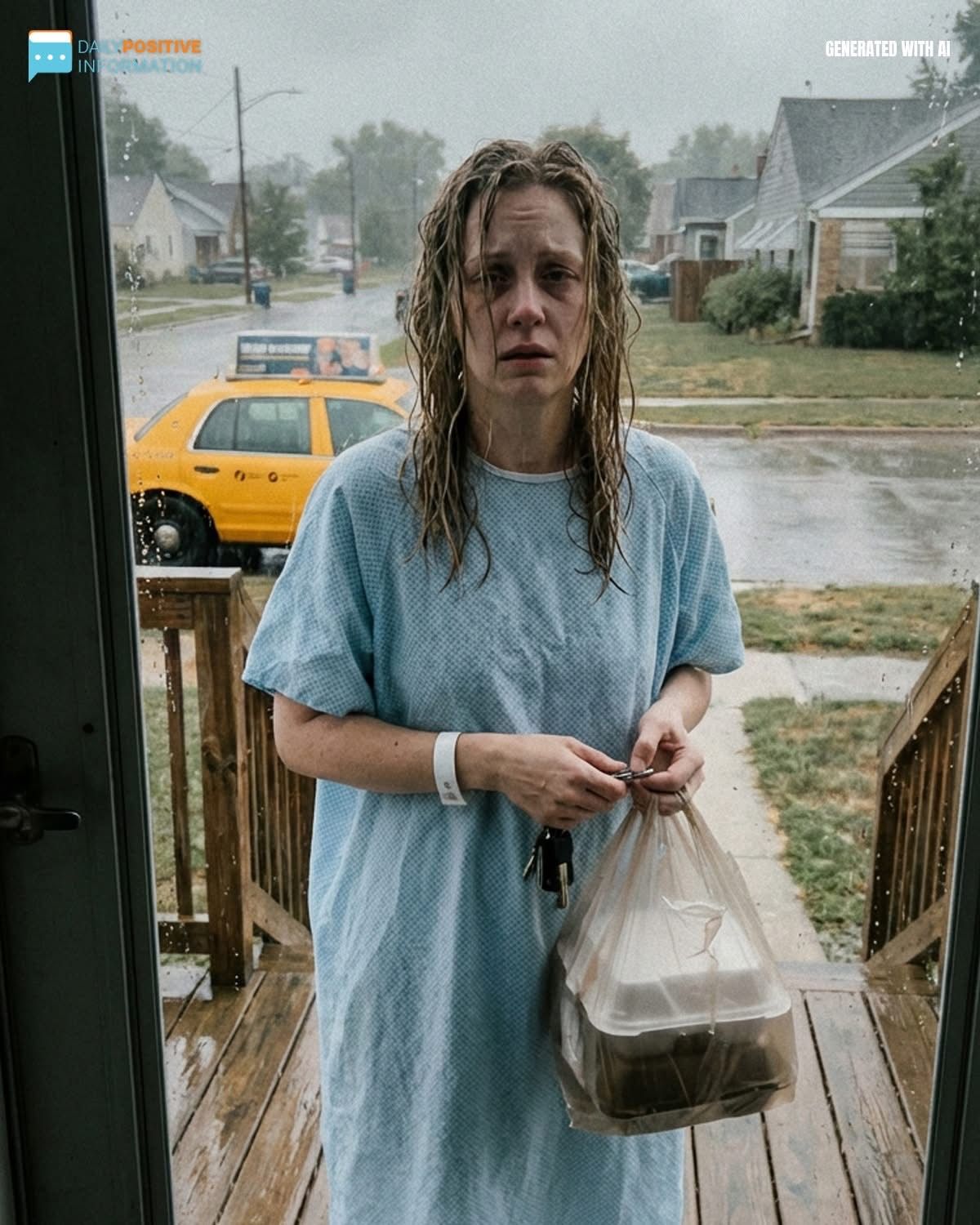
She stared at that note for a long moment, and a strange, cold clarity washed over her like ice water. The grief she’d been carrying for the son she thought she had raised—the son she’d believed would take care of her after Arthur died—was replaced by a profound, aching respect for the husband she had lost.
She reached out and touched the cold wood of the door that Arthur had refinished with his own hands fifteen years ago.
“Oh, Arthur,” she whispered to the empty October air, her breath visible in the cold. “You were right about him. I defended Owen for so long. I told you he would step up when the time came. I told you he just needed to mature. But you knew. You always knew what he really was.“
She didn’t bang on the door. She didn’t press her face to the windows where she could see the faint flicker of the television playing inside. She didn’t shout or plead or beg or give Owen the satisfaction of seeing his elderly mother reduced to desperation.
Instead, Martha walked slowly and deliberately to the wooden garden bench on the porch—a bench Arthur had built with his own hands thirty years ago—and sat down carefully, mindful of her still-healing heart. She pulled her cell phone from her purse with hands that were steadier than she would have expected.
She didn’t call Owen. She didn’t call her sister Linda in Pennsylvania. She dialed a number she had carefully memorized five years ago, a number she had hoped she would never need to use.
“Hello, Mr. Henderson,” she said when a familiar voice answered on the second ring. Her tone was steady and clear, completely devoid of the tremors of age or fear. “It has happened. Exactly as Arthur predicted it would. Owen has changed the locks on the house and left a note telling me to leave. Yes, I’m sitting on the front porch right now. Please bring the file—you know which one I mean. And please bring a locksmith. And perhaps… perhaps you should bring the sheriff as well.“
She ended the call, wrapped her thin coat tighter around her frail body, and settled in to wait. She wasn’t a helpless victim shivering pathetically in the cold. She was a general waiting for her artillery to arrive.
The celebration inside that was about to be shattered
Inside the warm, well-lit living room of the house, the atmosphere was one of triumphant celebration mixed with greedy planning for the future.
Owen Miller sprawled in his father’s favorite brown leather recliner—the chair Arthur had sat in every evening to watch the news and read the paper, the chair that still smelled faintly of his aftershave. Owen had a glass of his father’s expensive Macallan scotch in his hand, the bottle he’d found in the cabinet that Arthur had been saving for special occasions.
Across from him, his wife Jessica was already redecorating in her mind, flipping through paint color swatches she’d brought from Home Depot and holding them up against the walls to see how they’d look.
“I absolutely hate this wallpaper,” Jessica said, wrinkling her nose in disgust at the floral pattern Martha had chosen twenty years ago. “It smells like old people and mothballs. We need to gut this entire first floor. Open concept is what’s trendy now. Knock down this wall between the living room and dining room. Put in one of those big kitchen islands everyone has.“
Owen laughed, a sound that contained no warmth or genuine happiness—just satisfied greed. “Do whatever you want, babe. It’s ours now. Finally. We can renovate the whole damn place.“
“Are you absolutely sure she won’t come back?” Jessica asked, pausing her decorating plans with a flicker of concern. “What if she still has a key? What if she tries to get back in?“
“I changed all the locks this morning,” Owen bragged, swirling the expensive scotch in his glass like he was some kind of sophisticated businessman instead of a forty-three-year-old man who’d never held a job for more than two years. “Had a locksmith come first thing. Cost me three hundred bucks, but it was worth it. Let her try to get in. She’ll see the note I left and go crying to her sister Linda in Pennsylvania. I’m done carrying her dead weight. Dad is gone, and the law is the law. I’m the only son. Possession is nine-tenths of the law, right? I’m physically in the house. She’s out on the street where she belongs.“
He took a long, self-satisfied sip of the scotch that wasn’t his. “I deserve this house after putting up with Dad’s lectures and criticism for thirty years. This is my payment for all those years of listening to him tell me I needed to get my life together.“
They clinked their glasses together in a toast to their new fortune, completely oblivious to the headlights that were sweeping across the front window as multiple vehicles pulled into the driveway.
Ten minutes later, a loud, mechanical drilling sound suddenly erupted from the front door, shattering the comfortable silence.
Owen jumped up from the recliner so fast he spilled expensive scotch all over his father’s chair. “What the hell is that?“
“Oh my God, is she trying to break in?” Jessica shrieked, her voice going high with panic. “Should we call the police?“
“I’ll handle this,” Owen growled, his face flushing red with anger and indignation. He marched toward the front door, ready to physically intimidate his seventy-two-year-old mother if necessary. “I told that woman to leave! She’s trespassing!“
The front door swung open before Owen could even reach it, pushed inward by someone with the legal authority to do so.
It wasn’t just Martha standing in the doorway.
Standing in the hallway was his mother, looking somehow regal and dignified despite her obvious fatigue and her cheap hospital jacket. But she wasn’t alone. Flanking her on both sides were two uniformed sheriff’s deputies with their hands resting casually on their duty belts. Beside them stood Mr. Robert Henderson, the family attorney—a tall, distinguished man in his late sixties with iron-gray hair and sharp eyes that had seen every possible variation of human greed and stupidity in his forty years of practicing law. He was holding a thick leather briefcase that looked expensive and official.
Behind all of them, a locksmith was packing up his drill and gathering the new locks Owen had installed that morning, which were now sitting in pieces on the porch.
“What is this?” Owen shouted, his face turning from red to purple with rage and confusion. “You’re all trespassing! Get out of my house right now! This is my property! Dad left it to me when he died!“
He pointed a shaking finger at the sheriff’s deputies, his voice getting louder and more aggressive. “Officers, I want you to remove this woman from my property immediately! She doesn’t live here anymore! She has no right to be here!“
Mr. Henderson stepped forward calmly, setting his briefcase down on the dining room table with a heavy thud that seemed to echo through the room. The sound was loud enough to cut through Owen’s shouting and create a moment of shocked silence.
“Mr. Miller,” the lawyer said, his voice calm and authoritative, projecting effortlessly over Owen’s hysteria without needing to raise his volume at all, “I strongly suggest you lower your voice. You are currently disturbing the peace in a private residence that does not belong to you.“
“It’s MY residence!” Owen yelled, spittle flying from his mouth. “My father’s house! He built it! I’m his only son!“
“No,” Mr. Henderson said flatly. He opened his expensive briefcase with two crisp clicks and pulled out a document bound in official blue legal paper with multiple notary seals visible on the pages.
“You are operating under a significant and rather dramatic misunderstanding of the legal facts, Mr. Miller,” the attorney continued, his voice taking on the lecturing tone of someone explaining something to a particularly slow student. “Your father did not leave this house to you. In fact, your father did not legally own this house at the time of his death.“
Owen froze, his mouth hanging open. “What? That’s impossible. That’s a lie. He built this house. We’ve lived here for forty years.“
Martha stepped forward then, into her own home, but she didn’t look at her son. She looked instead at the walls she had painted, at the floors she had cleaned for decades, at the life she had built in this space.
“Five years ago,” Mr. Henderson explained, pulling out a certified copy of a legal document and handing it to one of the sheriff’s deputies to verify its authenticity, “when Arthur was first diagnosed with the heart condition that would eventually take his life, he came to my office. He was very, very specific about what he wanted done. He was worried about the future. Specifically, he was deeply worried about you, Owen.“
“Me?” Owen whispered, his aggressive bluster starting to deflate like a punctured balloon. “Why would he worry about me?“
“Because he knew exactly what kind of man you were,” Mr. Henderson said bluntly. “Arthur executed what’s called a Deed of Gift five years ago. At that time, while he was still in perfect health and sound mind, he transferred the legal title of this house, the land it sits on, and the entirety of his savings accounts and investment portfolios into the sole name of Martha Elizabeth Miller. Your mother. This house has belonged exclusively to her for five years. You have no claim to it whatsoever.“