

It vibrated again, the kind of pulse that traveled through bone.
I didn’t need to see the screen to know. But I did anyway, angling it low in the shadow of my knees.
A red-coated alert bloomed against the glass.
14 RED LEVEL PRIORITY.
For a second, the room tilted. The sounds of laughter and clinking forks blurred, as if I’d moved underwater. That kind of message didn’t exist for convenience. It didn’t arrive unless someone had already exhausted every other route and decided time was no longer a luxury.
I locked the phone fast and tucked it back under the tablecloth, hoping the moment had passed unnoticed.
It hadn’t.
A faint pulse of light brushed against my collarbone.
I looked down.
The pendant I always wore had begun to glow, a coded flicker under the dim chandelier light. I covered it with my palm instinctively, the metal warm against my skin. It dimmed slightly, but not enough.
One of the kids, Lily, leaned closer from across the table, her eyes wide with that unfiltered curiosity children still have.
“Aunt Vic,” she said, voice high and clear, “why is your necklace lighting up?”
The question cut clean through conversation. Laura turned her head, eyes narrowing. Michael’s smile appeared again, the kind he used when he wanted things to stay normal.
I kept my face calm, even as my heart beat in measured, controlled thuds.
“It’s just something I keep with me,” I said. “It helps.”
Not a lie. Not an explanation.
Lily frowned, unsatisfied, but someone shoved a roll into her hand and the moment drifted forward again, though not fully. A seam had opened in the room. People didn’t talk about it directly, but I felt their attention shift toward me like a slow tide.
The pendant cooled under my palm, its job done for the moment, leaving a faint heat behind.
I tried to return to the conversation, tried to be the version of myself they could dismiss easily.
But my body was already elsewhere.
Signals like that didn’t come without reason.
Whatever I’d been keeping at bay had found me here, at this table, under this bright light.
The wine bottle made another round. Laughter loosened. And with looseness came old habits.
Michael’s gaze began landing on me more often, lingering, drifting away again like he was testing the weight of an idea. Every time someone mentioned careers, stability, achievements, I could feel him waiting for the moment he could pivot the room toward me.
It felt familiar in a way that made my stomach tighten.
When I was seventeen, I used to sit at this same table and listen to people talk about my future like I wasn’t in the room. Michael had always been the golden one. Steady. Reliable. The son who stayed close, who fit in the shape our parents expected. I had been the odd angle, the girl with too many questions and too much stubbornness in her spine.
I hadn’t thought about that version of myself in years, but tonight she hovered near the surface, alert and braced.
Laura leaned back with her wine, her tone playful but edged.
“Life up in Maine must be pretty quiet, right?” she said. “Not much going on day to day.”
Her husband chuckled, adding, “Ever think about moving somewhere with more opportunities? Portland’s really booming.”
The questions slid in smoothly, but they weren’t meant to understand. They were small reminders of where they believed I belonged in the unspoken hierarchy of this family.
I smiled, lifted my fork, took a bite of food I didn’t taste.
“I’m fine,” I said. “I like my life.”
Michael made a small sound, as if that answer wasn’t enough.
Dessert plates arrived. The children’s excitement rose again, but the adults settled into something heavier. The air thickened with the weight of words people saved until they had an audience.
Michael set his dessert plate down with a firmness that didn’t belong to cake.
He looked straight at me, and there was no attempt to hide the thing he wanted.
“Twelve years gone, Vic,” he said, voice loud enough that the table stilled around it. “No one knows where you’ve been or what you’ve been doing. You only show up when someone reaches out. I just want to understand where your life is heading.”
The adults froze mid-movement. Kids stopped tapping their spoons. Even the chatter from the kitchen seemed to pause, as if the house itself was listening.
My pulse remained steady. Years of training had done at least that for me. But my chest tightened anyway, not with fear, but with a familiar exhaustion.
I kept my voice level.
“Enough to live quietly,” I replied.
Michael frowned, unsatisfied.
“Quiet isn’t a direction,” he said. “You need something more concrete.”
He wanted remorse. He wanted validation for the picture he’d drawn of me all these years. He wanted me to admit that I’d failed so his life could shine brighter by comparison.
I didn’t give him any of it.
My silence pushed him further.
“You had potential once,” Michael continued, leaning forward slightly, his hands splayed on the table as if he were making a case. “But it’s like you drifted off course for over a decade. Don’t you think the rest of us wonder how it came to this?”
The phrase landed like a stone.
How it came to this.
As if I were a cautionary tale. As if my life were a warning to the children at the table about what happened if you didn’t follow the acceptable script.
A few relatives shifted uncomfortably. No one interrupted. No one told him to stop. The silence was its own kind of agreement.
I could have ended it right then. I could have stood, smiled, excused myself, left without giving him the satisfaction of a reaction.
But my phone vibrated again under the tablecloth.
Short. Sharp. Unmistakable.
My breath caught.
I covered the movement by adjusting my napkin. My fingers brushed the phone, and the screen lit briefly beneath the cloth, casting a faint red glow against my thighs.
This wasn’t a reminder. This was escalation.
Michael kept talking, voice rising with frustration.
“Everyone here works hard to keep this family together,” he said. “But you, you’re always gone. You’re never here when it matters.”
The words struck deeper than he realized, not because they were true, but because of the arrogance of believing he knew where I’d been.
I opened my mouth, ready to stop the conversation before it curdled further, ready to say something that would shut him down without revealing anything.
Then the air changed.
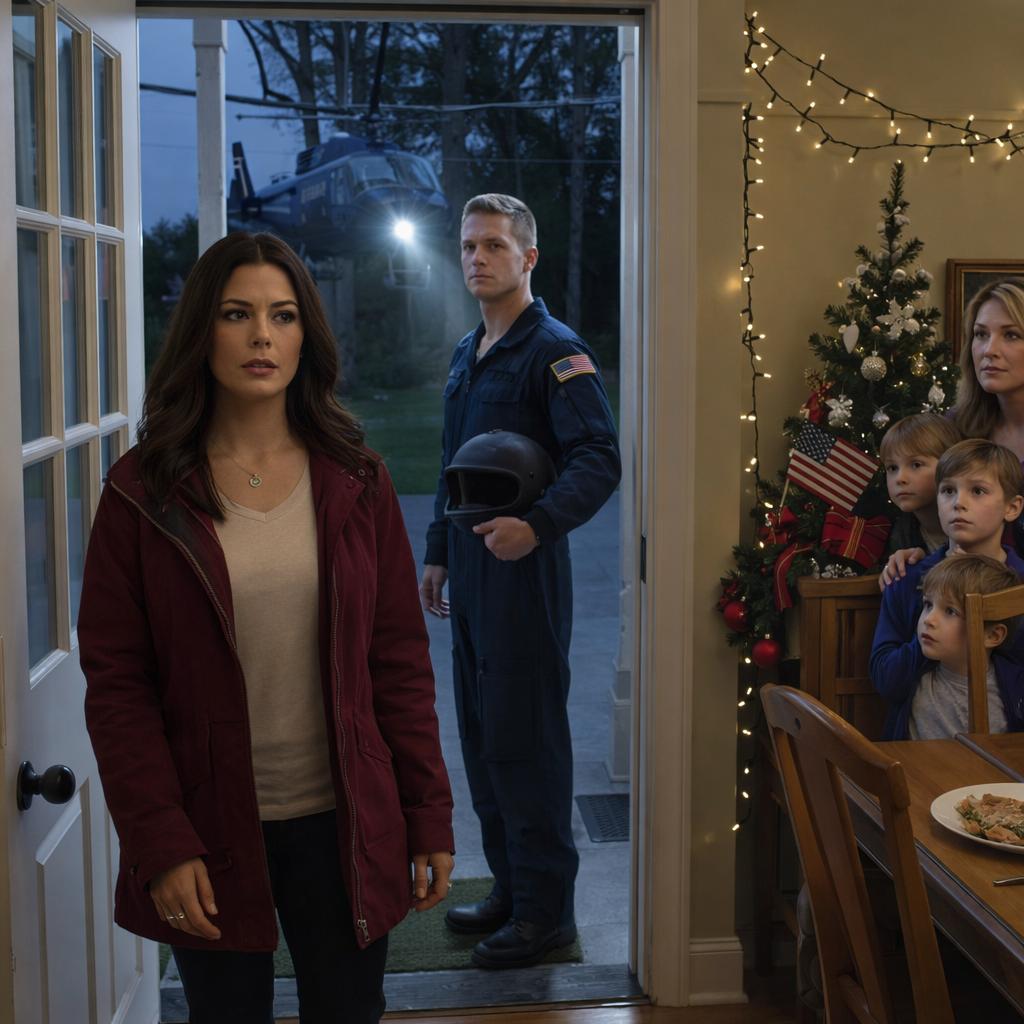
A low, distant rumble rolled through the night. Slow at first. Almost like wind.
But it wasn’t wind.
It grew heavier, deeper, vibrating the glass in the window behind Michael.
One of the water glasses trembled against the table, a soft chitter of crystal against wood. A few people glanced at it, confused. Someone laughed nervously and said, “Earthquake?”
The rumble deepened, moving closer.
I felt my pulse slow into that familiar clarity. My senses sharpened. The room’s bright light seemed to flatten, turning faces into shapes and motives into outlines.
Michael turned his head toward the window.
“What is that?” he demanded, but the edge in his voice was gone now, replaced by uncertainty.
I stood slowly.
The rumble grew into a roar.
A sweep of white light cut across the backyard window, scanning the yard in a smooth, deliberate arc. The maple trees outside bent violently as if shoved by a giant invisible hand. Leaves launched into the air in frantic spirals.
Laura shot upright, knocking her chair backward.
“What is that?” she cried. “Who flies that low over a neighborhood?”
The kids scrambled toward the window, pressed their hands against the glass, faces lit with awe and fear. I moved quickly, pulling them back by their shoulders, guiding them away from the pane.
“Stay back,” I said, voice firm.
The sound outside swelled, swallowing everything else. The chandelier overhead swayed, crystals clattering together in frantic, brittle tones.
Michael stepped toward the door that led to the backyard, his face pale.
“You know what’s happening,” he said, not a question anymore.
I didn’t answer. It was too late for comfortable lies.
He reached for the door handle. I caught his arm.
“Not with that downdraft,” I said.
His eyes widened at the certainty in my voice.
“How do you even know…”