

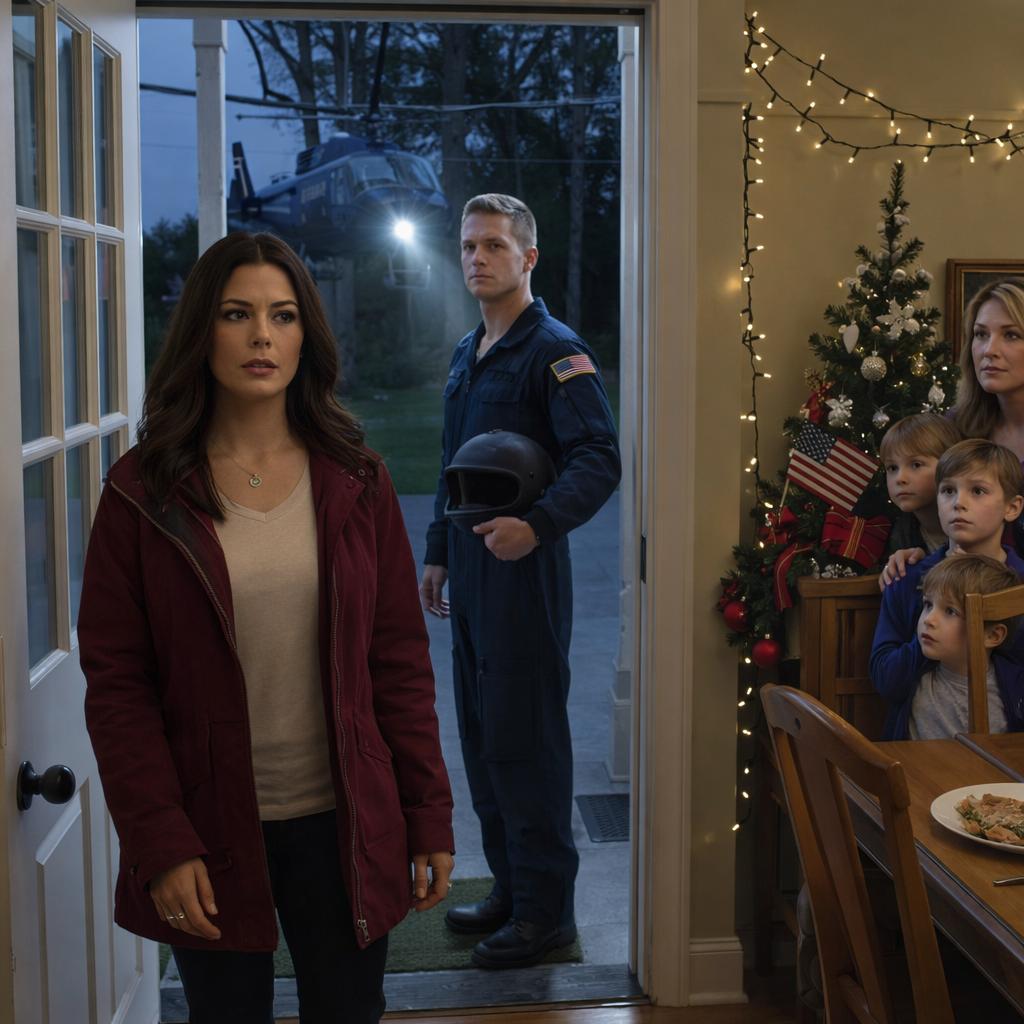
His question died as a massive shadow swept across the ceiling, darkening the room for a heartbeat.
Then the helicopter dropped fully into view.
An MH-60S Seahawk, low and deliberate, descending straight into Michael’s backyard as if it owned the air itself.
The lawn erupted into chaos. Leaves and debris whipped into a storm. Patio chairs skittered across concrete. The force hit the house with a creak that made Laura’s sister scream.
Michael peered through the curtain, his mouth slightly open.
“Someone’s getting out,” he whispered.
I didn’t need to look to know the silhouette. The helmet. The posture. The precision. That particular kind of presence only arrived when time had become a weapon.
Laura turned toward me, hands trembling.
“Vic,” she said, voice thin and tight. “What did you get yourself into?”
Before I could answer, there was a knock at the back door.
Not frantic. Not polite.
Three firm, efficient strikes.
The house went dead quiet.
Michael froze mid-step. No one moved. No one breathed.
I walked toward the door. This time, no one grabbed my arm, no one tried to stop me, as if some instinct in all of them recognized that whatever was on the other side of that door had come for me.
The roar outside swallowed sound as I opened it. Cold wind slammed into my face, carrying the bite of exhaust and damp earth. Floodlights from the helicopter carved the yard into harsh white light.
An officer stood on the porch, helmet tucked under one arm, radio cable dangling from his flight suit. His eyes locked on mine with absolute focus.
He straightened as if pulled by a string and snapped into a salute so crisp it felt like a blade.
“Ma’am,” he said, voice cutting clean through the rotor thunder. “We had to approach directly. Long-range communications are experiencing severe interference.”
I leaned into the wind, letting the cold ground me.
“Priority level?” I asked.
“Omega,” he answered instantly. “Three active hot zones. We’ve been waiting for confirmation of your location for twenty minutes.”
Twenty minutes.
While my brother dissected my life over dessert, the world had been trying to reach me with an urgency most people never had to imagine.
I kept my voice steady.
“Formation established?”
“Assembling at Trident Pier,” he replied. Then, louder, as if sealing it into the night itself: “We need you immediately, Admiral.”
Behind me, the house made a sound, a collective inhale of disbelief. I didn’t turn around yet. I could feel their shock like heat against my back.
I nodded once.
“I need three minutes,” I said.
He didn’t question it. He saluted again and stepped back into the floodlight wash, turning his head slightly toward the helicopter as if receiving silent updates.
I closed the door and faced my family.
In the sudden muffled quiet, the house felt smaller, tighter. The bright dining room lights seemed almost ridiculous now, like a stage set left standing after the play had ended.
Every face stared at me. Mouths slightly open. Eyes wide. Fear and confusion tangling together.
Laura spoke first, voice thin.
“Vic… what is happening? Why did he call you that?”
Michael’s voice came out hoarse, like he’d swallowed his certainty and it had lodged in his throat.
“Admiral,” he whispered. “Is that… is that actually you?”
The look on his face wasn’t dominance anymore. It wasn’t judgment. It was something close to fear, not of me, but of the fact that the story he’d believed about me had never been real.
“It’s a name for the work I do,” I said softly. “Not for family dinners.”
The silence that followed pressed heavy into the walls.
Laura took a shaky step forward.
“How long have you been in the military?” she demanded, as if volume could make the truth easier to digest. “Why didn’t you ever say anything? How could none of us know?”
“Because I wasn’t allowed to,” I said. “And because even if I had, no one would have believed me.”
The truth hung there, sharp and plain.
Michael’s face tightened. He let out a small, incredulous laugh that never fully formed.
“My God,” he said. “Where did you go? What were you doing all those years? We all thought you were just… drifting.”
I met his gaze.
“I wasn’t drifting,” I said. “I was doing what I was assigned to do.”
A cousin near the far end of the table spoke, voice trembling.
“If they came for you like that… that means tonight something serious is happening, doesn’t it?”
I nodded once.
“Serious enough that they exhausted every other way to reach me.”
Another blast of rotor wash rattled the windows. The glass shuddered in its frame. A spoon on the table vibrated, clinking against a plate.
Laura’s eyes shone as if she might cry, but she didn’t. Her voice dropped to a whisper.
“You’ve lived like this for years,” she said. “All alone.”
I felt something tighten in my chest, but I didn’t let it show in my face. That kind of vulnerability wasn’t useful right now.
“I’ve done what I had to do,” I said. “Nothing more. Nothing less.”
No one spoke after that. The silence was different than the ones I grew up with. It wasn’t dismissive. It wasn’t meant to shrink me. For the first time, it was recognition, an admission they hadn’t known how to give.
I moved fast. No wasted motions.
I took my coat from the hook by the door. Buttoned it. The brine scent rose again, sharp and steady. I reached for my small bag and slid the strap over my shoulder.
When I turned back, my family stood exactly where I’d left them, frozen in a loose semicircle as if the room itself had congealed around my truth.
No one tried to stop me.
No one reached out.
No one filled the moment with soft excuses or apologies that would have arrived too late.
I walked toward the back door again. Wind pressed against it, eager.
My hand paused on the knob for half a second.
Not because I was afraid to go.
Because the house behind me held a version of my life I had never wanted to bring into it. Once revealed, it couldn’t be put back.
I opened the door.
Cold air slapped my cheeks. The yard was transformed into a harsh white circle under the helicopter’s floodlights. Leaves spun like frantic insects. The grass bent under the force of the rotors.
The officer waited, arm lifted to guide me.
I glanced back once, just once.
My family filled the doorway like silhouettes caught between disbelief and shame, the warm yellow light behind them making their faces look strangely small.
My voice came out softer than I expected, nearly swallowed by the wind.
“Don’t look at me like I changed tonight,” I told them. “I’ve always been who I am. You just never saw me clearly.”
Then I turned away and stepped into the light.
The metal steps rang beneath my boots as I climbed toward the open cabin, the sound sharp and clean against the thunder of the rotors. Wind tore at my coat, snapping the fabric hard enough to sting my wrists. The officer kept one gloved hand raised, guiding me with precise motions born of repetition, not urgency. Everything about him said this was controlled, expected, already accounted for.
Behind me, Michael’s house stood frozen in light and chaos. The backyard that once hosted summer barbecues and birthday parties was unrecognizable now, grass flattened into wild patterns, patio furniture overturned like toys forgotten by a careless child. My family clustered in the doorway, unmoving silhouettes framed by yellow light. They looked small from here. Smaller than I remembered.
I didn’t wave.
The cabin door slid shut with a solid, final sound, sealing out the noise of my former life along with the wind. Inside, the air was dense with fuel and metal and something sharper, electrical, alive. Red lights bathed the interior, turning every face into angles and shadows. Harnesses hung ready. A crew chief moved with quick efficiency, securing straps, checking instruments, his eyes flicking to me once and then away.
The helicopter lifted before I had fully settled, the ground dropping out from beneath us in a smooth, practiced motion. The vibration traveled up through the seat and into my spine, a familiar rhythm that my body recognized instantly. My breath slowed without conscious effort.
We were airborne.
Through the small round window, Michael’s neighborhood shrank into geometry, neat rows of roofs and driveways dissolving into abstraction. The house with the ruined backyard became indistinguishable from the rest. I watched until I couldn’t tell which one had been his anymore.
The officer who had knocked on the door settled into the seat across from me, helmet now clipped overhead. Up close, he looked younger than he had outside, early thirties at most, eyes sharp and alert. He studied me with the careful neutrality of someone who had been instructed not to stare and was failing quietly.
“Commander Hale,” he said over the intercom, tapping the name stitched to his flight suit. “Air Wing Two. I’ll be your transport tonight, Admiral.”
“Thank you, Commander,” I replied. “Sorry about the landing zone.”
He grimaced slightly. “We did our best. Interference ruled out our preferred approach.”
That word again. Interference.
“How widespread?” I asked.
Hale hesitated, then glanced toward the cockpit, where the pilots moved in synchronized silence, hands steady on controls glowing green and amber.
“They’ll brief you at Trident Pier,” he said carefully. “What I can tell you is this isn’t localized. East Coast ports, Gulf traffic, parts of the Pacific grid. Satellite feeds are stable, but anything routing through civilian gateways is getting scrambled. We went contingency an hour ago.”
An hour.
While dessert plates were being cleared and my brother dissected my life, systems that held cities together had been unraveling.
I nodded once. “Fleets?”
“Strike Group Seven checked in from the Atlantic, then went dark on standard channels. They’re within protocol tolerances, but blind to civilian traffic overlays. Amphibious Ready Group off San Diego is holding. Cyber Command is running hot.”
The Seahawk banked, and the dark ocean filled the window, moonlight shattering across the surface like broken glass. I felt the pendant at my throat cool now, its earlier warmth gone, as if satisfied it had done its part.
A crew chief shifted a heavy duffel at my feet.
“Your go-bag, ma’am,” he said. “Retrieved from your residence in Maine. Scrubbed and loaded at Brunswick before diversion.”
Of course it had been.
I unzipped it just enough to confirm what I already knew. Civilian clothes folded with exactness. A uniform sealed in protective wrap. Documents in a slim fireproof sleeve. Everything where it was supposed to be. Everything waiting.
“You didn’t get much warning,” Hale said quietly.
“I had twelve years,” I replied.
We flew the rest of the way in focused silence. The coastline slid past beneath us, jagged and dark, the familiar shape of responsibility stretching farther than any family boundary ever could. Somewhere beyond the horizon, ships adjusted course, aircraft shifted patterns, and people who would never know my name slept under the assumption that the systems protecting them would hold.
They usually did.
Trident Pier came into view as a skeletal arm reaching into the water, lit bright against the darkness. Floodlights burned white, reflecting off steel and wet surfaces. Figures moved with urgency below, vehicles lining up in orderly rows. This was not panic. This was response.
The helicopter settled onto the pad with a jolt that rattled my teeth. The door slid open, and cold, metallic air rushed in. I stepped down onto vibrating steel, boots ringing sharp against the surface.
Two Marines flanked me, guiding me toward a waiting SUV. Hale jogged ahead, speaking quickly to an officer in a dark coat holding a tablet tight against his chest.
“Admiral,” the man said when I approached. “Commander Lewis. Logistics control. We’ll get you to the command center.”
“Brief me on the move,” I said.
Inside the SUV, the hum of the engine muted the world. Lewis pulled up a map layered with red and yellow icons scattered across the coastline.
“Three primary impact zones,” he said. “Savannah, Norfolk, Houston. Civilian port infrastructure showing coordinated disruption. Traffic systems deadlocking. Cranes freezing mid cycle. Fuel pipelines tripping failsafes in sequence.”
“And the cause?” I asked.