

I met him at an architecture networking event when I was 26. He was kind, patient. He never pushed me to confront my past before I was ready.
My mother never called. Not once in 10 years.
I was about to find out why.
The invitation arrived on a Thursday in late September. I almost threw it away, thinking it was junk mail—one of those glossy charity gala requests that found their way to anyone with a Manhattan zip code.
But the return address made me stop.
Thornton residence, Cedar Grove, New Jersey.
Inside was a thick cream-colored card embossed with silver lettering.
You are cordially invited to celebrate the 15th wedding anniversary of Linda and Richard Thornton.
Fifteen years.
My mother had been married to that man for 15 years, and this was the first time she’d reached out.
I called Aunt Patricia that evening.
“I got something strange in the mail today.”
When I told her, she went quiet for a long moment.
“I’ve heard things,” Patricia said carefully. “Through old friends from the neighborhood. Richard’s business hasn’t been doing well. Something about a failed expansion. They’ve had to make cuts. So they’re struggling enough that people have noticed. Your mother’s been less generous with her charity appearances lately. The country club membership is apparently in question.”
I stared at the invitation on my kitchen counter.
“You think that’s why they want me there?”
“I think your mother has never done anything without a reason.”
She was right. Linda Meyers—Linda Thornton now—operated on calculation. If she was extending an olive branch after a decade of silence, it wasn’t because she missed me. It was because she wanted something.
“What are you going to do?” Patricia asked.
I picked up the invitation again, ran my thumb over the embossed lettering.
“I’m going to go.”
“Are you sure?”
“Not for her,” I said. “For me. I need to close this chapter.”
Patricia paused. “If you need backup, I still have your father’s letter.”
I hadn’t forgotten. I never would.
The weeks leading up to the party, I found myself doing something I hadn’t expected.
I bought a gift.
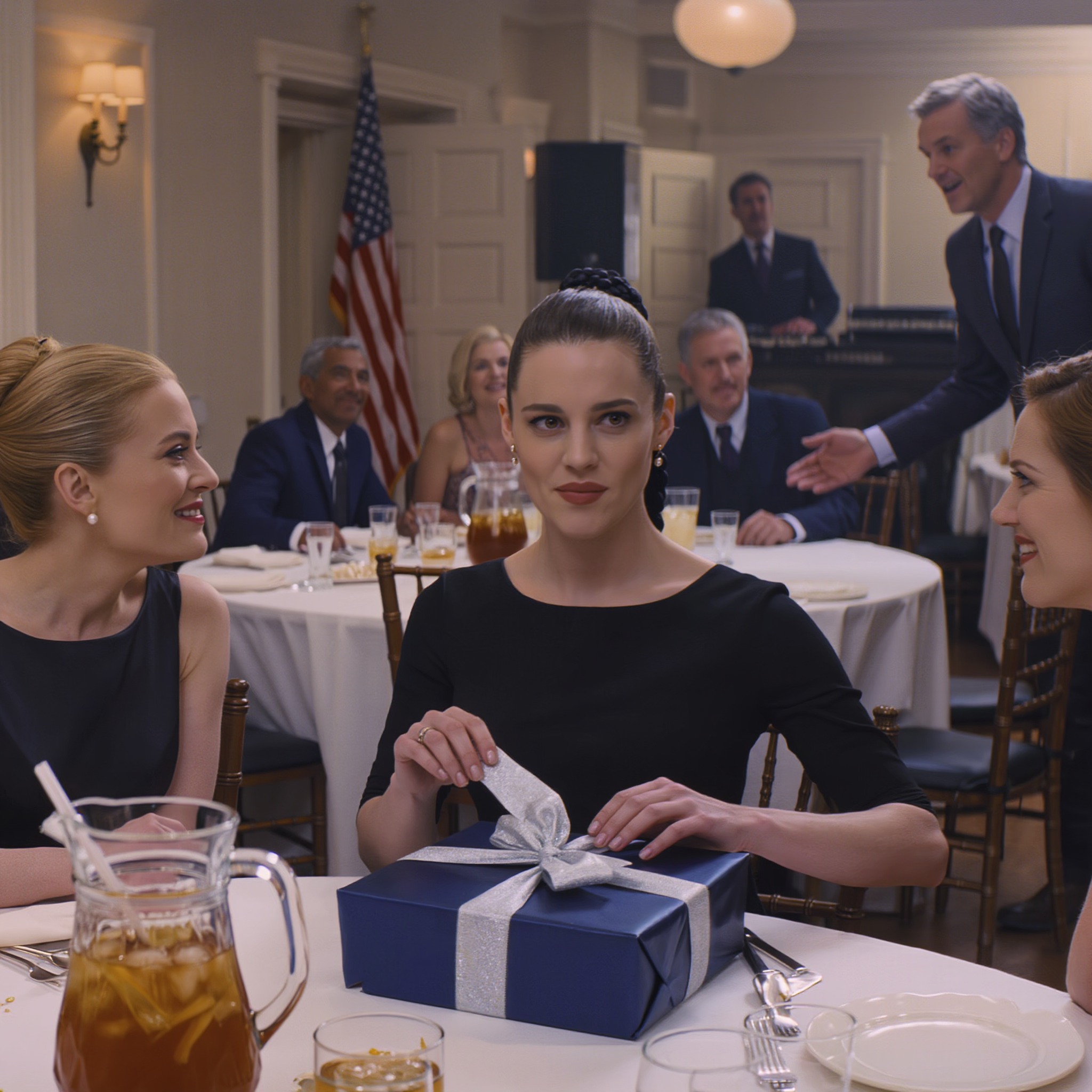
Marcus watched me wrap it at our dining table. A sleek box covered in navy blue silk paper, finished with a silver ribbon. His expression shifted between confusion and concern.
“You’re really bringing them something.”
“I know how it looks,” I said.
“Help me understand, then. These people treated you like garbage. They threw you out. Ten years of nothing, and now you’re buying them a present.”
I smoothed the ribbon carefully, aligning the bow.
“It’s not about them,” I said. “It’s about who I want to be.”
Inside the box was a single key on a velvet cushion. Beneath it, neatly folded ownership paperwork for a two-bedroom apartment in a quiet neighborhood in Manhattan. Not flashy, but solid. Safe. The kind of place where someone could start over.
$450,000.
Money I’d earned myself. Dollar by dollar, late night by late night.
I wanted to give her a chance—a real one. If she’d changed, if there was any part of her that regretted what happened, this could be a new beginning.
Marcus took my hand.
“And if she hasn’t changed?”
“Then at least I’ll know I tried.”
He didn’t argue. That was one of the things I loved about him.
The night before the party, I slipped something into my clutch: a copy of my father’s letter, along with documents showing the savings account history—proof that everything I had, I’d built on the foundation he gave me.
Not stolen. Not borrowed. Mine.
I hoped I wouldn’t need them. But I’d learned a long time ago that hope and preparation aren’t the same thing.
What I didn’t know was that I was walking into something far worse than I’d imagined.
Let me pause here for just a second. I’m genuinely curious. If you were in my shoes, would you have gone to that party? Drop “yes” in the comments if you’d have faced them head-on, or “no” if you think I should have stayed far away. And if you’re enjoying this story so far, hit that like button so I know to keep going.
All right—back to that night.
The country club looked exactly like I remembered from the photographs my mother used to post before she stopped posting anything at all. Crystal chandeliers dripping from vaulted ceilings. Tables dressed in white linen. A string quartet playing softly in the corner.
Roughly 50 guests milling about with champagne flutes, their laughter echoing off marble floors.
I walked in alone. Heads turned. Whispers followed.
“Is that Linda’s daughter? The one who disappeared?”
“I heard she’s been struggling, living hand-to-mouth somewhere in the city.”
I kept my expression neutral. My black cocktail dress was simple but expensive, the kind of understated elegance that people with real money recognize. My hair was pulled back in a low, sleek chignon.
In my hands, I carried the navy blue box.
I spotted my mother across the room before she spotted me. Linda Thornton stood at the center of a cluster of women, gesturing animatedly, her silver anniversary jewelry catching the light. She’d aged well—or expensively. Her smile was bright and practiced, the smile of someone who had spent years perfecting her public performance.
Then her eyes found me.
The smile froze just for a second. A flicker of something—surprise, calculation, annoyance—before the mask slid back into place.
She didn’t come to greet me. Didn’t wave. Just gave me a slight nod, the way you might acknowledge the caterer.
“Thea.”
I turned. Derek stood behind me, champagne in hand, smirking like we were old friends.
“So,” he said, “the prodigal daughter returns.” He looked me up and down. “Coming to beg for scraps?”
I met his gaze evenly. “I was invited.”
“Sure you were.” He stepped closer. “Word of advice—don’t embarrass yourself. Nobody here cares about you.”
I smiled slightly. “Then nobody should mind if I stay.”
Derek hadn’t changed. Thirty-two years old and still coasting on his father’s money. What was left of it, anyway. I’d done my research. The California degree had led to nothing. He’d bounced between consulting jobs, each one more vague than the last, before returning home to work for Richard in some made-up management position.
“Let me guess,” he said, swirling his champagne. “You’re here for a handout.”
“I’m here because I received an invitation.”
“Right,” he laughed. “My stepmother felt sorry for you. Said you’d probably show up in something from Goodwill, but we should be gracious anyway.”
I felt the familiar burn of anger, but I’d had 10 years to learn how to keep it contained.
“Is that what she told everyone,” I said, “among other things?”
Derek leaned in conspiratorially.
“That you couldn’t hold down a job. That you blamed everyone else for your problems. That you’re basically homeless.”
So that was the narrative. My mother had spent a decade painting me as a cautionary tale: the ungrateful daughter who couldn’t survive on her own.
“Interesting,” I said calmly.
“What’s interesting?”
“That she talks about me at all since she hasn’t called me in 10 years.”
Derek’s smirk faltered slightly. “Whatever. Just don’t cause a scene.”
He nodded toward the gift in my hands. “And don’t expect anyone to be impressed by whatever that is. We all know you can’t afford anything decent.”
I thought about telling him. Thought about watching his face change when he realized exactly who I’d become.
But not yet. Not like this.