

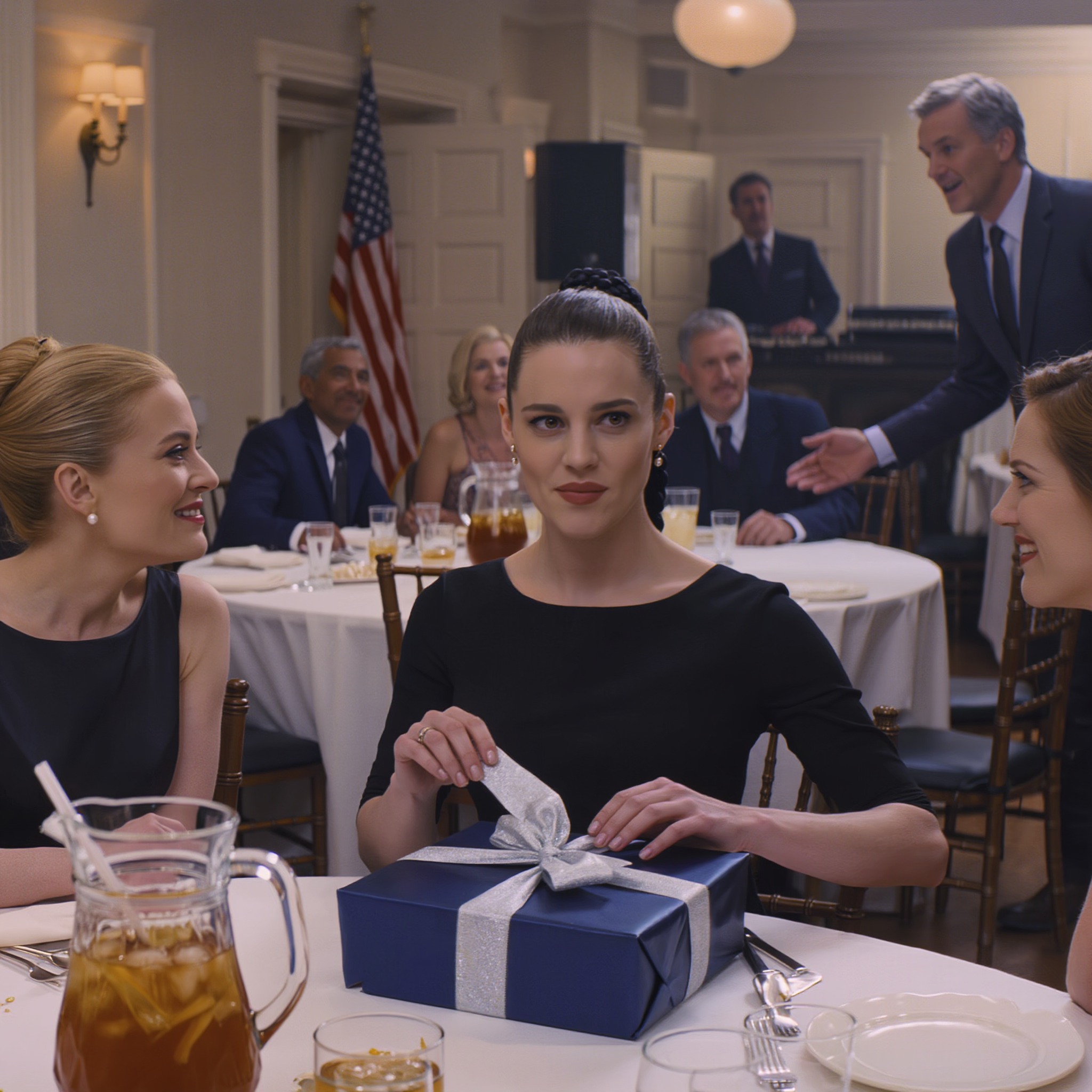
“Excuse me,” I said. “I should go congratulate the happy couple.”
I walked past him toward the main table where my mother sat like a queen surveying her court. The box felt heavier with every step.
The table fell silent as I approached. Richard sat at my mother’s right, nursing a whiskey. His face had grown harder over the years—deeper lines, a permanent furrow between his brows.
The look he gave me was the same one he’d worn the day he told me to get out.
I stopped in front of them and placed the box on the table.
“Happy anniversary, Mom.”
My mother glanced at the gift like it might bite her. Then she turned to the women beside her, a cluster of country club regulars in pearls and designer dresses, and laughed.
“Oh, look,” she said. “My daughter decided to show up after all.”
The women exchanged glances, polite smiles that didn’t reach their eyes.
“That’s a lovely box,” one of them offered.
My mother didn’t touch it.
“I’m sure it’s very… thoughtful,” she said, emphasizing the word like it was a joke. “Thea was never very good with gifts. Or money. Or planning ahead, really.”
Richard snorted. “Remember the Christmas she gave us those homemade picture frames?”
Laughter rippled through the table.
“What’s in it?” another woman asked.
My mother shrugged elaborately, pushing the box aside.
“Probably something from a clearance rack,” she said. “That’s about all she can manage these days.”
Her voice was louder now. Performing.
“This is my daughter, everyone,” she announced, gesturing at me like I was an exhibit. “The one I told you about. Hasn’t called in years. Couldn’t manage to finish college properly. And now she shows up here with—” she waved dismissively at the box.
“Mom,” I said.
“Don’t ‘Mom’ me.” Her eyes hardened. “I know why you’re here. You heard we were doing well, and you came looking for a handout. Same as always.”
The room had gone quiet. Dozens of eyes watching.
“You’re a freeloader, Thea,” she said. “You always have been.”
Richard stood up, his chair scraping loudly against the floor. He grabbed the box and shoved it toward me hard enough that I had to catch it against my chest.
“We don’t need your cheap gift,” he said, his voice carrying across the room. “Take it and get out.”
And my mother nodded approvingly.
“He’s right,” she said. “You’re embarrassing yourself.”
The silence was absolute. Even the string quartet had stopped playing.
Fifty pairs of eyes burned into me—some pitying, some curious, some simply entertained by the spectacle.
I could feel my heartbeat in my temples, the weight of every judgment, every assumption, every lie my mother had told about me pressing down.
An older woman near the back shook her head slightly. A waiter froze mid-step, champagne bottle in hand. Someone whispered something that sounded like, “Poor thing.”
For a moment, I saw my 16-year-old self standing in that hallway, being told there was no money for her education. I saw my 18-year-old self carrying two suitcases out the door. I saw every version of me who had been told she wasn’t enough, would never be enough.
Then I felt something else rise up. Something that had been building for 12 years.
Calm.
I looked at my mother, at Richard, at the crowd of strangers who thought they knew my story.
And I laughed.
Not bitter. Not mocking. A genuine, soft laugh of release.
“What’s so funny?” my mother snapped.
“Nothing,” I said, holding the box steady. “I’m just thinking about how you have no idea what you just refused.”
“Excuse me?”
I began untying the silver ribbon.
“You wanted to know what’s inside?” I said. “Fine. Let me show everyone.”
The room leaned in collectively. Even Richard’s sneer flickered with uncertainty.
What happened next, no one in that room would ever forget.
I set the open box on the table where everyone could see. Inside, resting on a cushion of navy velvet, was a single silver key. Beneath it, folded precisely, lay a sheet of official-looking paperwork.
I lifted the key first, letting it catch the light.
“This,” I said, my voice steady, “is the key to a two-bedroom apartment in Manhattan. Upper West Side. Doorman building. Good schools nearby.”
Murmurs rippled through the crowd.
I unfolded the paperwork and held it up.
“This shows full ownership,” I said. “No mortgage.”
I paused.
“Valued at approximately $450,000.”
My mother’s mouth opened, closed, opened again.
“I was going to give it to you,” I said, looking directly at her. “A place you could go if you ever needed a fresh start. A gift from your daughter.”
The woman beside my mother, someone I didn’t recognize, gasped audibly.
“You?” Linda’s voice had lost its performance quality. Now it was raw. “Where did you get money like that?”
“I earned it,” I said. “Running my own business—Thea Meyers Interiors. We specialize in high-end residential design.”
I let that settle.
“You might have seen our work featured in Architectural Digest last spring.”
The whispers grew louder. A man near the bar pulled out his phone, typing rapidly.
“That’s impossible,” Derek blurted from somewhere behind me. “You’re lying.”
“Google it,” someone said, and more phones emerged.