
Six months ago, that BMW had felt like proof that fairness was possible in my family.
I remembered the day they gave it to me with a clarity that still made my chest tighten. March fifteenth. My twenty-second birthday. A Sunday dinner just like this, the living room lit by a lamp with a faded shade, Grandma Dorothy’s apple pie cooling on the counter. The smell of cinnamon mixing with the faint scent of old furniture polish.
Grandpa had called me into the living room with a grin like he was letting himself enjoy a secret. Grandma stood beside him, hands clasped, her cheeks flushed.
“There,” Grandpa had said, pointing through the window to the driveway. “Look outside.”
I’d gone to the window and seen it. Black paint shining, clean lines, the car sitting there like it belonged in a better life than mine.
I’d turned around, stunned.
Grandpa had held out the keys. They’d felt heavy in my palm. Not heavy like metal. Heavy like meaning.
“Every grandchild deserves something special when they come of age,” he’d said. “Your sister got her car at eighteen for graduation. This is yours. Fair and square. Fair and square.”
He’d repeated it, like he wanted the words to sink into the walls.
Fair and square.
It had lodged in my brain because fairness wasn’t the language my parents spoke.
My parents had their own system, one built around Emma’s orbit. Emma’s needs. Emma’s dreams. Emma’s sensitivities. Everything else revolved around keeping her comfortable, keeping her uplifted, keeping her from feeling the weight of consequences.
I didn’t blame Emma when we were kids. Not at first. When we were little, it was just… the way things were. Emma cried, and my mother rushed in. Emma demanded, and my father figured out a way. Emma got praised for small wins, and I got told to stop fishing for compliments.
By the time we were teenagers, the pattern had grown teeth. Emma learned how to weaponize it. Learned how to tilt her head, how to let her voice wobble, how to say, “I’m just trying my best,” while she took whatever she wanted.
And my parents reinforced it, again and again.
“She’s sensitive,” my mother would say.
“She needs support,” my father would add, as if support meant unlimited access to everyone else’s resources.
I became “the easy one,” which was just a prettier phrase for “the one who won’t cause trouble.”
When I got into the engineering program, my parents acted pleased in the way people act pleased when something is expected. Like it was not a triumph, just the natural outcome of me being “the smart one.” When I mentioned tuition, my father said, “You’ll figure it out.”
Emma, meanwhile, announced a marketing program and immediately had family money arranged around it like a cushion.
I worked. I borrowed. I lived on cheap meals and late nights. I told myself it was fine because I had a plan. Engineering paid well. I would graduate, pay off loans, become independent.
And then the BMW arrived like a strange blessing, a symbol that at least my grandparents saw me as worth something.
I drove it carefully at first, terrified someone would tell me it wasn’t really mine. I kept the interior spotless. I parked far away from other cars. I did everything right.
Then three weeks ago, everything changed.
Emma crashed her red Honda Civic into a telephone pole while texting. That’s what I was told, at least. The story arrived in bits, as these stories always did. First a frantic call from my mother.
“Emma had an accident,” she’d said, voice trembling with drama.
I’d pictured blood. Ambulances. Hospitals.
Then, after a pause that felt too long, she added, “She’s fine. Just shaken up.”
The next day, Emma showed up at my apartment near campus with tears streaming down her cheeks. She looked beautiful even while crying, which was part of her talent. Mascara in soft smudges that somehow made her eyes look bigger. Lip gloss still intact. Hair in that casual, styled mess that looked effortless but wasn’t.
“Jared,” she’d said, and her voice had that tremor I knew too well. “I need your help.”
I stood in my small living room with my backpack still on the floor, textbooks stacked on the coffee table, my whole life arranged in a cramped space that smelled like laundry detergent and stale coffee.
“Help how?” I’d asked, already knowing.
“My car is totaled,” she said, sniffing. “Insurance is being awful. They’re dragging their feet. And I can’t get to work. I can’t get to my program. I can’t… I can’t do anything.”
She looked at me like I was the only pillar holding up her world.
“Mom says you should let me borrow the BMW,” she added quickly. “Just temporarily. Just until the insurance comes through.”
Temporarily.
The word landed, and I felt that old, familiar pressure in my chest. The pressure of being the one expected to solve the crisis.
“Emma,” I’d said, trying to sound reasonable, “that car was a gift. From Grandpa. It’s mine.”
“I know,” she’d said, too quickly. “And I’m not taking it. I’m borrowing it. Please, Jared. I’m your sister.”
She’d reached for my hand. Her fingers were cold. She squeezed like she was anchoring herself to me.
“It’s just for a little while,” she’d whispered. “I swear.”
My brain had flashed through images. My mother’s anger if I refused. My father’s disappointment. The family narrative: Jared won’t help his sister. Jared is selfish. Jared thinks he’s better than us.
I’d been raised on that narrative like it was air.
So I handed her the keys.
I told myself I was being kind. I told myself it was temporary. I told myself it was what a good brother did.
And then the BMW didn’t come back.
At first, it was excuses.
“Work has been crazy.”
“Insurance is still pending.”
“I’ll drop it off this weekend.”
Then my mother stopped even pretending it was temporary. She started referring to the BMW as Emma’s, casually, in conversation, like she was rewriting reality by speaking it.
I should have acted sooner. I know that now. But when you grow up inside a system like mine, you don’t always recognize theft when it’s dressed up as family obligation. You don’t always recognize fraud when it’s wrapped in a smile.
Three days ago, something shifted. I got a notice in the mail. An official-looking envelope from the state.
I opened it with a strange feeling, like my skin knew before my brain did.
Inside was paperwork about title changes. Ownership. Transfer. My name, printed, and beneath it a signature that looked like mine, but wasn’t. The strokes were too smooth. Too confident. Like someone who had practiced.
My stomach had dropped so hard I thought I might throw up.
I went to the DMV the next morning, because denial only lasts so long when paper tells you the truth.
The DMV smelled like old carpet and tired breath. The fluorescent lights made everyone look washed out. I waited in line behind a man arguing about plates, behind a woman bouncing a crying baby on her hip, behind a teenager staring at his phone like he was trying to disappear.
When it was finally my turn, I slid the paperwork across the counter and asked the clerk, voice tight, “Can you tell me what this is?”
She typed, clicked, frowned slightly.
Then she looked up and said, “The vehicle is registered to Emma Patterson.”
My pulse roared in my ears.
“That’s not possible,” I whispered.
She shrugged in that bored way people shrug when they see things all day that aren’t their problem. “Title transfer was processed three weeks ago. Signature matches file.”
“It’s forged,” I said, and my voice shook. “I didn’t sign anything.”
She raised her eyebrows, finally attentive. “Then you’ll need to file a fraud report.”
A fraud report.
The words felt unreal. Like they belonged to someone else’s life.
I walked out of the DMV feeling like I wasn’t fully in my body. I sat in my taxi afterward because I didn’t know where else to go. I stared at my hands and tried to understand how my family had turned my life into a crime scene.
And now I stood in my grandparents’ hallway, and my mother was saying, casually, “That car belongs to his sister now,” like she was talking about a sweater she’d loaned out.
Grandma Dorothy’s voice floated from the dining room. “Dinner’s almost ready. Come in, all of you.”
Her voice had that gentle authority that always made people behave, at least on the surface. I loved her for it. I also hated that she had to use it.
Grandpa Walter finally stepped forward, ushering me inside with a hand on my shoulder. His palm was warm through my jacket.
He didn’t say anything else yet. But I could feel his silence like a presence.
We moved into the dining room.
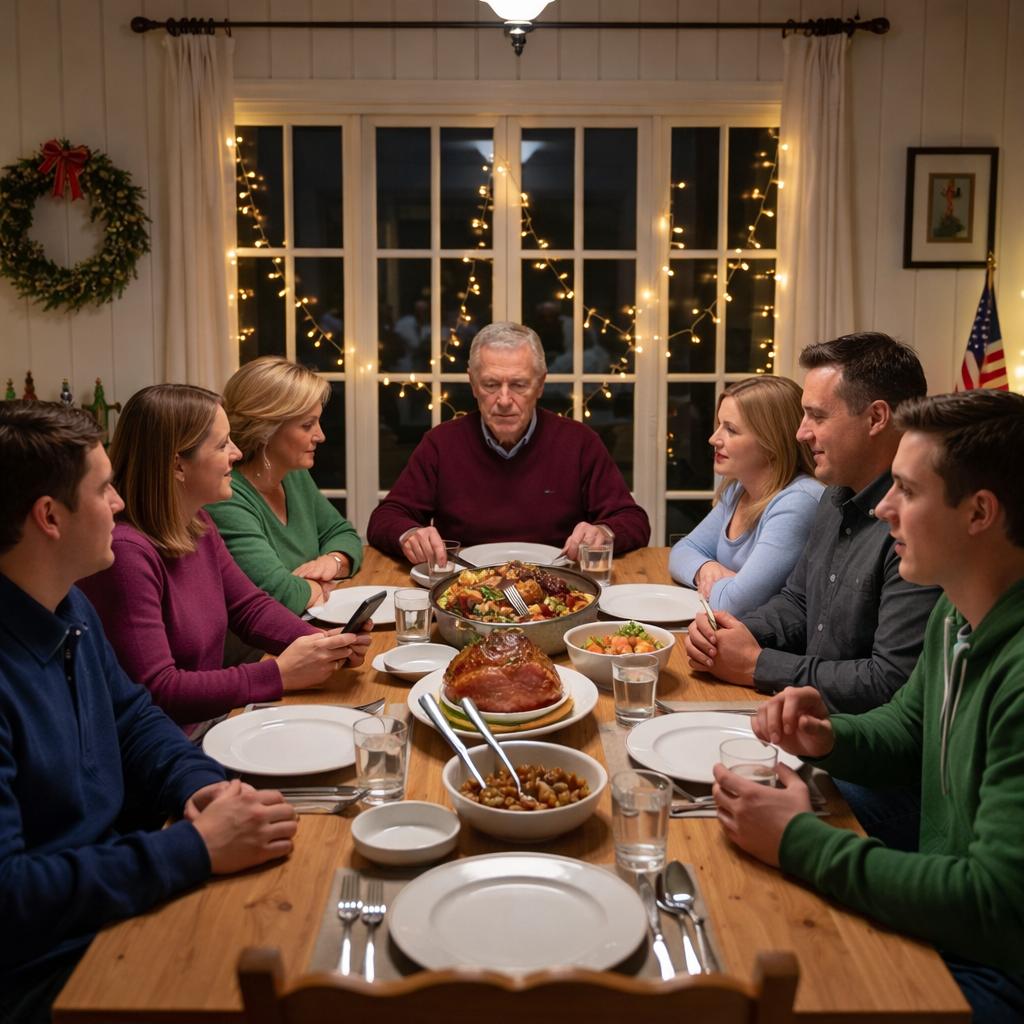
The table was set with Grandma’s good china, cream-colored plates with tiny blue flowers. Silverware lined up neatly. A bowl of mashed potatoes steaming in the center. Roast chicken shining under the overhead light. The whole room smelled like butter and thyme and the kind of home cooking that makes you want to believe everything will be okay.
My parents sat as if nothing was wrong.
My mother smoothed her napkin across her lap. My father poured himself water. They had always been excellent at pretending their choices were normal.
Emma’s chair was empty, which wasn’t unusual. Emma operated on her own schedule. When she was late, it was because she was busy, important, living. When I was late, it was because I was inconsiderate.
I sat down and tried to steady my breathing.
Grandpa Walter sat across from my parents, posture straight. Grandma Dorothy sat beside him, hands folded for a moment before she reached for the serving spoon.
“So,” Grandpa said, voice mild, passing the mashed potatoes toward me first, which was a small kindness I noticed sharply. “How’s school, Jared? Engineering still treating you like a punching bag?”
I almost smiled. It was one of his jokes, the kind he delivered deadpan.
“It’s good,” I said. “Hard. Expensive. I’m managing.”
My father looked up, chewing slowly. “Engineering pays well. You’ll be fine.”
There it was. The assumption. The dismissal. The idea that because I was capable, I was also responsible for absorbing whatever was taken from me.
“The loans are pretty brutal,” I added, careful. “I’m working, but it’s a lot.”