
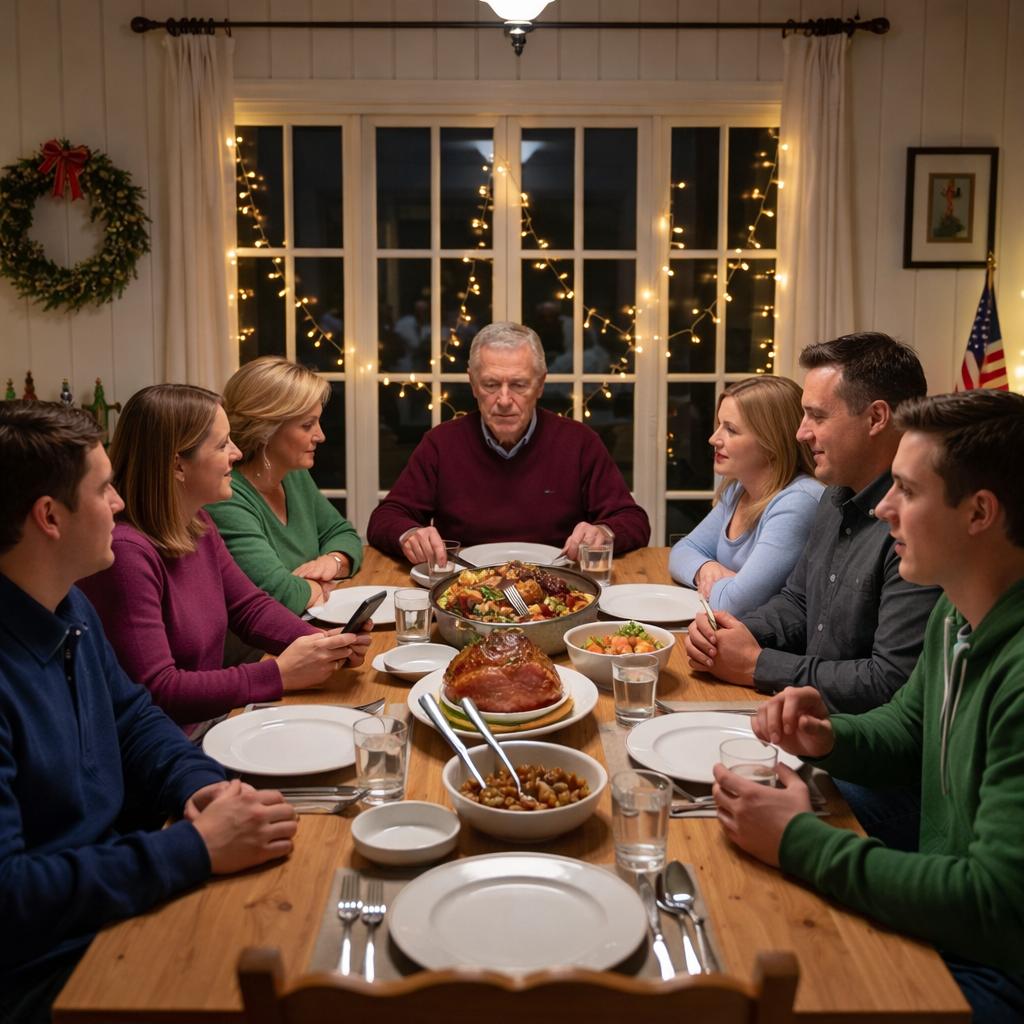
My mother waved a hand as if brushing away a fly. “You’re smart, Jared. You always figure things out.”
Grandpa Walter’s fork paused midair. “Student loans,” he repeated, and his eyes sharpened slightly. “I thought the college funds were set up.”
My mother’s shoulders stiffened, just a fraction. “They were.”
“And?” Grandpa asked.
My parents exchanged a look, the kind married couples exchange when they’re choosing a script. Their faces settled into the same expression, neutral and united.
“Well,” my mother said, voice careful, “Emma needed more support. Her graduate program is expensive. Marketing is competitive. We used family funds to help her.”
My fork slipped from my hand and clattered against the edge of my plate. The sound rang too loudly in the quiet.
Grandma Dorothy’s eyes flicked to me. Concern, immediate and soft.
“What family funds?” Grandpa Walter asked, and his voice was quiet now. Too quiet.
My mother’s smile returned, tight. “The college fund.”
Grandpa Walter stared at her. “Which college fund.”
She hesitated, then said it like it was obvious, like she didn’t understand why anyone would question it.
“The one you set up for both of them,” she said. “Twenty-five thousand each. Emma used hers, and… she needed Jared’s too.”
My throat went tight. The room felt suddenly too warm, like the air had thickened.
“My college fund,” I said, and my voice sounded strange, like it belonged to someone else. “You used my college fund for Emma.”
My father set his fork down with a small click. “Jared, you’re in engineering. You’ll pay off loans easily. Emma needed the advantage.”
“The advantage,” I repeated, tasting the bitterness.
Grandma Dorothy leaned forward slightly. “Sarah,” she said softly, “did you tell Jared about this?”
My mother’s chin lifted. “We’re the parents. We make decisions about what’s best.”
Grandpa Walter’s face didn’t change much, but I saw his jaw tighten. His hand, the one holding his fork, trembled slightly, as if he had to actively keep it steady.
“And the car?” he asked.
My mother’s eyes flicked toward me, then away. “Emma needed transportation.”
“She crashed her car,” I said, and my voice sharpened despite my effort. “While texting. And instead of making her deal with the consequences, you took mine.”
My father’s expression hardened. “Don’t speak about your sister like that.”
“Speak about her like what?” I asked. “Like someone who makes choices and then expects everyone else to pay for them?”
“Jared,” Grandma Dorothy murmured, warning and pleading at the same time.
I pressed my lips together and forced myself to inhale slowly. My heart was pounding so hard it made my ears ring.
A few seconds passed. The grandfather clock in the hallway ticked steadily, counting out the silence.
Then we heard the front door open.
Keys in the lock. A gust of outside air. Emma’s voice already rising in the entryway, bright and breathless.
“Sorry I’m late!”
She appeared in the dining room like she always did, taking up space as if it belonged to her. Her blonde hair looked perfectly styled in a way that suggested she’d been at a salon, not rushing over. Her outfit was effortlessly expensive, jeans that fit like they’d been tailored, leather boots that made a confident sound against the hardwood.
“Traffic was insane,” she said, not sounding sorry at all. “But guess what? Madison and I planned the most amazing thing. Like, life-changing.”
My parents’ faces lit up instantly. My mother practically glowed. My father’s mouth softened into something that might have been pride.
Emma dropped into her chair and started serving herself food as if she hadn’t just walked into a room crackling with tension.
“Three months,” she announced, waving her fork like a wand. “Three months in Europe. Paris, Rome, Barcelona, London. Everything. It’s going to be incredible.”
Grandma Dorothy’s eyebrows lifted. “Three months is a long time.”
Emma laughed. “It’s an investment in myself. My boss totally gets it. She said travel is basically professional development.”
Grandpa Walter didn’t smile. He watched her like he was studying a spreadsheet.
“And how are you funding this?” he asked.
Emma’s face brightened even more, as if this was the best part. “Oh, that’s the genius thing. I’m selling my BMW.”
The words landed like a dropped plate.
My mother took a sip of water too quickly. My father’s eyes snapped to Grandpa, then back to Emma.
Emma continued, oblivious. “I found a buyer who’s offering thirty-two thousand. Which is perfect because I calculated I need about twenty-eight for the whole trip, so I’ll have four left for a down payment on something fun when I get back. Maybe a convertible. I’ve been looking at these adorable little Mercedes.”
Silence.
Not the polite kind. The kind that makes your skin prick.
“My BMW,” Grandpa Walter repeated, very quietly.
Emma finally looked up, sensing the room’s temperature. “Well, technically it’s Jared’s name on some old paperwork,” she said with a dismissive wave, “but Mom explained it was always meant to be mine anyway. I mean, Jared barely drives it. He’s always taking the train or biking. It just sits there.”
I felt something hot and sharp in my chest. Rage, yes, but also disbelief at her confidence. At the way she could rewrite reality and truly expect everyone to nod along.
“I barely drive it because you’ve had it for three weeks,” I said.
Emma smiled triumphantly like she’d caught me proving her point. “See? You don’t even miss it. Plus, I already promised the buyer we’d close tomorrow. He’s coming with cash. Noon. Done.”
Grandpa Walter stared at her, expression unreadable.
“And you believe you have the legal right to sell this car,” he said.
Emma’s lips pursed. “Mom handled the title transfer. It’s fine.”
My mother jumped in quickly, voice bright. “We took care of it weeks ago. It was simpler for Emma to have clear ownership rather than dealing with borrowing paperwork.”
“Without consulting Jared,” Grandma Dorothy said, her voice still gentle but now edged with something firmer.
“Jared understands,” my father said. “He’s always been reasonable about family decisions.”
Reasonable.
The word hit me like a bruise pressed too hard.
Emma scrolled through her phone and turned it so Grandpa could see pictures of convertibles. “Look at this one. Isn’t it gorgeous? Red is my favorite.”
Grandpa didn’t look at the phone.
He looked at me.
And in that glance, I felt the question he wasn’t asking out loud yet.
Is any of this true?
Are you okay?
How deep does this go?
I swallowed hard.
Grandma Dorothy set her fork down. “Emma,” she said softly, “have you already spent money from the sale?”
Emma shrugged. “I booked my flight to Paris. First class. Life’s too short to be cramped for eight hours.”
My stomach twisted. First class. Europe. Thirty-two thousand in cash from a car she hadn’t earned, from a title she didn’t legally have.
“You spent money you don’t have yet,” Grandma Dorothy repeated, incredulous.
“It’s called planning ahead,” Emma said, as if Grandma were being childish. “The buyer is totally reliable. Madison’s dad knows him.”
Grandpa Walter pushed his chair back. The legs scraped against the floor, loud in the silence.
“Excuse me,” he said. His voice was calm, almost too calm. “I need to check something in my office.”
He stood and walked down the hallway, footsteps steady.
As he disappeared, I caught Grandma Dorothy’s eye.
She looked at me with something I’d never fully seen from her before. Not just concern.
Recognition.
Like she was finally seeing the shape of the pattern. The cost.
My mother tried to fill the space with forced normalcy.
“So, Jared,” she said brightly, reaching for the gravy, “how are classes?”
I didn’t answer. I couldn’t. The room felt like it was vibrating.
Emma kept talking, undeterred, about museums and train passes and how she wanted to “find herself” in Italy. My father nodded along as if she were describing a scholarship she’d earned.
I sat there with my hands clenched under the table, nails biting into my palm, and waited.
Fifteen minutes passed. Maybe more. The grandfather clock kept ticking.
Then Grandpa Walter returned.
He carried a thick manila folder.
The kind you don’t casually carry to the dinner table unless you’re bringing something that will change the room.
He set it down beside Grandma’s good china with deliberate care.
My mother’s nervous laugh popped out too fast. “Walter, what’s that?”
“Documentation,” he said simply.
He opened the folder.
Inside were neatly organized papers, arranged in sections with tabs. Bank statements. Photocopied checks. Official forms. A ledger in Grandpa’s handwriting.
My father’s fork clinked against his plate.
Emma stopped scrolling.
Grandpa put on his reading glasses like he was about to do taxes, and his voice stayed calm as he said, “Let me show you what I’ve discovered.”
And for the first time all night, I felt truly proud of him before he’d even finished the first sentence.
Grandpa Walter didn’t rush.
That was the first thing I noticed as he sat back down at the table, adjusted the folder so it was perfectly aligned with the edge of the placemat, and folded his hands on top of it. He didn’t look angry. He didn’t look smug. He looked focused, the way he used to when I was a kid sitting in the waiting room of his accounting firm, watching through the glass as he calmly dismantled someone else’s financial disaster with nothing but a calculator and patience.
The room had gone very still.
Even Emma had stopped moving.
“Over the past few months,” Grandpa began, “I’ve noticed a few inconsistencies. Nothing dramatic at first. Just… patterns. And patterns are hard to ignore when you’ve spent four decades looking for them.”
My father shifted in his chair. My mother crossed her arms, the dish towel still clutched in one hand like a shield.
“Walter, if this is about the car—” my mother started.
“It’s not just about the car,” Grandpa said gently, cutting her off without raising his voice. “The car was simply the most visible symptom.”
He opened the folder and pulled out the first document.