

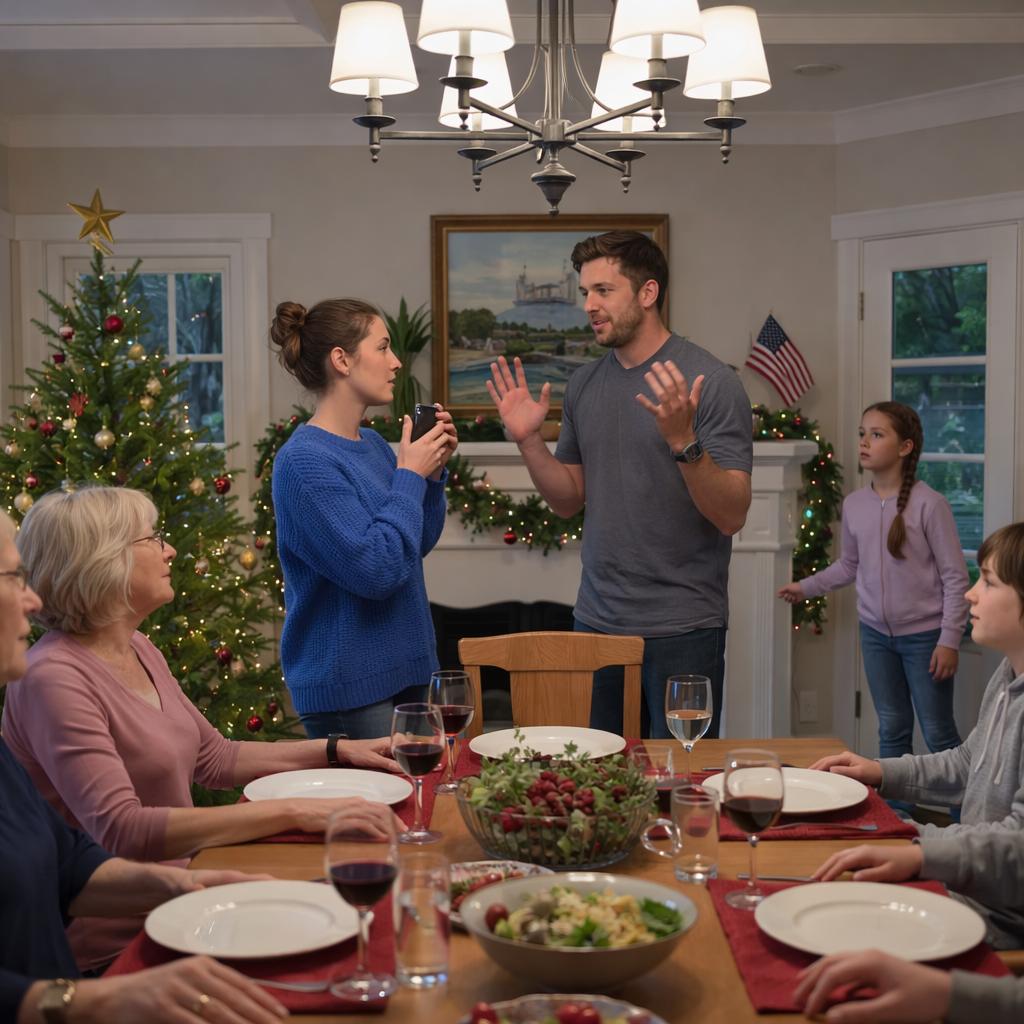
By Monday night, the dishwasher was humming, the kitchen still smelled faintly of garlic and dish soap, and the day’s noise had finally drained out of the walls.
That was when my phone rang.
I glanced at the screen and felt my shoulders tense before I even read the name. My younger brother, Garrett.
For a second I considered letting it go to voicemail. It would have been easier. It always was, when it came to him. But I had a damp dish towel in my hand, my daughter was in the next room, and some stubborn part of me still wanted to believe my family could call for ordinary reasons. Warm reasons. The kind of reasons people talk about when they say, Family is everything.
So I answered.
“Hey,” I said, trying to keep my voice neutral. “What’s up?”
He didn’t say hello. Garrett never did, not when he was excited. His excitement came with momentum, like a car that assumed every light would turn green just because he was approaching.
“Holly, listen. Cole’s fifth grade graduation party is going to be huge. We booked the entire country club. Live band, catering, the works.”
The words hit me in bright, glossy images. A stone archway. White tablecloths. Strings of lights. People laughing too loudly near a pool. Garrett standing at the center of it all with that grin he wore when he felt important.
I waited for the next part. The natural part.
So of course you and Kennedy are coming.
Instead, there was a pause, as if he were sorting something in his mind and placing it carefully on a shelf.
Then his voice cooled, sharpened.
“Just so we’re clear, you can come if you want. But Kennedy? Leave her home. She’s not important enough to be part of Cole’s big day.”
For a moment I couldn’t tell if I’d misheard him. My brain tried to rearrange the sentence into something else, something that made sense. But the words didn’t change. They stayed exactly what they were.
A judgment.
A dismissal.
My daughter reduced to a problem to be managed.
I tightened my grip on the towel until it twisted, damp fabric digging into my palm.
“Did you really just say that about my child?” I heard myself ask.
Garrett let out a small laugh, quick and slicing, like the sound of someone flicking ash.
“It’s Cole’s moment,” he said. “Don’t make it weird.”
The line went dead.
I stood there in the kitchen staring at my phone like it might explain itself. The screen had gone black, reflecting my face back at me. I looked pale. Older than I felt. My heart beat hard, heavy, each thud pushing heat up into my throat.
Behind me, the dishwasher clicked and swished. Outside the window, a streetlight pooled amber on the sidewalk. Everything in the world kept moving as if nothing had happened.
But something had.
It took a long time for me to move again. When I finally set the towel down, my hands were shaking.
I wasn’t always the kind of woman who could absorb a sentence like that and remain upright. For most of my life, I learned how to get smaller at other people’s tables, how to tuck myself in at the edges so I didn’t take up space, didn’t demand anything that might make someone sigh or roll their eyes or say I was being dramatic.
I’m the oldest. The one who was supposed to set the tone, keep the peace, understand. The one praised for being “easy” and “low-maintenance” as if those traits were proof of character instead of proof of training.
Garrett came eight years after me, after difficult pregnancies and the kind of anxiety that turns parents into worshippers. By the time he was born, my parents were so relieved to have him that they treated him like a miracle that deserved constant applause. If Garrett wanted something, it was reasonable. If Garrett broke something, it was someone else’s fault. If Garrett threw a tantrum, it was because he was “spirited.”
And I learned early that my role was to smooth everything over.
“You’re the oldest, Holly,” my mother would say, that familiar tone that tried to make responsibility sound like affection. “You understand.”
It sounded like love, but it was work. It was a contract I never signed.
I carried that contract into adulthood without realizing it. I kept showing up. I kept giving grace. I kept telling myself it would look different when I had my own child. I told myself a granddaughter would soften my parents. I told myself Garrett would look at his niece and feel something protective, something instinctive and good.
When Kennedy was born, I honestly believed she would change the weather in the room.
She didn’t.
She became an afterthought. A footnote. A name spoken with casual fondness and then forgotten the moment Cole walked in and everyone’s eyes recalibrated toward Garrett’s son like a compass needle snapping north.
My marriage didn’t last, either. Kennedy’s father didn’t explode out of our life in some dramatic scene that friends could repeat over brunch. There was no screaming fight, no slammed doors, no police, no scandal.
He just faded.
He stopped showing up. Stopped answering. Stopped being someone we could count on. Like a light left on in an empty room until the bulb finally burned out.
Kennedy was two when it became clear he wasn’t coming back. At that age, she still believed the moon followed our car. She still pressed her face to the window and squealed when she saw a dog in someone’s yard. She still ran to the door every time she heard footsteps in the hallway.
I did what you do when you’re alone with a toddler and a mortgage and a life that can’t pause to mourn what it should have been.
I tightened my grip.
I got up earlier. I worked later. I built our routines like scaffolding so nothing could collapse. I learned how to keep my voice steady when bills arrived. I learned how to cry quietly in the shower so my child never saw it. I learned how to be both the soft place and the strong wall.
And I built a career in the quiet, too.
A bookkeeping gig turned into operations. Operations turned into finance. Finance turned into consulting for small businesses that were bleeding money because nobody understood their own numbers. I learned to read spreadsheets like stories. I learned to spot what was broken, fix it, and get paid without asking permission.
Over time, I stopped trading hours for survival and started trading decisions for leverage.
I didn’t announce any of it to my family.
Not because I wanted to be secretive, but because I knew them. The minute they smelled money, they would either resent me for it or feel entitled to it. Either way, the air would change. Kennedy would be dragged into it. People would treat us like a resource instead of people.
So to them, I stayed Holly. Single mom. Reliable. The one who brings a casserole. The one who never makes a fuss.
And if I’m honest, some part of me kept hoping that if I stayed helpful enough, quiet enough, easy enough, they would finally look at my daughter and see what I saw.
That hope lasted right up until the moment Garrett told me my child wasn’t important enough to attend his son’s party.
Because in that sentence, he didn’t just insult Kennedy.
He confirmed something my body had been learning for years.
In my family, love had rankings.
And my daughter was at the bottom.
I heard Kennedy’s footsteps before I saw her. She padded into the kitchen in socks, earbuds dangling around her neck, holding a glass of water. She was twelve, tall for her age, her limbs still in that in-between stage where kids seem to stretch overnight. Her hair was pulled into a messy knot, loose strands curling at her temples. She had my eyes, the same habit of looking at someone’s face and reading it like a page.
She took one glance at me and slowed.
“What happened?” she asked.
I tried to swallow and discovered my throat felt raw, as if I’d been shouting. I hadn’t. Not yet.
I sat down on the edge of a kitchen chair, the wood cool against the backs of my legs.
“Sweetheart,” I said, and my voice sounded too careful, like I was walking on ice. “Uncle Garrett called about Cole’s graduation party.”
Her expression shifted, quick as a shadow. Not surprise exactly. More like recognition. Like she’d been bracing for this without telling me.
I didn’t want to say it. The words felt poisonous in my mouth, something that shouldn’t exist in the same world as her.
“He said…” I paused, because my chest tightened. “He said you’re not invited.”
Kennedy didn’t speak for a second. She stared at the condensation sliding down her glass. Then her fingers found the sleeve of my hoodie and twisted it, twisting hard until the fabric stretched pale under her grip.
“Oh,” she said softly.
Just one syllable, but it carried so much.
I watched her face for the break, the crack where her feelings would spill out. She held herself together in that way she’d learned from watching me. That was what hurt the most.
She’d learned to go quiet when people disappointed her.
I picked up my phone with hands that felt clumsy and typed the shortest message I could manage.
To Garrett: We won’t be coming.
I hit send before I could overthink it.
The screen barely dimmed before my mother’s name lit up. Right on cue. Like Garrett had called her the second he hung up with me.
I put it on speaker. Not because I wanted Kennedy to hear, but because I was done repeating myself, done being dragged into separate conversations where people pretended they didn’t know what happened.
Mom didn’t bother with hello, either.
“Holly Marie Griffin,” she began, using my full name the way she only did when she’d already decided I was wrong. “Garrett says you’re making a scene over a children’s party.”
I closed my eyes. The kitchen light seemed too bright suddenly. The air felt thin.
“He told my daughter she isn’t important enough to attend,” I said. “That’s the scene.”
“Oh, please.” My mother’s sigh crackled through the speaker. “He’s excited. Cole’s the youngest grandchild. You know how your brother gets when it’s about his kid. Don’t turn this into World War Two.”
Kennedy’s fingers tightened again. I covered her hand with mine, feeling how cold her skin had gone.
“I’m not turning anything into anything,” I said, and I was proud of how flat my voice sounded. “I’m keeping my daughter away from people who think she’s disposable.”
Mom made a sound like a laugh, but it held no humor.
“You were always the sensitive one,” she said. “Let it go, Holly. For family.”
For family. The phrase landed like a weight on my chest. As if family was a god you sacrificed to. As if my child’s dignity was an offering to keep everyone else comfortable.
Before I could answer, she hung up.
A beat of silence followed, and then my phone began vibrating against the tabletop like it was alive.
The family group chat.
The screen filled with messages stacking on top of one another.
Bridget, my cousin, was first. She never missed an opportunity to sharpen her teeth.
Wow. Boycotting a fifth grade graduation party. Real mature, Holly.
Cole’s been looking forward to this for months. Stop being petty.
Garrett said you decided Kennedy shouldn’t come. Don’t rewrite history.
Then a cousin’s eye-roll emoji. Then a GIF of a toddler throwing a tantrum. Then someone else chiming in with, Come on, it’s not that deep.
Dad stayed quiet.
He always stayed quiet when it mattered.
His silence was loud in its own way, a door closing without a slam.
Kennedy leaned closer and read over my shoulder. I felt her body stiffen beside me.
“They think I didn’t want to go,” she said.
Her voice was small. Cracked right down the middle.
I turned the phone facedown like it was something dirty.
“They believe whatever’s easiest,” I said. “Whatever lets them feel like they’re still the good guys.”
Kennedy tried to lift her shoulders in a shrug, but they trembled.
“I don’t even like country clubs,” she whispered, attempting humor, attempting armor.
But her eyes shone, and then the tears came, fast and silent. She didn’t sob. She didn’t make noise. She just breathed in shallow little pulls like she couldn’t get enough air.
I wrapped my arm around her and held her close. Her hair smelled like strawberry shampoo. Her cheek was damp against my shoulder.
We stayed like that while the house settled around us.