
She pushed her goggles up and leaned close.
“You’re totally scared.”
“Fine,” I admitted. “I’m a responsible adult. I fear unnecessary injury.”
Kennedy laughed, loud and unrestrained, and it felt like sunlight breaking through cloud.
When we hit the water at the bottom, it swallowed our screams and spit us out into laughter so hard I had to hold the edge of the pool to steady myself.
By late afternoon, our skin smelled like chlorine, our hair was frizzed into halos, and our cheeks ached from smiling.
On the drive home, Kennedy replayed the day out loud as if telling the story could pin it in place.
“The purple slide was the best.”
“No, the one with the lights,” I corrected.
She pointed at me from the passenger seat.
“Okay, fine. The lights. But you screamed so loud the lifeguard looked at you.”
I laughed, glanced over, and saw her relaxed in a way I hadn’t seen in weeks. Her face wasn’t guarded. Her joy wasn’t cautious.
At a stoplight, she grew quieter and stared out the window at the passing trees.
“Do you think they noticed we weren’t there?” she asked.
I watched the road ahead, the sky deepening toward evening.
“I think they noticed what they wanted to notice,” I said.
Kennedy nodded slowly, absorbing it.
Then she surprised me.
“I’m glad we came here,” she said. “I didn’t want to sit around all day thinking about it.”
“Me neither,” I admitted.
I wanted her to remember Saturday as the day she was chosen. Not by them.
By me.
That’s why, even after a long drive and a long day, I still turned the car toward my mother’s house for the monthly family dinner that nobody ever missed.
Not because I owed my family my presence.
Because Kennedy deserved to walk into any room with her head up, knowing she belonged beside me. And if they were going to make her feel small, they were going to do it in front of my face.
So I could stop it.
Kennedy fell asleep against the passenger window before we even left the parking lot, her hair still slightly damp, her mouth parted, one hand loose on her lap. The streetlights strobed softly across her face as we drove, each one a brief flare of gold.
It was almost 8:30 when we pulled into Mom’s driveway.
The porch lights were bright. Cars lined the street. In the center of it all sat Garrett’s brand-new white Range Rover like it owned the property.
I reached over and touched Kennedy’s shoulder gently.
“Hey,” I whispered. “We’re here.”
She blinked awake, rubbed her eyes, and groaned.
“Do we have to stay long?”
“Just long enough to eat and be polite,” I said.
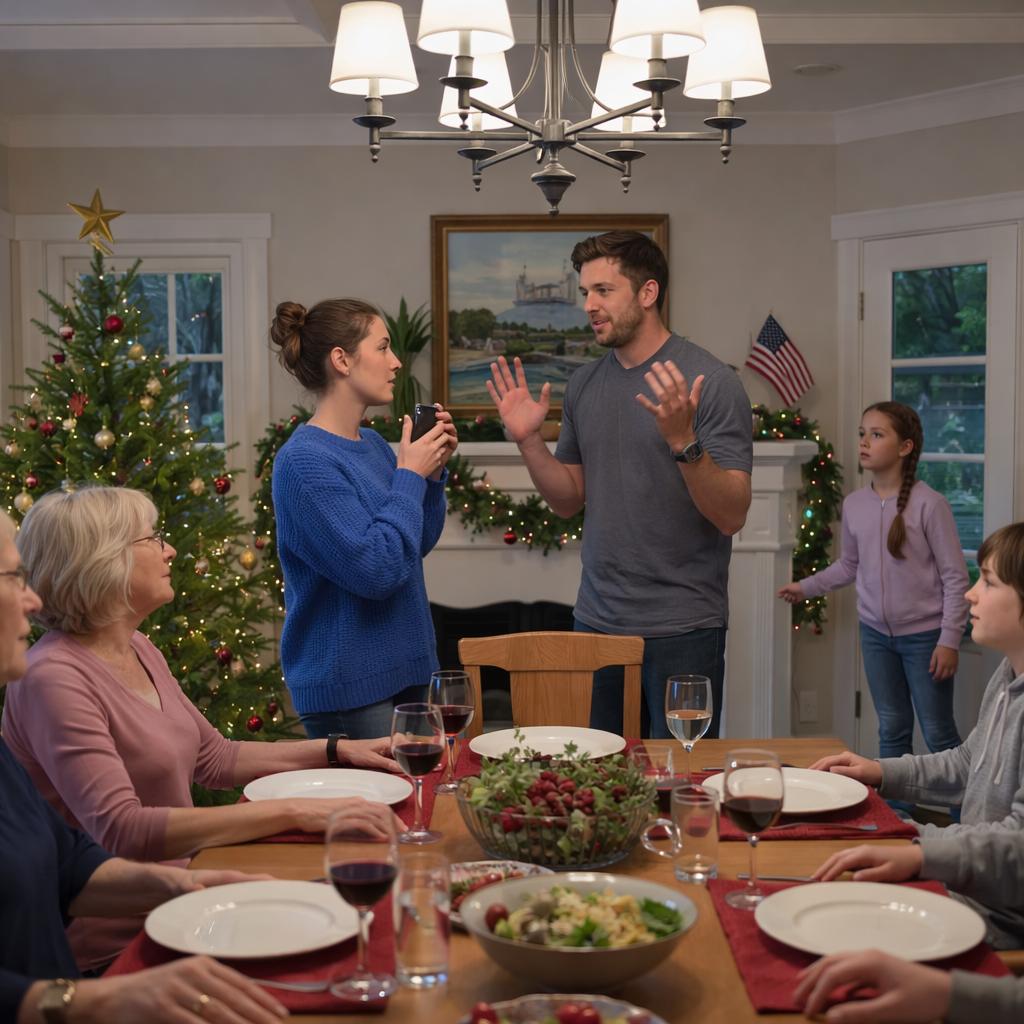
We walked in through the kitchen door that opened straight into the dining room. The air was warm with roasted chicken, gravy, butter, and that faint metallic scent of wine.
The table was already full.
Mom stood at the head, spooning gravy like she was conducting a ceremony.
Dad, Wayne, was carving chicken at the far end, his face set in the same neutral expression he wore whenever tension hovered near the surface.
Bridget sat closest to the wine bottle, glass already half empty, her lipstick perfect.
Sierra wore a new emerald dress that gleamed under the chandelier. Her jewelry caught the light each time she moved her hand.
Cole sat with his graduation medal clipped crookedly to his blazer collar, glowing with leftover attention.
And Garrett sat near the center, relaxed, arms draped across the backs of two chairs, grinning like a man who believed the world made sense because it centered him.
Every head turned the second we stepped in.
“Well, look who finally showed up,” Mom called, waving the spoon. A drop of gravy slid and fell back into the bowl. “We saved you two spots right here.”
Kennedy hesitated, half a step behind me. I squeezed her hand and guided her toward the empty chairs.
Cole bounced in his seat.
“Kennedy! They gave me a real medal,” he said, holding it up proudly. “Look!”
Kennedy managed a small smile.
“That’s cool,” she said, voice careful.
Bridget smirked over her glass.
“Yeah,” she said. “Where were you guys all day? The party was insane.”
Garrett tilted his head, performing concern.
“Holly said Kennedy had a stomach bug,” he said, loud enough for everyone to hear. “You look pretty energetic now.”
Kennedy’s fingers went cold in mine. I felt it immediately, that tiny betrayal landing in her body.
Mom slid two steaming plates in front of us.
“Sit, eat,” she said briskly. “Cole was the star today. Tell her about the sundae bar.”
Cole launched into it, delighted.
“Twenty toppings,” he said. “And confetti cannons. And a photographer followed me around for half the day. Like a real celebrity.”
Sierra leaned forward, smiling as if sweetness could erase the edges.
“We really missed you girls,” she said. “Big days are better when the whole family’s together.”
Bridget let out a laugh that wasn’t friendly.
“Some people just can’t handle not being the center of attention for once.”
Dad cleared his throat, the sound sharp and warning, but nobody even looked at him.
Garrett chuckled.
“Come on,” he said. “Holly decided all the excitement would be too much for Kennedy, right?”
He delivered it like a punchline.
The table laughed.
Mom, Bridget, Sierra.
Even Dad cracked a reluctant smile, the kind of reflexive smile people give when they’re trying not to make things worse.
Kennedy stared down at her plate. The mashed potatoes sat like a pale hill, untouched. Her fork trembled slightly in her hand.
I watched her lips press together. Watched her swallow hard. Watched her try to hold herself.
Then the fork slipped from her fingers and clattered against the plate.
The sound was small but it cut through the laughter like a crack in glass.
Mom frowned, a little annoyed.
“You okay, honey?”
Kennedy’s face flushed dark red. She opened her mouth, but the sound that came out wasn’t words. It was a broken little noise, as if her throat had closed around the truth.
Cole kept talking, oblivious, drunk on attention.
“They had a drone,” he said. “Like flying above us. Dad said it’s because it was a big deal.”
Kennedy shoved her chair back so fast it scraped the hardwood with a squeal.
She stood, eyes already shining, and bolted through the kitchen, past the fridge covered in years of family photos, out the side door to the porch.
The screen door slammed behind her, loud as a gunshot.
The dining room went still.
Bridget rolled her eyes.
“Drama queen,” she muttered.
Mom turned toward me, her expression already preparing to scold.
“Holly…”
I rose slowly.
Every eye fixed on me. Garrett wore a small satisfied smirk, like he’d won something.
“Kids are sensitive,” he said, lifting his wine glass. “She’ll get over it.”
I looked at each adult at that table, at the ease with which they’d laughed while my daughter’s face crumpled. I looked at Kennedy’s empty chair, the fork lying sideways in cold mashed potatoes, the untouched food congealing.
And something in me went very calm.
Not numb. Not detached.
Focused.
I reached into my pocket and pulled out my phone.
Garrett’s smirk faltered.
“What are you doing?” he asked.
I didn’t answer him. I scrolled to a contact saved under a name that meant nothing to anyone in that room.
J. Chen.
I hit call.
Then I turned on speaker and set the phone on the table so everyone could hear.
The ring sounded loud in the silence.
Once.
Twice.
Then a voice, even and professional, filled the room.
“Holly.”
Every person at the table leaned forward slightly, like they couldn’t help themselves.
“James,” I said, my voice steady enough to surprise even me. “The Series A with Garrett Harrison. Kill it right now.”
Garrett’s face drained of color.
“What?” he snapped.
James paused only a fraction of a second.
“Reason?” he asked, direct.
I locked eyes with Garrett.
“Because the founder just made it clear, in front of our entire family, that he believes my twelve-year-old daughter is worthless,” I said. “I will not put five million dollars behind someone who treats my child like she doesn’t matter.”
The air in the room changed, like a window had been opened in winter.
Garrett’s chair slammed backward as he shot to his feet.