

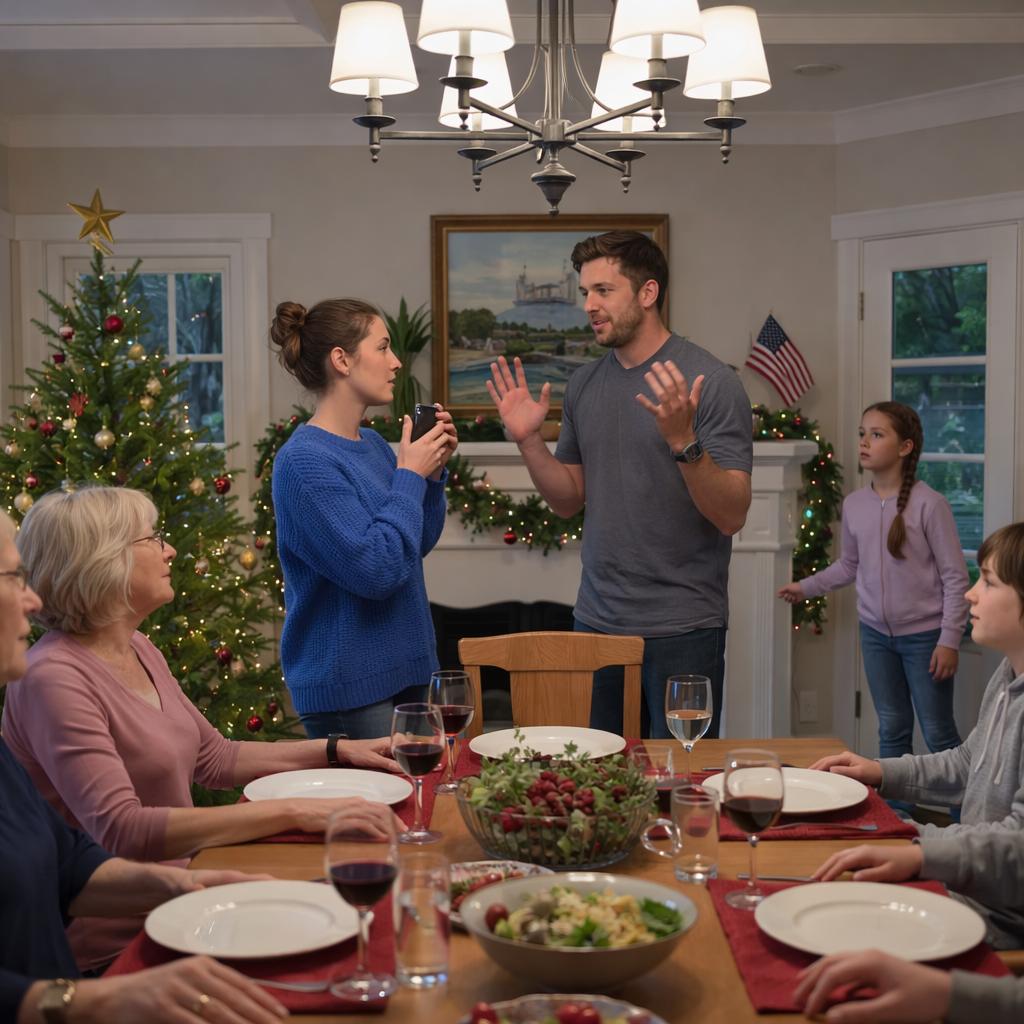
“No, you move.”
The door handle jiggled. The lock held.
Kennedy stared at the door like it might swing open and spill all that chaos onto the steps.
“Are they coming out here?” she asked, voice thin.
I smoothed the hair back from her forehead. “Not unless I let them.”
I could feel her trying to decide whether to trust that.
Inside, the voices surged again, then dropped. The house settled into a new kind of noise, the restless pacing sound of people who realized the room had shifted and they didn’t know how to put it back the way it was.
Kennedy swallowed. “Are we leaving?”
I looked out at the driveway, the line of cars, the bright porch lights making everything look too exposed. “Yes,” I said. “But not because we’re running. We’re leaving because we choose to.”
I stood slowly, keeping one arm around her shoulders as we rose. My legs felt steady. My hands didn’t. Somewhere in me, the oldest-child reflex still twitched, the instinct to fix, to soothe, to make sure everyone calmed down and dinner continued and nobody felt uncomfortable.
But that instinct had a limit.
And my daughter was it.
I guided Kennedy down the steps and along the side path to the driveway. The gravel crunched under our shoes. I heard the screen door open behind us.
“Holly!” my mother called again, the word stretched into a plea.
I didn’t turn around.
Kennedy’s hand tightened around mine until it hurt.
At my car, I opened the passenger door and helped her in. The interior smelled like sunscreen and faint chlorine from our water park bags in the back seat, the warm residue of a day that had belonged only to us. Kennedy pulled the seatbelt across herself with a sharp click, like she wanted the sound to be definitive.
I closed her door and walked around to the driver’s side.
That was when Garrett’s footsteps hit the driveway, fast and heavy.
“Holly, wait!” he shouted.
I slid into the car and shut the door. The world muffled instantly, his voice reduced to a dull, distant sound through glass.
He appeared beside my window, face pale, eyes frantic. The porch light caught the sweat on his forehead.
He knocked hard, knuckles white. “Roll it down.”
I stared straight ahead and put the key in the ignition.
“Holly!” he shouted, as if volume could force compliance. “You can’t do this. You can’t just destroy everything because you’re pissed.”
Kennedy turned her head toward him, eyes wide, mouth slightly open. She looked like she wanted to vanish into the seat.
I started the engine. The familiar rumble was grounding, like the car itself was saying, I know what to do. I shifted into reverse.
Garrett leaned closer, his mouth forming words I couldn’t hear. His hand slapped the glass again.
Then my mother appeared behind him, one hand clutching her cardigan closed at her chest, her face crumpled with tears.
“Holly, please,” she mouthed.
Her eyes flicked to Kennedy in the passenger seat, and for a flicker of a second I saw something like shame.
It wasn’t enough.
I backed out of the driveway, slow and careful. Garrett stepped back reluctantly, his face twisting as the car moved away, as if he couldn’t accept that I was leaving on my own terms.
Kennedy stayed rigid beside me, staring at her knees.
As we drove away, the house receded, still blazing with light, still full of people who had never learned how to be gentle.
The street ahead was dark and quiet.
After a few minutes, Kennedy whispered, “Are they going to hate us now?”
Her voice cracked on the last word.
I kept my eyes on the road, hands steady on the wheel. “They might,” I said. “But that’s not the same as being wrong.”
She picked at the edge of her seatbelt, then asked, almost inaudible, “Are you in trouble?”
The question made my throat tighten. She still thought in terms of punishments handed down by adults, by authorities. She still expected consequences to come from the people with the loudest voices.
I glanced at her, forcing softness into my expression. “No,” I said. “I’m not in trouble. I’m just… done.”
Kennedy swallowed. “Done with them?”
I didn’t answer immediately. The word done felt too clean for something this messy. But the truth was, I’d been done in small ways for years. Tonight had simply turned it into a sentence I couldn’t take back.
“I’m done letting anyone make you feel like you’re not worth being included,” I said finally.
She stared out the window at the passing streetlights, her reflection ghosting across the glass.
After a long silence she whispered, “Thank you.”
Two days later, the aftermath arrived like a swarm.
It started while I was making coffee. The kitchen was quiet except for the drip of the machine, the soft clink of my spoon against the mug. Morning light spilled across the counter in pale stripes through the blinds. Kennedy was still asleep, her door closed, the house finally calm after the long, tense night.
My phone buzzed on the counter. Once, twice, then again, vibrating hard enough to rattle against the granite.
I glanced at the screen.
Missed calls: 12.
Then, as I watched, it jumped.
My stomach clenched. I tapped the screen and saw the names stacked in a familiar, relentless pattern.
Mom.
Garrett.
Sierra.
Bridget.
Over and over, as if rotating through them could wear me down.
The coffee maker beeped and clicked off. The smell of coffee should have been comforting. It wasn’t. It mixed with the sour taste of dread and anger.
Then an email notification slid across the screen, and my eyes snagged on the subject line.
From: James Chen
Subject: Official Termination — Harrison Technologies Series A
My fingers went cold.
I opened it.
James’s email was crisp, formal, written in the language of finality. The kind of language that didn’t care about family dinners or tears or apologies whispered too late.
Apex Ventures is formally terminating the Series A term sheet with Harrison Technologies effective immediately…
Below, a chain of replies from other investors. One after another. Short, decisive. The corporate equivalent of doors slamming.
We are withdrawing.
Pulling our commitment.
Effective immediately.
No room for bargaining. No softening.
My phone buzzed again, then began ringing outright.
Sierra.
I watched it ring out until it stopped.
It rang again.
Mom, FaceTime.
I declined without thinking.
Bridget called. Then Garrett. Then Sierra again.
The kitchen felt too bright, too exposed. I set my mug down and stared at the phone as if it were an animal waiting to bite.
Footsteps padded down the hallway. Kennedy appeared in the doorway in pajamas, hair a tangled halo, rubbing sleep from her eyes.
She took one look at my face and stopped.
“Is it them?” she asked quietly.
I nodded.
She walked into the kitchen and climbed onto the stool at the island, pulling her knees up close. Her gaze flicked to the phone, then away, as if looking at it directly might invite it to attack.
Another FaceTime call came in. Mom again.
Kennedy watched it ring. Watched me decline it.
Her expression was unreadable, but I could see the tension in her jaw.
When the call ended, a flood of messages appeared, one after another. Bridget’s name and photo kept popping up, filling the screen like a billboard.
Kennedy leaned over. “Can I see?”
I slid the phone toward her. If she was old enough to be excluded, old enough to be mocked and dismissed, then she was old enough to see the truth without me filtering it into something prettier.
She scrolled slowly, eyes moving across lines of text.
Bridget: You evil. Do you have any idea what you’ve done?
Bridget: Garrett hasn’t slept in 48 hours. His company is collapsing because of your temper tantrum.
Bridget: I hope you rot.
Kennedy’s thumb paused on another message.
Bridget: Cole asked why Aunt Holly hates him. How do you explain that to an eleven-year-old?
Kennedy’s face tightened. Her lips pressed into a thin line. For a moment, she looked exactly like me.
I felt my own eyes sting, not because Bridget’s words hurt me, but because of the audacity of trying to turn this into a story where my daughter was the problem and their cruelty was just a misunderstanding.
Kennedy lifted her gaze to mine.
“They’re really mad,” she said.
“Yeah,” I replied. “They are.”
The phone rang again. Garrett.
Kennedy looked at the screen, then at me. Her voice was small but steady. “Are you going to answer?”
I considered it. Not because I wanted to hear him, but because I wanted to be sure. I wanted to hear whether, in the face of consequences, he would finally do the one thing that mattered.
Ask about her. Say her name. Apologize.