

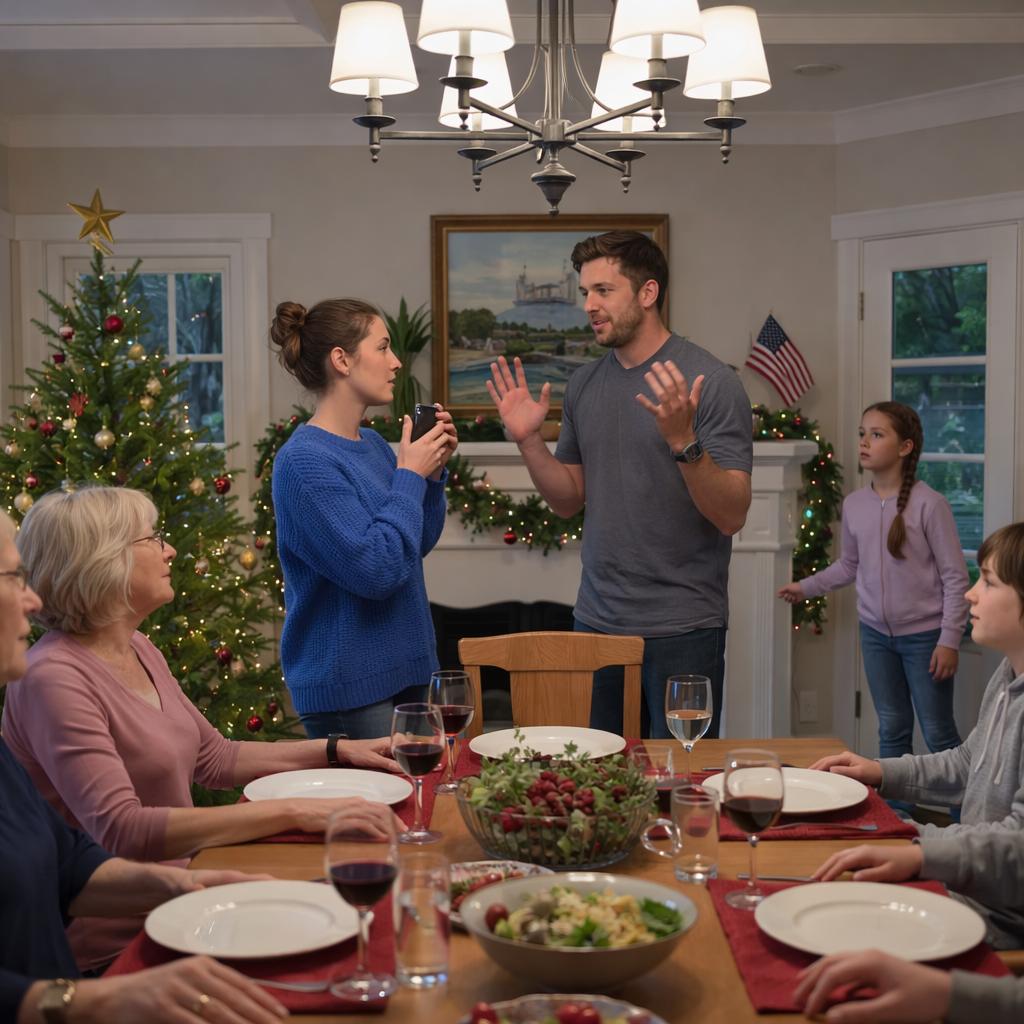
I hit answer and put it on speaker.
Garrett’s voice came through immediately, hoarse and ragged.
“Holly,” he said. “What did you do?”
I kept my voice even. “You know what I did.”
“This is insane,” he snapped. I could hear him breathing hard, like he’d been running. “Investors are pulling out. James won’t take my calls. Sierra is freaking out. The employees, Holly, do you understand? People’s jobs are on the line.”
Kennedy’s shoulders tensed beside me. She stared at the counter, listening.
I waited. I gave him a beat, two beats, three, the space where he could choose to say what mattered.
Instead he barreled forward.
“You can’t punish me like this over a party,” he said. “It was a kids’ thing. It got blown out of proportion. Mom’s a wreck. Dad is furious. Everyone thinks you’ve lost your mind.”
I closed my eyes briefly. My patience was thin as paper.
“Garrett,” I said. “Did you ever plan to apologize to Kennedy?”
Silence.
On the line, I heard him swallow. Then he exhaled sharply, irritated.
“This isn’t about her,” he said.
Kennedy’s breath caught.
I opened my eyes and looked at my daughter. Her face went still, like something in her had quietly shut.
My voice turned cold. “It is only about her.”
Garrett scoffed. “You’re making it about her so you can act like a hero. Cole is my son. His party. His day. Kennedy isn’t…” He hesitated, then pushed through anyway. “She isn’t part of that.”
Kennedy’s hand curled into a fist on the counter.
I felt the last thread of softness snap.
“You’re right,” I said calmly. “She isn’t part of that. And you aren’t part of us.”
“Holly,” Garrett barked. “Stop. Call James. Fix this.”
“No,” I said.
On speaker, he sounded like he was losing control of his own voice. “You can’t do this to me. I’m your brother.”
I stared at the kitchen tile, at the way sunlight cut across it, at how ordinary the morning looked for something so ugly.
“And she’s my daughter,” I replied.
Garrett’s voice sharpened into a snarl. “So what, you’re going to ruin my life over one sentence?”
“It wasn’t one sentence,” I said, each word measured. “It was a lifetime of you being allowed to treat us like we don’t matter. It ends now.”
“Mom always said you were dramatic,” he spat.
Kennedy flinched at that. Not because she cared what Mom said, but because it was a familiar knife.
I leaned my elbow on the counter, steadying myself.
“This call is over,” I said.
“Holly, wait, don’t…” Garrett started.
I ended the call.
The silence afterward was thick. My phone immediately lit up again with another incoming call. Sierra this time. I didn’t answer.
Kennedy stared at the phone like it was a bomb.
For a moment, neither of us spoke. The coffee sat cooling, forgotten.
Then Kennedy reached out and turned the ringer off completely. Her fingers were deliberate, no shaking.
The sudden quiet felt like someone closing a door against a storm.
She looked up at me, eyes wet but steady.
“Mom,” she said softly, “you did the right thing.”
I blinked hard. The words hit me in the chest. Coming from anyone else, they might have sounded like reassurance. From her, they sounded like permission.
My eyes filled. I didn’t bother wiping the tears away fast enough.
Kennedy slid off the stool and came around the island, climbing into my lap like she hadn’t done in months. She curled against me, her arms around my neck, and for a moment I let myself fold into her, let myself cry into her hair.
The phone buzzed again on the counter, relentless.
Kennedy lifted her head slightly, looked at the screen, then at me.
“Do you want me to block them?” she asked.
The question was so grown-up it hurt.
I swallowed. “Not yet,” I said. “Not today.”
She nodded, as if she understood there were steps to this, that severing ties wasn’t just a moment but a series of choices.
Then she said something that made me laugh through tears.
“I’m not a baby anymore,” she murmured, wiping her face against my shoulder. “And I’m not sorry we left.”
I kissed her temple. “Me neither.”
Wednesday afternoon, the doorbell started like a warning.
Three sharp rings. A pause. Then another three.
I was at the kitchen island working, laptop open, payroll spreadsheets pulled up. The numbers were familiar and steady, a kind of comfort. Kennedy was at the dining table doing homework, headphones on, tapping her pencil against a notebook.
The doorbell rang again, then again, then a long press, the kind that held the sound down like someone was trying to grind it into the house.
Kennedy lifted her headphones off one ear. “Who is that?”
I didn’t answer. I already knew. My skin knew.
I stood and walked to the door, my steps measured. Not rushed. Not hesitant. Just sure.
I opened it a few inches, chain still latched, enough to see but not enough to allow entry.
Garrett and Sierra stood on my porch.
They looked smaller than I’d ever seen them, not physically, but in the way desperation strips away performance.
Garrett’s shirt was wrinkled and untucked, stubble darkening his jaw. His eyes were bloodshot, the whites streaked red like he hadn’t slept in days. He smelled faintly of stale coffee and sweat, even from where I stood.
Sierra’s hair was pulled into a messy knot, strands escaping. Her mascara had smudged beneath her eyes, bruising her skin. The emerald dress and polished jewelry were gone. She wore a plain cardigan and leggings, her hands clasped together as if praying.
“Holly,” Garrett said, voice rough. “We need to talk.”
I didn’t move. “Kennedy’s doing homework,” I said evenly. “Ten feet away.”
Sierra’s gaze flicked past me, toward the interior of the house, and for a second something like guilt flashed in her expression. Then it vanished under panic.
“Five minutes,” Sierra pleaded. “That’s all.”
Garrett leaned forward, eyes wide, as if proximity could create intimacy we no longer had.
“The company is gone,” he said, words tumbling out. “Investors pulled out within hours. Employees are leaving. We’re going to lose the house. Cole’s school. Everything.”
His voice cracked on the last word. He blinked hard, jaw working.
Sierra reached out and gripped his arm. Her own voice shook. “We’ll do anything. We’ll sign anything. We’ll say whatever you need us to say. Please, Holly.”
I watched them carefully. Their faces, their hands, the way they stood too close together like they were bracing for impact.
Neither of them had said Kennedy’s name.
Neither of them had asked if she was okay.
Not once.
I kept my hand on the doorframe, steadying myself.
“Where’s your apology to my daughter?” I asked quietly.
Sierra blinked, thrown. “What?”
“You heard me,” I said. “You’re here begging me for money, but you haven’t asked about the child you humiliated. You haven’t apologized for what you said and what you laughed at.”
Garrett’s mouth opened, then closed. His eyes flicked down, then back up, avoiding mine.
“Holly,” he began, frustration creeping in beneath the desperation, “this is bigger than…”
“No,” I cut in. My voice stayed calm, but it carried weight. “It’s exactly that small. It’s about a twelve-year-old girl who learned from her own family that she ranks dead last.”
Sierra’s face tightened. “We didn’t mean…”
But her sentence trailed off, flimsy in the air.
Garrett’s breath hitched. Then, unbelievably, he dropped to his knees on my porch, right on my welcome mat.
The sight was almost absurd. Garrett, who had always been the center of things, reduced to begging on a patch of coir that said HOME SWEET HOME in faded script.
“I’m begging you,” he whispered. His eyes shone wet. “For Cole. For our family. Save us.”
Sierra knelt beside him, her shoulders shaking. She covered her mouth with one hand as a sob escaped.
“We’ll lose everything,” she cried. “Please.”
I stared down at them and waited for the one thing that might have shifted my heart even a fraction.
Kennedy’s name.
A question about how she was.
Anything that wasn’t about themselves.