

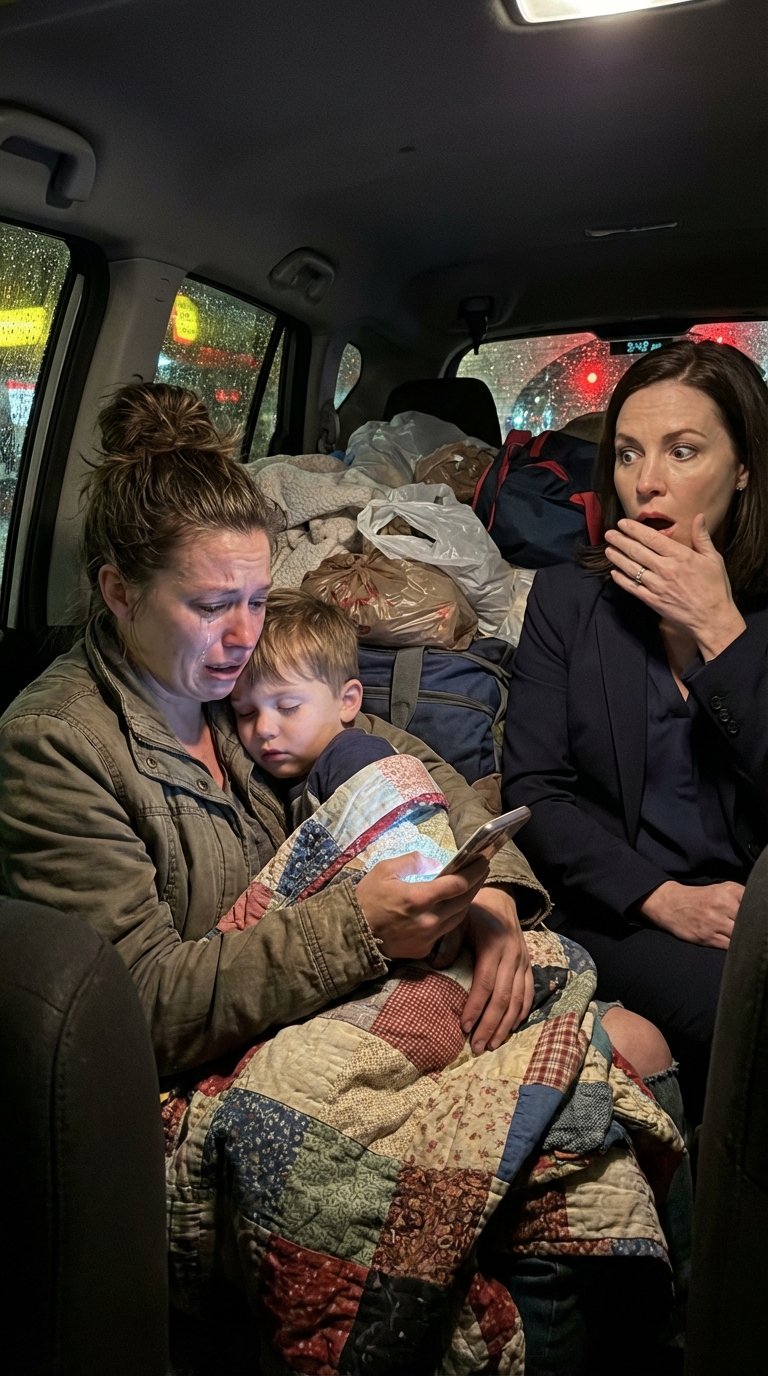
The Auditor’s Revenge: A Chronicle of Justice
Chapter 1: The Ghost in the Line
It was the duct tape that caught my eye first. A jagged, silver scar binding the sole of a sneaker that should have been thrown away months ago. Then, I noticed the jeans—faded to a pale, washed-out blue, with amateur patches stitched clumsily over both knees.
But it was the posture that stopped my heart. The woman was standing in line at the community soup kitchen on a blistering Tuesday morning in downtown Baltimore. The July humidity was a physical weight, pressing down on the asphalt, making the air shimmer with heat and exhaust fumes. She was holding the hand of a small boy, gripping him so tightly her knuckles were white, as if she were terrified that if she let go, he would simply evaporate into the city smog.
I almost didn’t recognize her.
My brain refused to process the visual data. This was Jessica, my younger sister. The woman who had been teaching third grade at Riverside Elementary for a decade. The woman who, five years ago, had purchased a pristine, three-bedroom colonial in the suburbs with a white picket fence and a manicured lawn. The same woman who, just last Christmas, had sent me a glossy photo card of her family opening presents under a twelve-foot Douglas fir in a living room that looked like a page out of a catalog.
Now, she was here. In the suffocating heat of the inner city, waiting for a tray of lukewarm food.
“Jess?”
I walked up behind her, my voice barely a whisper, swallowed by the murmur of the crowd and the distant wail of a siren.
She turned sharply, flinching as if she expected a blow. That’s when I saw it. The hollows beneath her eyes were deep enough to hold shadows. Her cheekbones, usually soft and round, were sharp, jutting out against skin that looked papery and gray. Her shoulders were hunched forward, a defensive curl, trying to make herself occupy as little space as possible in the world.
For a split second, there was a flash of pure, unadulterated terror in her eyes. Then, recognition set in, followed immediately by a mask of desperate, fragile normalcy.
“Pat? Hi! What… what are you doing here?” Her voice was high, brittle.
“I volunteer here every Tuesday,” I said, keeping my tone deliberately steady, though my pulse was hammering against my throat like a trapped bird. I had been distributing food at this kitchen for three years, ever since I retired from the FBI. I had seen thousands of faces pass this counter. I never, in my darkest nightmares, expected to see my own blood on the other side of the serving table. “Jess, what are you doing here?”
She looked down at the boy clinging to her leg. Tyler, my seven-year-old nephew. “We just… we needed lunch today. We were in the area. Daniel is between jobs, you know, and money’s a little tight this month.”
Daniel. Her husband of six years. The man who had charmed our entire family with his gleaming smile and endless ambition. The “entrepreneur” who was always one meeting away from the next big break.
“Where is your car?” I asked, scanning the parking lot. She drove a reliable Honda Accord, a car she had been so proud of when she bought it three years ago.
“Oh, Daniel needed it for work meetings today,” she stammered, avoiding my gaze. “We took the bus.”
“You took the bus? In ninety-degree heat? With a seven-year-old?”
“It’s an adventure,” she said, forcing a smile that looked more like a grimace. “Right, Ty?”
I looked at Tyler. He didn’t smile back. His shirt, a superhero graphic tee, was clean but visibly too small; the hem rode up his stomach, and the sleeves pinched his arms. His hair was shaggy, overgrown, hanging in eyes that held a watchful, terrified stillness—the look of a child who has learned that home is no longer a safe place.
“Have you two eaten today?” I asked quietly.